

⚡ Key Takeaway
Kitchen remodel financing covers a wide range of project budgets, from a $15,000 cabinet refresh to a $100,000-plus gut renovation. For projects up to $100,000 without using home equity, a personal loan is the fastest and most predictable option, with fixed rates, same-day funding, and no appraisal required. For larger projects with substantial equity, a HELOC or home equity loan can offer a lower rate. The right choice depends on your project scope, credit profile, and whether you want to put your home on the line as collateral. This guide maps each option to the project size where it makes the most financial sense.
The kitchen is the most financially consequential room in the house. It is the only interior remodel that consistently appears in the top five of Zonda’s annual Cost vs. Value Report, and it is typically the deciding factor in buyer decisions at the point of sale. For most homeowners, it is also the most expensive single project they will undertake, which means choosing the wrong financing can cost as much as choosing the wrong contractor.
We compared five financing options across rates, total cost, collateral requirements, and best-fit project size to give you a clear decision framework. This guide is part of BestGuide’s home improvement loan coverage. The goal here is not just to list options but to show you which option makes financial sense at each level of kitchen project scope.
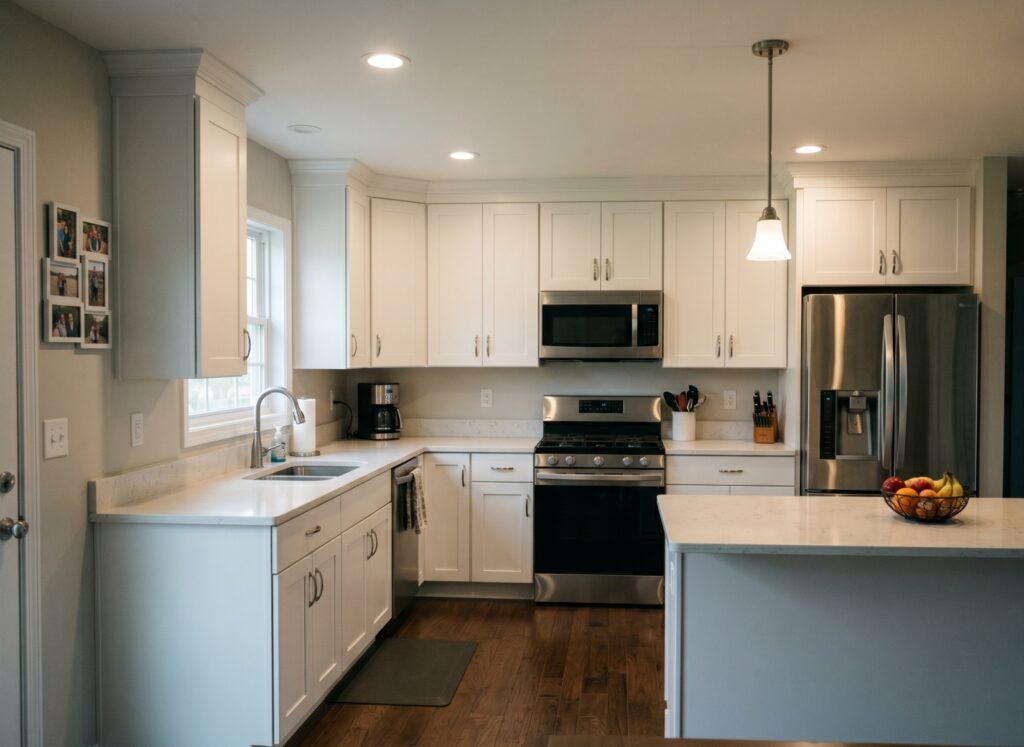
A minor kitchen remodel in the $28,000 range returns an average of 112.9% of its cost at resale, the best ROI of any interior home improvement project nationally, according to the 2025 Zonda Cost vs. Value Report.
How Much Does a Kitchen Remodel Cost?
Kitchen remodeling costs vary more than almost any other home project because the scope can range from cosmetic updates to complete structural renovation. Understanding where your project falls in this range is the prerequisite for choosing the right financing option.
| Scope | Typical Cost Range | What It Includes | Best Financing Option |
|---|---|---|---|
| Minor refresh | $10,000–$25,000 | Cabinet refacing, countertops, appliances, paint, hardware | Personal loan |
| Mid-range remodel | $25,000–$50,000 | New cabinets, flooring, lighting, minor layout changes, new appliances | Personal loan; home equity for top of range |
| Major remodel | $50,000–$100,000 | Layout changes, custom cabinetry, high-end appliances, structural work | Personal loan (up to $100K) or HELOC |
| Gut renovation | $100,000+ | Full structural reconfiguration, custom everything, high-end finishes | HELOC or home equity loan |
According to data from Angi and HomeGuide, the average kitchen remodel costs approximately $27,000 nationally in 2026, with a wide range from $14,500 for modest updates to $100,000 or more for full-scope renovations. One data point worth anchoring: a minor kitchen remodel in the $28,000 to $30,000 range delivers a 112.9% ROI nationally, according to the 2025 Zonda Cost vs. Value Report, making it the best-returning interior remodel in the country and the only interior project in the report’s top five. That is the specific scope that justifies financing even if you could pay cash, because you are likely to recover more than you spend when you sell.
5 Kitchen Remodel Financing Options Compared
| Option | Best For | Collateral? | Typical APR | Funding Speed |
|---|---|---|---|---|
| Personal loan | $5K–$100K; no home equity; fast start | No | Fixed, from ~6–7% for excellent credit | Same day to 2 business days |
| Home equity loan | $30K+; established equity; fixed payment | Yes (home) | 7%–10% | 2–4 weeks |
| HELOC | Phased projects; variable budget | Yes (home) | Variable, 7%–12%+ | 2–6 weeks |
| Cash-out refinance | Large projects; favorable current mortgage rate | Yes (home) | Based on mortgage rate | 30–60 days |
| Contractor / government financing | Specific programs; convenience financing | Varies | Varies widely | 1–10 business days |
Personal Loan
A personal loan is the most practical financing option for the majority of kitchen remodels, particularly minor refreshes and mid-range renovations. Because personal loans are unsecured, they require no home equity, no appraisal, and no collateral. Fixed rates and predictable monthly payments make budgeting straightforward from day one, and the best lenders fund the same day you apply, which matters when a contractor has a start date and needs a deposit.
For good-to-excellent credit borrowers, the best personal loans cover kitchen projects from around $5,000 to $100,000 with zero fees and fixed rates, and the most competitive rates for excellent credit start in the 6–7% range. Some lenders classify kitchen remodeling as a home improvement loan, which can come with extended repayment terms to keep monthly payments manageable even on larger projects. Compare top-rated personal loan lenders to find the best fit.
A practical tip: get your loan approved before meeting with contractors. Walking into contractor quotes with confirmed financing in hand eliminates the pressure to accept contractor-arranged financing and gives you the same negotiating power as a cash buyer.
Home Equity Loan
A home equity loan provides a lump sum at a fixed rate secured by your home’s equity. Rates are typically lower than personal loans because the loan is backed by collateral, but the tradeoff is meaningful: your home is at risk if payments are missed, the process requires a full appraisal, and approval takes two to four weeks. Closing costs of 2% to 5% of the loan amount add to the effective borrowing cost.
Home equity loans make the most financial sense for kitchen projects in the $40,000 to $100,000 range where the rate advantage compounds over a longer repayment period and the closing costs represent a smaller percentage of total project cost. For projects below $30,000, a personal loan almost always delivers better economics when closing costs are factored in.
HELOC
A HELOC gives you a revolving line of credit secured by your home’s equity, with a draw period of typically 10 years during which you borrow as needed. This structure suits kitchen remodels that evolve in scope: a project that starts as a cabinet replacement and expands into new flooring and a layout change, for example. You pay interest only on what you draw, not on the full line.
The primary risk with a HELOC is rate variability. Most HELOCs carry variable APRs tied to the prime rate, which means your payment can change as rates shift. For borrowers who prefer payment certainty through the life of the project, a fixed-rate personal loan or home equity loan is a more stable structure.
Cash-Out Refinance
A cash-out refinance replaces your existing mortgage with a larger loan and delivers the difference in cash. This is the slowest option (30 to 60 days) and only makes sense when your current mortgage rate is low enough that you would not be significantly penalizing your long-term interest cost by refinancing. In the current rate environment, most homeowners with existing mortgages below 6% would take on a materially higher rate by refinancing, making this the least attractive option for most kitchen remodel budgets.
Contractor and Government Financing
Many contractors offer in-house financing through lending partners, and government programs like the FHA Title I Property Improvement Loan are available for qualifying homeowners. The same caution from any contractor-arranged financing applies here: ask specifically whether promotional rates are deferred interest or true 0% APR, and what the rate converts to after the promotional period. FHA Title I loans have lower limits ($25,000 for a single-family home) and a slower application process, but are worth exploring for borrowers with limited equity or lower credit scores who need a government-backed option.
Match Your Project Size to the Right Financing
This is the framework that most kitchen remodel financing guides skip. The question is not just “which loan has the lowest rate” but “which loan delivers the best total economics for my specific project budget.”
Projects Under $25,000: Minor Kitchen Refresh
A personal loan is almost always the right choice at this project size. Home equity products carry $2,000 to $5,000 in closing costs, which on a $15,000 project represents 13% to 33% of the loan amount before you have paid a dollar of interest. The best personal loans cover this range from around $5,000 to $100,000 with same-day funding and zero fees. The math consistently favors the personal loan at the minor refresh tier.
This is also the tier where the ROI argument is strongest: a $28,000 minor remodel returning 112.9% at resale means a well-scoped refresh essentially pays for itself. Financing that project with a personal loan at 7% to 9% APR over five years costs less in interest than the value added to the home in most markets.
Projects Between $25,000 and $60,000: Mid-Range Remodel
Personal loans work well throughout this range, with the best lenders extending up to around $100,000. For borrowers with significant equity who want the lowest possible rate and can wait two to four weeks for funding, a home equity loan becomes worth evaluating at the top of this range. The comparison to make: take the personal loan’s total interest cost over the full term versus the home equity loan’s total interest plus closing costs. The personal loan often wins on total cost even at a slightly higher rate because it carries no origination fees.
The key question for this tier: how long do you plan to stay in the home? If you are selling within three years, a personal loan’s lack of closing costs and faster payoff timeline may be more economical than a home equity product even if the equity rate is lower.
Projects Above $60,000: Major Remodel and Gut Renovation
For major remodels, both personal loans (up to $100,000) and home equity products are viable. Personal loans remain attractive if you have good credit and want to avoid encumbering your home. A HELOC makes increasing sense as the project approaches $100,000 and especially if the scope is likely to shift or expand during construction.
One important ROI note for this tier: major kitchen remodels at $82,000 to $164,000 return an average of 36% to 51% of their cost at resale, according to the 2025 Zonda Cost vs. Value Report. This is not an argument against major remodels. Daily quality-of-life value is real and significant, but it does mean the financial case for financing a gut renovation rests primarily on lifestyle value and planned length of ownership rather than on investment return.
Compare Options
Find the Right Kitchen Remodel Loan
Compare rates, funding speed, and credit requirements across BestGuide’s top-rated personal loan lenders before you accept a contractor’s financing.
Does a Kitchen Remodel Add Value to Your Home?
Yes, but the amount depends heavily on scope. The most important data point in this market comes from the 2025 Zonda Cost vs. Value Report, which tracked 28 remodeling projects nationally:
- A minor kitchen remodel (average cost $28,458) returned 112.9% of its cost at resale, the best return of any interior home improvement project and the only interior project in the national top five
- A midrange major kitchen remodel (average cost $82,000) returned approximately 51% of its cost
- An upscale major remodel (average cost $164,000) returned approximately 36% of its cost
The pattern is consistent and counterintuitive: smaller, well-scoped kitchen updates deliver dramatically better financial returns than comprehensive renovations. This has direct implications for financing decisions. If you are renovating primarily for resale value, a $28,000 minor remodel financed with a personal loan is likely to net more at sale than it costs in financing charges over the hold period. A $100,000 gut renovation is a lifestyle investment that may or may not recover its cost depending on market conditions, how long you own the home, and what buyers in your specific area will pay for premium kitchens.
An important caveat: ROI varies significantly by region. The Pacific and West South-Central regions consistently show the highest returns on kitchen remodels, according to Zonda. Local market conditions, comparable home prices, and buyer preferences in your specific neighborhood matter more than national averages when projecting actual resale impact.
Additionally, 80% of homebuyers identify the kitchen as one of the three most important rooms when evaluating a home, according to Kitchen Cabinet Kings. A dated kitchen is one of the most common reasons buyers discount an asking price or move on to a competing property. This buyer behavior provides real financial justification for financing a kitchen remodel even when the numeric ROI calculation does not fully pencil out.
Is a Personal Loan Right for Your Kitchen Remodel?
Some personal loan lenders classify kitchen remodel loans as home improvement financing, which can come with extended repayment terms on larger loan amounts. That lets the right personal loan match the monthly payment profile of a home equity loan without requiring collateral.
When a Personal Loan Makes Sense
- Good-to-excellent credit, generally 670 or higher, with the most competitive rates reserved for excellent-credit borrowers
- Project budget of $5,000 to $100,000, covering the full range of minor, mid-range, and most major kitchen remodels
- You want to start quickly: same-day or next-day funding lets you commit to a contractor start date without waiting weeks for an appraisal
- You prefer not to use home equity as collateral: the loan is fully unsecured with no lien on your property
- You want rate certainty: a fixed APR, zero fees, and no prepayment penalty mean your monthly payment never changes
- You want to negotiate with contractors as a cash buyer: confirmed funding before soliciting bids removes any pressure to accept contractor-arranged financing
When a Personal Loan May Not Be the Best Fit
- Project above $100,000: most personal loans cap around $100,000. Full gut renovations above that threshold require a HELOC or home equity loan.
- Credit score below 670: the best personal loan rates serve good-to-excellent credit. Borrowers below this threshold should look at lenders with broader credit acceptance at higher rates, or consider FHA Title I if equity is limited.
- You want the lowest possible rate and have substantial equity: a secured home equity loan or HELOC may run lower than an unsecured personal loan over a long repayment period, at the cost of putting your home on the line and waiting weeks for funding.
Recommended
Finance Your Kitchen Without Home Equity
For projects up to $100,000, a fee-free personal loan offers fixed rates, same-day funding, and no lien on your property, so you can negotiate with contractors like a cash buyer.
How to Qualify for a Kitchen Remodel Loan
For a personal loan, underwriters evaluate the following factors:
- Credit score: Good-to-excellent credit, generally 670 or higher, with the most competitive APRs reserved for excellent-credit borrowers.
- Income verification: W-2s, pay stubs, or recent tax returns. Lenders review income and employment as part of the application.
- Debt-to-income ratio: Generally below 43%. Lenders assess your total monthly debt payments relative to gross monthly income to evaluate repayment capacity.
- Credit history depth: Lenders look for a credit profile that includes multiple account types managed over several years with a strong on-time payment record and low revolving utilization.
- No recent delinquencies or bankruptcies: a clean recent payment history is a firm underwriting requirement with most prime lenders.
Practical tip: Obtain your loan approval before visiting contractors or requesting bids. Confirmed financing gives you the same position as a cash buyer, eliminates pressure to accept contractor-arranged financing (which may carry deferred interest or higher rates), and lets you negotiate on project price rather than monthly payment.
Frequently Asked Questions
What credit score do I need to finance a kitchen remodel?
For a competitive personal loan rate, good-to-excellent credit is required, generally a score of 670 or higher, with the most competitive APRs reserved for excellent-credit borrowers. Home equity loans are available with scores as low as 620 from most lenders, though rates are meaningfully higher below 700. Borrowers with scores below 670 can explore FHA Title I government loans or personal loan lenders with broader credit acceptance, at higher rates.
Can I finance a kitchen remodel without home equity?
Yes. Personal loans are unsecured, with no lien placed on your property. The best personal loans offer kitchen remodel financing from around $5,000 to $100,000 without any home equity requirement, collateral, or appraisal. This is the primary advantage of a personal loan over a home equity product for borrowers who are earlier in homeownership, have limited equity, or simply prefer not to put their home at risk for a remodel project.
What is the average cost of a kitchen remodel?
The average kitchen remodel costs approximately $27,000 nationally in 2026, according to Angi and HomeGuide, with a range from about $14,500 for modest cosmetic updates to $100,000 or more for full-scope renovations. The specific Zonda Cost vs. Value benchmark project, a minor remodel at $28,458, is the most studied reference point because it also delivers the highest ROI of any interior home improvement at 112.9% nationally.
Can I use a personal loan for a kitchen remodel?
Yes. Personal loans can fund kitchen remodels from around $5,000 to $100,000, with fixed rates, zero fees from the best lenders, and no collateral. Some lenders classify kitchen remodeling as a home improvement loan with extended repayment terms to keep monthly payments manageable on larger projects. Because they are unsecured, funding can arrive the same or next business day. Compare the best personal loan lenders for current rates and terms.
How fast can I get funded for a kitchen remodel loan?
Many personal loan lenders offer same-day or next-day funding, often within one to three business days. Home equity loans and HELOCs require two to six weeks for appraisal and underwriting. Cash-out refinances take 30 to 60 days. If your contractor has a deposit deadline, a personal loan is almost always the fastest path to confirmed funding.
Is it better to use a personal loan or HELOC for a kitchen remodel?
For projects under $40,000, a personal loan almost always delivers better total economics. Home equity products carry $2,000 to $5,000 in closing costs that offset their rate advantage on smaller loan amounts, and they require two to six weeks to fund versus same-day or next-day for personal loans. For projects above $60,000 where you have significant equity and can wait for funding, a HELOC’s lower rate may produce a lower total cost over a longer repayment period. The comparison to make: take the personal loan’s total interest cost over the full term versus the home equity loan’s total interest plus closing costs.
Does a kitchen remodel increase home value?
Yes, meaningfully for minor remodels and modestly for major renovations. According to the 2025 Zonda Cost vs. Value Report, a minor kitchen remodel averaging $28,458 returns 112.9% of its cost at resale nationally, making it the best-returning interior project in the country. A major kitchen remodel at $82,000 returns approximately 51%, and an upscale renovation at $164,000 returns approximately 36%. The ROI gap between minor and major remodels is the most important data point for financing decisions: well-scoped refreshes deliver dramatically better financial returns than gut renovations in most markets.
Related Home Improvement Financing Guides
A kitchen remodel is one piece of BestGuide’s complete home improvement loans coverage. If you are weighing more than one project, these guides compare the best financing option for each:
 Achieve Personal Loans
 LendingTree
 Upstart