

⚡ Key Takeaway
A pool loan is any financing product used to install or renovate a residential swimming pool. Personal loans are the fastest and most flexible option for projects up to $100,000: no home equity required, no appraisal, and funding as soon as the same day you apply. For good-to-excellent credit borrowers, a personal loan from a top-rated lender is consistently the best pick: zero fees, fixed rates, and funding as soon as the same day you apply, with the most competitive rates starting in the 6–7% range. The best financing choice depends on your project budget, credit profile, and whether you want to use your home as collateral.
The average inground swimming pool costs about $65,000 to install in 2026, according to data from Angi, HomeGuide, and Thursday Pools; that figure covers just the structure and basic equipment. Add decking, landscaping, fencing, a heater, and lighting, and a fully finished backyard project routinely reaches $80,000 to $100,000 or more. For most homeowners, that means financing.
The good news: the pool financing market is more accessible than ever. Personal loans now cover projects up to $100,000 without touching home equity, and the best lenders fund the same day you apply. Home equity options remain available for larger projects. Pool manufacturer financing programs offer a simplified process when buying direct.
We compared five financing options across rates, funding speed, collateral requirements, and credit thresholds to help you match the right loan to your specific project. This guide is part of BestGuide’s home improvement loan coverage, where we review and compare lending options across major project categories.
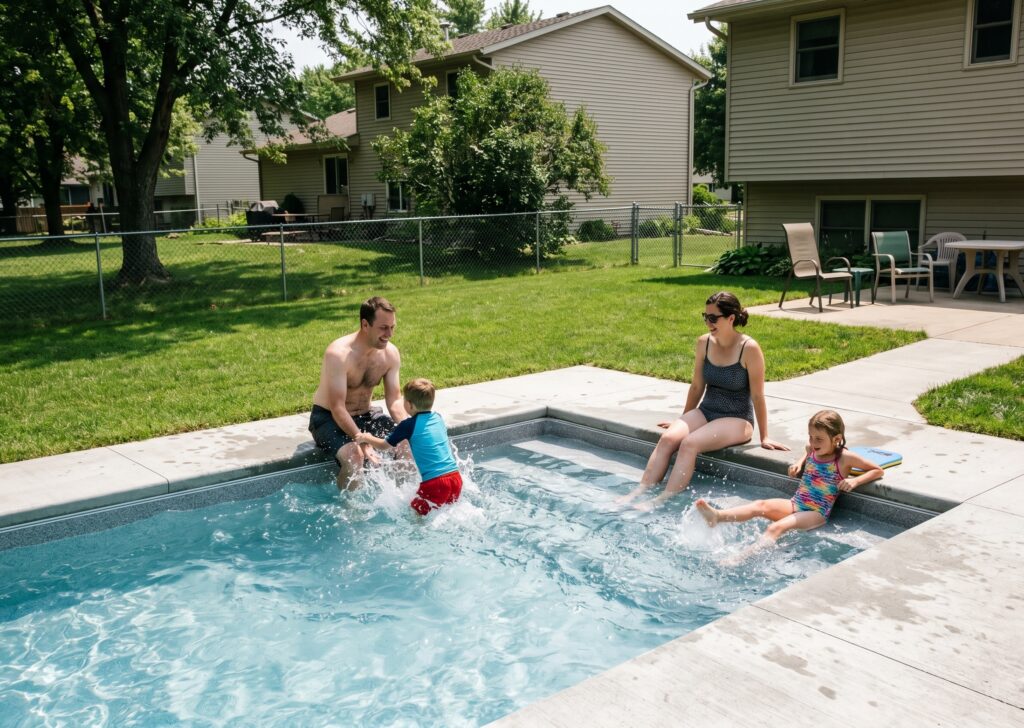
For most homeowners, a backyard pool is a long-term investment in quality of life. Financing options like personal loans make it possible to start swimming this season without waiting years to save the full cost.
How Much Does a Swimming Pool Cost?
Before choosing a financing option, it helps to anchor your budget to real project costs. Pool pricing varies significantly by type, material, and region.
| Pool Type | Typical Cost Range | Notes |
|---|---|---|
| Inground (vinyl) | $25,000–$65,000 | Most affordable inground option; liner requires replacement every ~10 years |
| Inground (fiberglass) | $45,000–$100,000 | Low maintenance; faster installation; limited shape options |
| Inground (concrete/gunite) | $50,000–$120,000+ | Most customizable; highest upfront and ongoing maintenance costs |
| Above-ground | $1,000–$6,000 | Materials only; add pump, filter, cover, ladder for total cost |
| Pool remodel or upgrade | $5,000–$30,000 | Resurfacing, retiling, new equipment, decking updates |
These figures cover base installation only. A complete, ready-to-swim project adds substantial costs beyond the pool itself. Budget for the following extras before selecting a loan amount:
- Decking and patio: $5,000–$20,000 depending on material and square footage
- Fencing: Required by code in most jurisdictions; $3,000–$8,000 for a typical perimeter
- Pool heater: $1,200–$6,500 installed, depending on type (gas, electric, solar)
- Landscaping and grading: $2,000–$10,000 to restore and finish the surrounding area
- Electrical and lighting: $700–$3,000 for standard pool lighting; more for automation
- Permits: $250–$1,800 depending on state and municipality
For a fully finished inground pool project with standard add-ons, plan on $60,000 to $100,000 as a realistic total budget for most markets. Premium builds with automation, custom finishes, and landscaping routinely exceed $120,000.
5 Swimming Pool Financing Options Compared
| Option | Best For | Collateral? | Typical APR | Funding Speed |
|---|---|---|---|---|
| Personal loan | Projects up to $100K; no home equity; fast funding | No | Fixed, from ~6–7% for excellent credit | Same day to 2 business days |
| Home equity loan | Large projects with established equity; fixed monthly payment | Yes (home) | 7%–10% | 2–6 weeks |
| HELOC | Phased projects; flexible draw access; interest-only option | Yes (home) | Variable, 7%–12%+ | 2–6 weeks |
| Pool manufacturer financing | Buying direct from a dealer; simplified one-stop process | Depends on lender | Varies widely | 1–5 business days |
| Cash-out refinance | Large projects when current mortgage rate is favorable | Yes (home) | Based on mortgage rate | 30–60 days |
Personal Loan
A personal loan is the fastest and most flexible way to finance a swimming pool for most borrowers. Loans from $5,000 to $100,000 are available unsecured, meaning your home is not used as collateral and no appraisal is required. Fixed rates and predictable monthly payments make budgeting straightforward, and the best lenders fund the same business day you apply.
For good-to-excellent credit borrowers, the best personal loans are the benchmark in this category: zero fees, competitive fixed rates, and funding as soon as the same day you apply, with the lowest rates, typically in the 6–7% range, reserved for excellent credit borrowers. Compare top-rated personal loan lenders in our buyer’s guide for a complete breakdown of rates, terms, and qualification criteria.
For a broader comparison of personal loan options across lenders, see our personal loans comparison.
Home Equity Loan
A home equity loan lets you borrow a lump sum against the equity in your home at a fixed interest rate. Rates are typically lower than unsecured personal loans because the loan is secured by your property, but the application process requires an appraisal and takes two to six weeks. This option makes the most sense for projects above $100,000 where personal loan limits are insufficient, or for borrowers who have substantial equity and want the lowest possible rate regardless of processing time.
The key tradeoff: your home secures the loan. Failure to make payments puts the property at risk. Closing costs of 2% to 5% of the loan amount also add to the effective cost of borrowing.
HELOC (Home Equity Line of Credit)
A HELOC functions like a credit card secured by your home’s equity, giving you a draw period (typically 10 years) during which you can borrow as needed up to your approved limit. This structure suits phased projects where you are not pulling the full budget at once, such as a pool installation followed by landscaping and decking in separate seasons.
The risk with HELOCs is rate variability. Most HELOCs carry variable APRs tied to the prime rate, which means your monthly payment can change over time. For borrowers who prefer payment certainty, a fixed-rate personal loan or home equity loan is a more stable structure.
Pool Manufacturer Financing
Many pool builders and manufacturers partner with lenders to offer financing directly through the sales process. Some personal loan lenders work with pool dealers and industry platforms, offering competitive rates through dealer referral links. The convenience of one-stop financing is appealing, but it is worth comparing the offered rate against a direct personal loan application before committing. Dealer financing programs sometimes carry higher rates or shorter terms than direct applications.
Cash-Out Refinance
A cash-out refinance replaces your existing mortgage with a new, larger loan and delivers the difference in cash. This can make sense when your current mortgage rate is favorable, your equity is sufficient, and the project budget exceeds personal loan limits. In the current rate environment, however, most homeowners with sub-6% mortgages face a significant rate penalty from refinancing. Processing takes 30 to 60 days, making this the slowest option among the five.
Compare Options
Compare Pool Loan Options in Minutes
See fixed-rate, fee-free personal loans for projects up to $100,000, with funding as soon as the same day. No home equity, no appraisal, no collateral.
Is a Personal Loan Right for Your Pool Project?
A personal loan is the most widely used financing option in residential pool projects for borrowers with good-to-excellent credit. The best options are online lenders offering fixed-rate, unsecured loans with no fees, funded quickly without an appraisal or a lien on your home.
When a Personal Loan Makes Sense
- Good-to-excellent credit, generally 670 or higher, with the most competitive rates reserved for excellent-credit borrowers
- Project budget of $5,000 to $100,000, which covers the full range of inground pool installations and most remodel projects
- You need funds quickly: the best lenders offer same-day or next-day funding once verification is complete
- You do not want to use home equity as collateral: personal loans are fully unsecured with no lien on your property
- You want a fixed rate with zero fees: the best lenders charge no origination fee, no prepayment penalty, and no administrative charges
- You want rate certainty: a fixed APR means your monthly payment never changes over the life of the loan, with flexible repayment terms
When a Personal Loan May Not Be the Best Fit
- Credit score below 670: the best personal loan rates serve good-to-excellent credit. For fair credit, lenders like LendingClub (from a 600 score, up to $60,000) and Achieve (from 640, up to $50,000) serve a broader credit range, and a marketplace like Best Rated Loan matches smaller-dollar needs across all credit profiles, at higher rates.
- Project above $100,000: most personal loans cap at $100,000. For larger projects, a HELOC or home equity loan is more appropriate.
- You prefer local or in-person service: many top online lenders have no branch network. If you want face-to-face service, a community bank or credit union may suit you better.
Recommended
Finance Your Pool Without Touching Home Equity
A fee-free personal loan funds projects up to $100,000 with fixed rates, same-day funding, no appraisal, and no lien on your home. Start swimming this season.
How to Qualify for a Pool Loan
Qualification requirements differ by loan type. Here is what lenders evaluate for each option.
Personal Loan Qualification
- Credit score: Good-to-excellent credit, generally 670 or higher, with the best rates reserved for scores of 720 and above.
- Income verification: Yes. Lenders review income and employment as part of the application, though specific minimums are not always disclosed publicly.
- Debt-to-income ratio: Generally below 43%. Lenders assess your existing monthly debt obligations relative to gross income to determine repayment capacity.
- Credit history: Lenders look for several years of credit history with on-time payment records, low revolving utilization, and no recent delinquencies or bankruptcies.
- Home equity: Not required. This is a key advantage of personal loans for borrowers who are earlier in homeownership or do not want to encumber their property.
- U.S. residency: Required. Must be at least 18 years old with a valid SSN.
Home Equity Loan and HELOC Qualification
- Home equity: Most lenders require 15% to 20% equity remaining after the loan. Combined loan-to-value (CLTV) ratio typically capped at 80% to 85%.
- Credit score: Minimum 620 for most lenders; 700+ for best rates.
- Appraisal: Required in most cases to establish current home value.
- Debt-to-income ratio: Generally below 43%.
- Closing costs: 2% to 5% of the loan amount, paid at origination.
Does a Swimming Pool Add Value to Your Home?
A pool adds measurable value in most markets, but the return on investment varies substantially by location, property type, and local buyer demand. According to data from RubyHome and RenoSys, inground swimming pools increase home value by an estimated 5% to 7% on average nationally. On the median U.S. home price of $435,500 as reported by the National Association of Realtors in mid-2025, a 7% increase represents approximately $30,000 in added value.
That figure should be weighed against installation costs. The average inground pool costs about $65,000 to install, which means most homeowners recover 40% to 50% of their investment at resale in a typical market. A pool built primarily as a financial investment rarely pencils out. A pool built for years of personal use, with some resale recovery, almost always does.
The regional variation is significant. A Redfin analysis found that pools in Los Angeles add approximately $95,393 in home value, while the same amenity adds only $11,591 in Phoenix, a market where nearly every home already has a pool. States with longer swimming seasons (Florida, California, Arizona, Texas) generally deliver higher ROI than northern markets where pools sit unused for six or more months per year.
Only about 10.7 million of the approximately 140 million housing units in the United States have a swimming pool, according to data from the Pool and Hot Tub Alliance. That relative scarcity supports pool ownership as a differentiating feature in most markets, particularly for single-family homes in suburban areas.
Frequently Asked Questions
What credit score do I need for a pool loan?
For a personal loan, good-to-excellent credit is required, generally a score of 670 or higher with the best rates going to borrowers at 720 and above. Home equity loans are available with scores as low as 620, though rates are higher below 700. If your credit score is below 670, lenders like LendingClub (from a 600 score) and Achieve (from 640) serve a broader credit range at higher rates, and a marketplace like Best Rated Loan matches across all credit profiles for smaller-dollar amounts.
Can I finance a pool without using my home as collateral?
Yes. Personal loans are unsecured, meaning no lien is placed on your property. The best lenders offer unsecured pool loans from $5,000 to $100,000 with no collateral requirement. This is the primary advantage of a personal loan over a home equity loan or HELOC for borrowers who do not want to encumber their home or who have limited equity.
How fast can I get funded for a pool loan?
The best personal loan lenders offer same-day or next-day funding once verification is complete, and most fund within one to three business days. Home equity loans and HELOCs require two to six weeks for appraisal and underwriting. Cash-out refinances take 30 to 60 days. If your contractor has a deposit deadline, a personal loan is almost always the fastest path to funding.
What is the average interest rate for a pool loan?
Personal loan APRs for pool financing depend on the lender and your credit profile, with the most competitive rates for excellent credit starting in the 6–7% range and rising for lower credit tiers. Home equity loan rates typically range from 7% to 10%. The exact rate you receive depends on your credit score, income, debt-to-income ratio, loan amount, and repayment term.
Can I use a personal loan for both the pool and landscaping?
Yes. Personal loans are not restricted to pool installation costs. Loan proceeds can be used for the full scope of a backyard project, including decking, landscaping, hardscaping, pool equipment, outdoor kitchens, and furniture. This makes a single personal loan a practical way to finance the complete outdoor living project, not just the pool structure itself.
Can I use a personal loan for a swimming pool?
Yes. Personal loans can fund pool projects from $5,000 to $100,000, with fixed rates, zero fees from the best lenders, and same-day funding. Funds can be used for the pool, decking, fencing, landscaping, equipment, and the full backyard project. Compare the best personal loan lenders for current rates and qualification details.
Related Home Improvement Financing Guides
A pool is one piece of BestGuide’s complete home improvement loans coverage. If you are planning more than one outdoor project, these guides compare the best financing option for each:
 Achieve Personal Loans
 LendingTree
 Upstart