

⚡ Key Takeaway
Basement remodel financing options include personal loans, HELOCs, home equity loans, and contractor financing. For projects up to $50,000, a personal loan is almost always the fastest and most flexible option: no collateral, no closing costs, fixed rate, and same-day funding from top-rated personal loan lenders. For projects above $50,000 with available equity, a HELOC is worth evaluating, especially because its revolving credit structure is better suited to basement projects than a fixed home equity loan, given how often basement scopes expand mid-project. One critical detail specific to basements: always budget 20% to 25% above your contractor’s initial quote to absorb moisture, foundation, or radon issues that frequently surface once demolition begins.
Finishing or renovating a basement is one of the few home improvement projects that consistently delivers strong returns, adds usable square footage to the home, and serves the daily life of everyone in the household. The 2025 Zonda Cost vs. Value Report gave basement remodels a 71% national ROI, the highest return among all newly added project categories, with unusually consistent returns across different regions.
It is also one of the most budget-unpredictable projects in residential construction. Hidden moisture, foundation cracks, inadequate ceiling height, and outdated plumbing or electrical systems behind the walls are discovered regularly once demolition begins. The choice of financing product matters because of this: not just which rate is lowest, but which product gives you the flexibility to handle an unexpected $10,000 to $20,000 addition to your scope without taking out a second loan or putting your home at risk during construction.
This guide is part of BestGuide’s home improvement loan coverage. We compare every relevant financing option, show the specific scenarios where each wins, and explain why basement projects require a different financing calculus than a kitchen remodel or other interior projects with more predictable scope.
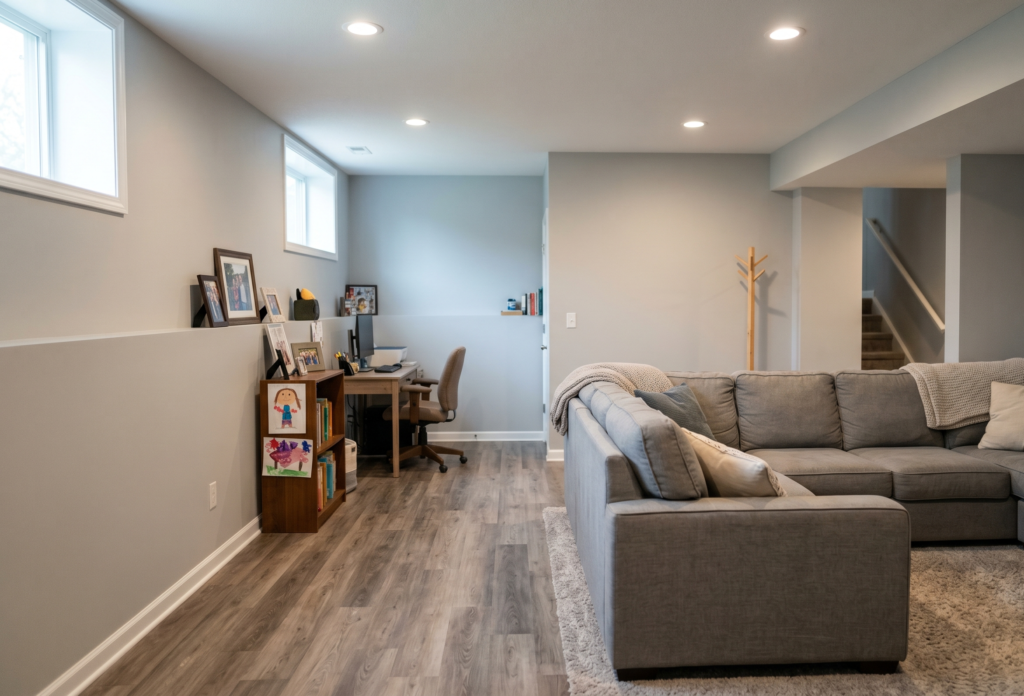
A finished basement with a dedicated home office and living area adds measurable square footage and consistently returns 71% of its cost at resale, according to the 2025 Zonda Cost vs. Value Report. The key is budgeting 20% above your contractor’s quote before the walls come down.
How Much Does a Basement Remodel Cost?
Basement project costs vary significantly depending on whether you are finishing an unfinished space or renovating an already-finished basement. The distinction matters for financing: finishing projects tend to have more predictable scope, while renovation projects involving structural or layout changes carry greater risk of cost escalation.
| Project Type | Typical Cost Range | What It Includes | Best Financing |
|---|---|---|---|
| Basic finishing | $15,000–$35,000 | Drywall, flooring, basic lighting, electrical | Personal loan |
| Mid-range finishing | $25,000–$50,000 | Includes bathroom, home office or bedroom with egress | Personal loan; HELOC at top of range |
| Full remodel with layout changes | $40,000–$75,000 | Structural changes, wet bar, guest suite, home theater | Personal loan up to $100K; HELOC for flexibility |
| Luxury basement | $75,000–$120,000+ | Full kitchen, home theater, wine cellar, full suite | HELOC or home equity loan |
On a per-square-foot basis, basement finishing typically costs $30 to $75 per square foot. A 1,000-square-foot unfinished basement converted to basic living space runs $30,000 to $75,000 depending on finishes, bathroom inclusion, and local labor rates. According to PrimeRates, the average full basement finishing project falls between $18,000 and $35,000 for basic work and $25,000 to $75,000 or more for projects with significant layout changes.
The Basement Budget Reality Check
This is the section that distinguishes basement financing from every other room in the house. No other interior project type has the same probability of mid-project scope expansion as a basement renovation. Understanding why changes how you should think about product selection.
Construction professionals and remodeling advisors, including Acorn Finance’s contractor survey data, recommend adding 20% to 25% above the initial contractor quote specifically for basement projects to absorb problems that are routinely discovered after demolition begins. The most common are:
- Water infiltration and mold: A significant share of unfinished basements have some degree of moisture intrusion that is not visible until framing is removed. Professional waterproofing ranges from $5,000 to $15,000 depending on severity and linear footage of the affected perimeter.
- Foundation cracks: Minor cracks can often be sealed for $500 to $2,000. Structural cracks requiring underpinning or wall reinforcement can run $5,000 to $25,000.
- Inadequate ceiling height: Many older basements have 6.5- to 7-foot ceilings. Adding a bedroom or conforming living space often requires 7 to 8 feet minimum by local code. Underpinning to lower the floor can cost $10,000 to $30,000.
- Radon: If a radon test reveals levels above the EPA’s 4 pCi/L action level, mitigation is required before the space can be occupied. System installation typically runs $800 to $2,500, but delays the project.
- Outdated electrical or plumbing: Knob-and-tube wiring or galvanized pipes discovered during demolition may need to be addressed before the project can continue, adding $2,000 to $10,000 or more.
On a $35,000 project, a 20% contingency means budgeting for $42,000. On a $50,000 project, it means being prepared for $60,000. This has direct implications for product selection: a home equity loan that releases a fixed $35,000 leaves you scrambling if the true project cost is $45,000. A HELOC with a $60,000 approved line lets you draw what you need as the scope becomes clear. A personal loan can be supplemented with a second application if needed, without using your home as collateral.
5 Basement Remodel Financing Options Compared
| Option | Best For | Collateral? | Typical APR | Scope Flexibility |
|---|---|---|---|---|
| Personal loan | Up to $50K; fast; no home equity | No | Fixed, from ~6–7% for excellent credit | Second loan available if needed |
| HELOC | $30K+; best for scope-uncertain projects | Yes (home) | Variable, 7%–12%+ | Draw more from approved line anytime |
| Home equity loan | $30K+; fixed scope; no rate risk | Yes (home) | 7%–10% | Fixed lump sum; needs second loan if scope grows |
| Cash-out refinance | $50K+; favorable current mortgage rate | Yes (home) | Based on mortgage rate | Fixed; slowest option (30–60 days) |
| Contractor financing | Convenience; verify deferred interest | Varies | Varies widely | Fixed; often deferred interest risk |
Personal Loan
A personal loan is the right choice for the majority of basement projects up to $50,000. Because it is unsecured, no lien is placed on your home, meaning the lender cannot take your property if you encounter financial difficulty during a project that is mid-construction. Fixed rates and predictable monthly payments make budgeting clear from day one, and same-day funding from top personal loan lenders means you can commit to a contractor start date without waiting weeks for an appraisal.
The scope-flexibility advantage specific to basement projects: if a moisture problem adds $12,000 to your project after demolition, you can apply for a second personal loan without using your home as collateral. This is a meaningful advantage over home equity products, where expanding the credit line requires a new approval process and additional closing costs.
For good-to-excellent credit borrowers, the best personal loans cover basement projects from around $5,000 to $100,000 with zero fees, fixed rates, and same-day funding, and the most competitive rates for excellent credit start in the 6–7% range. Compare top-rated personal loan lenders to find the best fit for your project.
HELOC
A HELOC is the home equity product better suited to basement remodels than a home equity loan, specifically because of its revolving structure. If your approved HELOC line is $60,000 and your initial project scope is $40,000, you draw $40,000 to start. If foundation issues add $15,000 to the scope, you draw another $15,000 from the existing line without a new application, new closing costs, or a new wait period. For projects above $50,000 where the scope has meaningful uncertainty, this flexibility is worth the tradeoff of variable rates and closing costs.
The primary risks with HELOCs for basement projects: variable APRs can shift your payment during a long project, and your home secures the debt. If the project exposes structural problems that reduce the home’s appraised value temporarily, that can affect your available HELOC draw.
Home Equity Loan
A home equity loan provides a fixed lump sum at a fixed rate. It is the right choice for basement projects with very well-defined scope where the homeowner has high confidence that the budget will not change significantly. The problem specific to basements: the scope almost always changes. Closing costs of $2,000 to $5,000, a two-to-six-week approval timeline, and the inflexibility of a fixed disbursement make this the weakest of the home equity options for most basement projects. If the scope is well-defined, however, the fixed rate and predictable payment are meaningful advantages over a HELOC’s variable rate structure.
Cash-Out Refinance
A cash-out refinance replaces your existing mortgage with a larger one and delivers the difference in cash. This is the slowest option (30 to 60 days) and is only worth evaluating when your current mortgage rate is favorable enough that refinancing does not significantly increase your long-term interest cost. For most homeowners who locked in rates below 5% or 6%, refinancing in the current environment would increase their overall housing cost substantially.
Contractor Financing
Many contractors offer in-house financing through lending partners. The same warning that applies throughout our home improvement financing guides applies here: ask specifically whether any promotional rate is a true 0% APR or a deferred interest arrangement. Deferred interest applies all accumulated charges retroactively if any balance remains at the end of the promotional period. For a baseline project budget that may expand mid-construction, deferred interest risk is compounded: you may end up with a larger balance than expected at exactly the moment when retroactive charges kick in.
Personal Loan vs. HELOC: A Direct Comparison for Basement Remodels
For the two most relevant products, here is how the numbers compare at two common project sizes:
| Factor | Personal Loan ($30K project) | HELOC ($30K project) | Personal Loan ($50K project) | HELOC ($50K project) |
|---|---|---|---|---|
| Loan amount | $30,000 | $30,000 drawn | $50,000 | $50,000 drawn |
| Closing costs | $0 | $2,000–$5,000 | $0 | $2,000–$5,000 |
| Approval timeline | Same day | 2–6 weeks | Same day | 2–6 weeks |
| Rate type | Fixed | Variable | Fixed | Variable |
| Home at risk? | No | Yes | No | Yes |
| Scope flexibility | Second loan available | Draw from existing line | Second loan available | Draw from existing line |
| Verdict | Personal loan wins | Closing costs eat the rate advantage at $30K | Crossover point | Rate advantage begins to offset closing costs |
The crossover point, where the HELOC’s lower rate begins to produce a lower total cost than the personal loan despite closing costs, falls around $50,000 to $60,000 for most borrowers. Below that threshold, zero closing costs and same-day funding almost always make the personal loan the better financial choice. Above it, the HELOC’s rate advantage compounds over a longer repayment period and the $2,000 to $5,000 in closing costs represents a smaller percentage of total borrowing cost.
What the table does not capture: HELOC flexibility for scope expansion is a meaningful qualitative advantage for basement projects specifically, regardless of loan size. If you are financing a $35,000 project with real scope uncertainty, the HELOC’s ability to absorb scope creep without a new application is worth something even if the numbers slightly favor the personal loan on a fixed-scope analysis.
Recommended
The Best Way to Fund a Basement Remodel
For projects up to $50,000, a personal loan means no collateral, zero closing costs, and same-day funding, with room for a second loan if your scope grows mid-project.
Does a Finished Basement Add Value to Your Home?
Yes, with notable consistency across different markets. The 2025 Zonda Cost vs. Value Report added basement remodels as a new category and measured a 71% national ROI, the highest return among the new project categories added that year. More significant from a planning perspective: the regional variation was only 14 percentage points from the highest-returning to the lowest-returning region. Compare that to a backup power generator, also new, which varied by 70 percentage points between hurricane-exposed and hurricane-free markets. The narrow regional variation for basement remodels signals that finishing a basement adds predictable value across most U.S. markets, not just in specific geographies.
Why the return is consistent: finishing a basement adds measurable square footage to the home, and buyers pay predictably for livable square footage. It is not a fashion-dependent project where subjective taste determines buyer appeal. A finished basement with a legal bedroom, bathroom, and functional living area will appeal to most buyers in most markets.
According to PNW Residences analysis of appraiser data, finished basement square footage typically appraises at 70% to 85% of above-grade square footage value, with daylight and walkout basements approaching full above-grade value in some markets because they function as regular living space.
Projects that maximize basement ROI: conforming bedrooms with legal egress windows, full bathrooms, home offices, and guest suites. Projects that reduce ROI: highly themed or personalized designs (media rooms with custom built-ins, wine cellars, hobby-specific spaces) that may not appeal broadly to buyers and cannot easily be repurposed.
Is a Personal Loan Right for Your Basement Remodel?
When a Personal Loan Makes Sense
- Project budget of $5,000 to $100,000, covering the full range from basic finishing to full renovation projects
- Good-to-excellent credit, generally 670 or higher, with the most competitive rates reserved for excellent-credit borrowers
- You want same-day or next-day funding: a personal loan lets you lock in a contractor start date without waiting weeks for an appraisal
- You prefer not to use home equity as collateral: fully unsecured, no lien on your property during a project that may temporarily affect your home’s condition
- Your project has scope uncertainty: if the foundation or moisture situation is unknown, a personal loan with the option for a second application protects you without the complexity of a HELOC application
- You want a fixed rate: no variable rate risk during a potentially lengthy basement project
When a Personal Loan May Not Be the Best Fit
- Project clearly above $50,000 with available equity: at this threshold, a HELOC’s lower rate begins to produce a lower total cost over the full repayment period, especially if the project scope may grow further
- Credit score below 670: the best personal loan rates target good-to-excellent credit, though some lenders serve a broader range at higher rates
- You qualify for a lower secured rate: with substantial equity and strong credit, HELOC or home equity loan rates may run lower than an unsecured personal loan over a long repayment period
Compare Options
Find the Right Lender for Your Project
Compare rates, funding speed, and credit requirements across BestGuide’s top-rated personal loan lenders to find the best fit for your basement remodel.
How to Qualify for a Basement Remodel Loan
For a personal loan:
- Credit score: Good-to-excellent credit, generally 670 or higher, with the most competitive rates reserved for excellent-credit borrowers.
- Income verification: Required. Lenders review income and employment stability as part of the application.
- Debt-to-income ratio: Generally below 43%. Existing monthly obligations relative to gross income determine repayment capacity.
- Credit history depth: Multiple account types managed over several years with a strong on-time payment record.
The most important practical tip for basement projects specifically: apply for a loan amount 20% above your contractor’s initial quote, not just the quote itself. On a $35,000 project, apply for $42,000. The excess stays in your account unused if the project comes in on budget. If moisture or foundation issues surface mid-project, you have the funds available without taking out a second loan at a critical moment. The interest cost on $7,000 held in reserve for six months is far less than the cost of a second loan application, waiting period, or contractor delays while you arrange additional financing.
Frequently Asked Questions
What credit score do I need for a basement remodel loan?
For a competitive personal loan rate, good-to-excellent credit is required, generally a score of 670 or higher, with the most competitive rates reserved for excellent-credit borrowers. Home equity loans and HELOCs are available with scores as low as 620 from most lenders, though rates are higher below 700. Borrowers below 670 can still access personal loans from lenders with broader credit acceptance at higher rates.
Can I finance a basement remodel without home equity?
Yes. Personal loans are fully unsecured with no lien on your property. The best personal loans cover basement projects from around $5,000 to $100,000 without any home equity requirement, collateral, or appraisal. This is particularly relevant for basement projects because the renovation process can temporarily affect your home’s condition, and an unsecured loan means your property is not pledged during that period.
How much does it cost to finish a basement?
Basic basement finishing (drywall, flooring, lighting, basic electrical) typically costs $15,000 to $35,000. A mid-range project that includes a bathroom and home office runs $25,000 to $50,000. Full remodels with layout changes, wet bars, or guest suites range from $40,000 to $75,000 or more. Luxury builds with full kitchens, home theaters, and wine cellars can reach $75,000 to $120,000. Always add 20% to 25% to your contractor’s quote for the contingency typical of basement projects.
Does a finished basement increase home value?
Yes. According to the 2025 Zonda Cost vs. Value Report, basement remodels deliver a 71% national ROI, the highest return among the new project categories added to the report that year. Regional variation is unusually narrow at only 14 percentage points, indicating consistent returns across most U.S. markets. Finished basement square footage typically appraises at 70% to 85% of above-grade value. Conforming bedrooms with legal egress windows and full bathrooms deliver the strongest returns.
Do personal loans cover basement remodel costs?
Yes. Personal loans can cover the full range of basement project costs from around $5,000 to $100,000, including contractor labor, framing, drywall, flooring, bathroom installation, lighting, electrical, waterproofing, and egress window installation. Because they are unsecured, there are no closing costs and funding can arrive the same or next business day. Compare the best personal loan lenders for current rates and terms.
Should I use a personal loan or HELOC for a basement remodel?
For projects under $50,000, a personal loan almost always delivers better total economics: zero closing costs, same-day funding, fixed rate, and no home as collateral. For projects above $50,000, a HELOC’s lower rate begins to produce a lower total repayment when closing costs are factored in over the full term. For basement projects specifically, the HELOC’s revolving draw structure is a meaningful qualitative advantage regardless of loan size, because basement scopes frequently expand once demolition begins. The honest answer for most borrowers: use a personal loan for predictable scopes under $50,000; use a HELOC when you have significant equity and expect the project to evolve or exceed $50,000.
How fast can I get funded for a basement remodel loan?
Many personal loan lenders offer same-day or next-day funding, often within one to three business days. HELOCs and home equity loans require two to six weeks for appraisal and underwriting. If your contractor has availability and you want to lock in a start date, a personal loan is almost always the fastest confirmed path to funding.
What hidden costs should I budget for in a basement remodel?
The most common hidden costs in basement projects are: waterproofing for moisture infiltration ($5,000 to $15,000), foundation crack repair ($500 to $25,000 depending on severity), ceiling height underpinning ($10,000 to $30,000 if required for code compliance), radon mitigation ($800 to $2,500), and updated electrical or plumbing uncovered during demolition ($2,000 to $10,000). Construction professionals recommend adding 20% to 25% above your contractor’s initial quote specifically for basement projects to absorb these costs. On a $40,000 project, that means budgeting $48,000 to $50,000 before selecting a loan amount.
Related Home Improvement Financing Guides
A basement remodel is one piece of BestGuide’s complete home improvement loans coverage. If you are weighing more than one project, these guides compare the best financing option for each:
 Achieve Personal Loans
 LendingTree
 Upstart