Deadline Alert: The IRS disaster tax relief window for qualifying taxpayers in Washington and Montana expires on May 1, 2026. If you are in a covered county or reservation and have not yet filed or paid taxes due on or after the disaster dates, today is your last opportunity to act. This article covers exactly who qualifies, what the extension covers, and what to do if you have not filed yet.
The Quick Answer
The IRS granted disaster tax relief to individuals and businesses in federally declared disaster areas in Washington (storms beginning December 9, 2025) and Montana (storms beginning December 10, 2025). The extended deadline for most federal tax returns and payments is May 1, 2026. This covers individual income tax returns, estimated tax payments, IRA and HSA contributions, payroll returns, and more. The IRS automatically identifies and applies the relief to taxpayers in covered areas. Taxpayers outside the covered areas whose records are located there must call the IRS to request relief manually. After May 1, affected taxpayers who still cannot pay may qualify for standard IRS resolution options including payment plans and penalty abatement.
Two major disaster declarations affecting taxpayers in Washington and Montana expire tomorrow, May 1, 2026. The IRS issued disaster tax relief under Section 7508A of the Internal Revenue Code following FEMA declarations for both states, granting a unified extended deadline for most federal tax obligations that were originally due between the disaster start dates and May 1.
For taxpayers in affected areas who have not yet filed their 2025 individual income tax return, made their April estimated tax payment, or handled other federal tax obligations, today is the final day to act under the disaster relief window. Here is the complete picture of who qualifies, what is covered, and what options remain after the deadline.
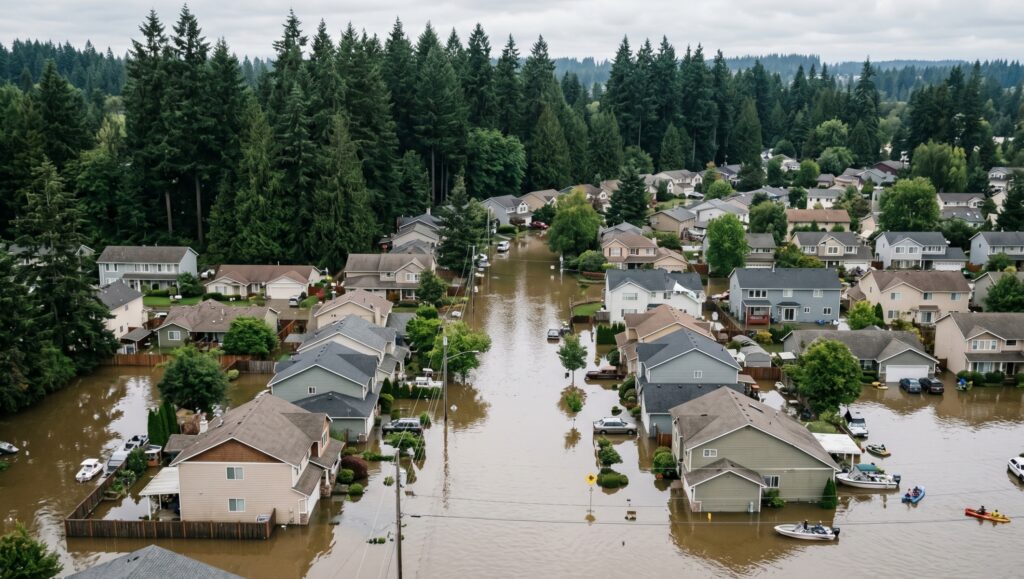
The December 2025 storms caused widespread flooding across 17 Washington counties and parts of northwest Montana. Affected taxpayers have until May 1, 2026 to file federal returns and make tax payments under IRS disaster relief provisions.
Washington State: Who Qualifies and What Is Covered
The IRS issued disaster tax relief for Washington (IRS announcement WA-2025-03) following FEMA Disaster Declaration 3629-EM for severe storms, straight-line winds, flooding, landslides, and mudslides that began December 9, 2025.
Covered Counties in Washington
Individuals and businesses in the following Washington counties qualify automatically for the May 1, 2026 extended deadline:
Benton, Chelan, Clallam, Grays Harbor, Jefferson, King, Kittitas, Lewis, Mason, Pierce, Skagit, Snohomish, Thurston, Wahkiakum, Whatcom, and Yakima counties, plus the Samish and other localities identified in the IRS covered disaster area declaration.
What Washington Taxpayers Get Until May 1
- Individual income tax returns and payments originally due on or after December 9, 2025
- 2025 IRA and health savings account contributions for eligible taxpayers
- Estimated tax payments originally due January 15, 2026 and April 15, 2026
- Quarterly payroll and certain excise tax returns normally due January 31, 2026 and April 30, 2026
- Corporate, partnership, S corporation, estate and trust, and tax-exempt organization returns with original or extended due dates before May 1, 2026
- Penalties on payroll and excise tax deposits due on or after December 9, 2025 and before December 29, 2025, as long as deposits were made by December 29, 2025
Montana: Who Qualifies and What Is Covered
The IRS issued disaster tax relief for Montana (IRS announcement MT-2026-02) following FEMA disaster declarations for severe storms and flooding that began December 10, 2025. According to CPA Practice Advisor, the Lincoln County flooding alone caused an estimated $9.69 million in damage, with county officials expecting the final figure to be substantially higher. A separate windstorm the following week added approximately $6.5 million in additional damage across northwest Montana.
Covered Areas in Montana
Blackfeet Indian Reservation, Lincoln County, and Sanders County.
What Montana Taxpayers Get Until May 1
- Individual income tax returns and payments originally due on or after December 10, 2025
- 2025 IRA and health savings account contributions for eligible taxpayers
- Estimated tax payments originally due January 15, 2026 and April 15, 2026
- Quarterly payroll and certain excise tax returns normally due February 2, 2026 and April 30, 2026
- Corporate, partnership, S corporation, estate and trust, and tax-exempt organization returns with original or extended due dates before May 1, 2026
- Penalties on payroll and excise tax deposits due on or after December 10, 2025 and before December 29, 2025, as long as deposits were made by December 29, 2025
What the Disaster Relief Does Not Cover
The disaster relief extension does not apply to all tax obligations. Specifically excluded are:
- Information returns in the W-2, 1094, 1095, 1097, 1098, or 1099 series
- Forms 1042-S, 3921, 3922, or 8027
- Employment and excise tax deposits (with the limited exception for deposits due between the disaster start date and December 29, 2025, as noted above)
If you have one of these excluded obligations, it was due on its normal schedule. If you did not file or pay and received an IRS penalty notice, you may still request penalty abatement for reasonable cause by calling the telephone number on the notice.
How to Access the Relief: Automatic vs. Manual
Automatic Relief (Most Taxpayers)
If your address on file with the IRS is in a covered county or reservation, the IRS automatically identifies you as an affected taxpayer and applies the filing and payment relief. You do not need to call the IRS, file a special form, or take any additional steps to receive the extended deadline. If you file by May 1 and your address matches the covered area, the extension applies automatically.
Manual Relief (Taxpayers Outside the Covered Area)
If you live or operate a business outside the covered disaster area, but your tax records or your tax preparer is located within the covered area, you are still entitled to relief but must request it manually. Call the IRS Special Services toll-free number at (866) 562-5227 to request this relief. If you are a tax practitioner with records for ten or more clients in the covered disaster area, refer to the IRS’s bulk request guidance at irs.gov/tax-professionals/bulk-requests-from-practitioners-for-disaster-relief.
If You Received a Penalty Notice
If the IRS sent you a late filing or late payment penalty notice for an obligation with an original due date within the postponement period, call the telephone number printed on that notice. The IRS will abate the penalty once you explain that the obligation falls within the covered disaster period.
Casualty Loss Deduction: An Additional Benefit for Disaster Victims
Taxpayers in federally declared disaster areas may deduct disaster-related property losses that are not covered by insurance or other reimbursements. Importantly, you can choose which tax year to claim the loss on:
- Claim on your 2025 return (the year the disaster occurred, filed this year), or
- Claim on your 2024 return (the prior year, which may already be filed), allowing you to receive a refund faster on an already-assessed year
You have until October 15, 2026 to make this election for individual taxpayers. When filing, include FEMA disaster declaration number 3629-EM (Washington) on your return. Montana taxpayers should reference their applicable FEMA declaration number. For details on calculating and claiming casualty losses, see IRS Publication 547 and Form 4684 (Casualties and Thefts).
What to Do If You Still Cannot Pay After May 1
The disaster relief extension gives you more time to file and pay. It does not eliminate the underlying tax obligation. If May 1 arrives and you still cannot pay what you owe, the standard IRS resolution options apply:
- File your return even if you cannot pay. Filing on time avoids the failure-to-file penalty (5% per month), which is five times larger than the failure-to-pay penalty (0.5% per month). File now; arrange payment separately.
- Installment agreement: Set up a payment plan online through irs.gov for balances under $50,000. The IRS streamlined agreement covers balances up to $50,000 paid within 72 months without requiring a Collection Information Statement.
- Currently Not Collectible status: If paying anything would create genuine financial hardship, request a temporary halt to IRS collection activity while you stabilize.
- Penalty abatement for reasonable cause: Disaster-affected taxpayers have strong grounds for reasonable cause penalty abatement requests even after the postponement period, given the documented nature of the qualifying disaster.
- Free tax preparation assistance: VITA (Volunteer Income Tax Assistance) and TCE (Tax Counseling for the Elderly) sites offer free filing help. Use the VITA Locator Tool at irs.gov or call (800) 906-9887 to find the nearest location. Note that VITA sites typically cannot help claim disaster losses specifically, but can assist with the return itself.
For balances over $10,000 or situations involving active IRS collection actions, professional tax relief help is worth evaluating. Among the verified options BestGuide has reviewed:
- Priority Tax Relief: Full-service firm handling installment agreements, OIC, penalty abatement, and audit representation with licensed enrolled agents and CPAs.
- Alleviate Tax: Transparent on pricing from the first consultation, with strong client reviews for communication throughout complex resolution cases.
- Anthem Tax Services: Attorney-backed case management for multi-year and business tax situations, including Collection Information Statement negotiation.
- Tax Relief Advocates: Strong track record in penalty abatement and OIC cases, a fit for disaster-affected taxpayers seeking maximum penalty reduction.
- 1099 Tax Problems: Specialist in self-employed and gig worker tax debt, including unfiled returns and self-employment tax liability.
See our ranking of best tax relief companies for verified options with honest fee disclosures, and our guide on when to use the IRS tool vs. when to hire a tax relief company for a framework on whether professional help makes sense for your situation.
Additional Relief: Retirement Plan and IRA Distributions
Disaster-affected taxpayers may also be eligible for special retirement plan and IRA relief:
- Special disaster distributions: Qualified disaster distributions from retirement plans may be exempt from the normal 10% early distribution penalty and may be spread over three tax years for income recognition purposes.
- Hardship withdrawals: Some plans allow hardship withdrawals for disaster-affected participants. Each plan has its own rules; contact your plan administrator directly.
- IRA contributions: The May 1 deadline extension also covers 2025 IRA and HSA contributions, giving affected taxpayers additional time to make contributions that count toward their 2025 tax year.
For details on retirement plan disaster relief, see IRS Form 8915-F (Qualified Disaster Retirement Plan Distributions and Repayments) and the IRS’s disaster relief FAQ for retirement plans at irs.gov.
Action Summary: What to Do Today
If you are in a covered Washington or Montana county, here is your priority list for today:
- File your 2025 federal return today if you have not already. Even if you cannot pay the full amount owed, filing today avoids the larger failure-to-file penalty. The IRS Free File options at irs.gov are available at no cost for individuals with AGI of $84,000 or less in 2024.
- Make your April estimated tax payment if you are a self-employed taxpayer or otherwise required to pay quarterly estimates. Today is the last day this payment is covered by the disaster extension.
- Make 2025 IRA or HSA contributions if you are eligible and have not yet reached your contribution limit for the year.
- Call (866) 562-5227 if you are outside the covered area but have records or a tax preparer within the covered area and need the extension applied to your account.
- If you cannot pay: File anyway, then set up an installment agreement at irs.gov or call the IRS at (800) 829-1040. The free IRS Tax Debt Help tool can walk you through your options without requiring a login or Social Security number.
Frequently Asked Questions
Who qualifies for the IRS May 1, 2026 disaster tax relief deadline?
Individuals and businesses in the covered disaster areas in Washington (Benton, Chelan, Clallam, Grays Harbor, Jefferson, King, Kittitas, Lewis, Mason, Pierce, Skagit, Snohomish, Thurston, Wahkiakum, Whatcom, and Yakima counties) and Montana (Blackfeet Indian Reservation, Lincoln County, and Sanders County) qualify automatically. Taxpayers outside these areas whose records or tax preparer is located within the covered area may call (866) 562-5227 to request relief manually.
Does the IRS disaster relief extension cover the 2025 individual income tax return?
Yes. The 2025 individual income tax return, which was originally due April 15, 2026, is covered by the disaster relief extension for qualifying taxpayers. Affected taxpayers in the covered Washington and Montana counties have until May 1, 2026 to file and pay. The IRS automatically applies this relief for taxpayers with addresses in covered areas.
What happens if I miss the May 1 disaster relief deadline?
After May 1, standard IRS filing and payment rules apply. If you have not yet filed, file as soon as possible to stop the failure-to-file penalty (5% per month, up to 25%) from accruing further. If you owe taxes you cannot pay, set up an installment agreement at irs.gov or call (800) 829-1040. Disaster-affected taxpayers may also request reasonable cause penalty abatement given the documented qualifying disaster, even after the postponement period ends.
Can I still deduct casualty losses from the December 2025 storms?
Yes. Taxpayers in federally declared disaster areas can claim casualty losses on either their 2025 return (the year of the disaster) or their 2024 return (the prior year). Claiming on the prior year allows for a faster refund if 2024 taxes have already been assessed. Individual taxpayers have until October 15, 2026 to make this election. Include the FEMA declaration number on the return. See IRS Publication 547 and Form 4684 for calculation details.