

Quick Answer: The Satoshi Nakamoto Meaning
Satoshi Nakamoto is the pseudonym used by the anonymous creator (or creators) of Bitcoin. In Japanese, the name roughly translates to “wise one at the central origin,” a symbolic choice for the author of a decentralized currency. The identity remains unconfirmed, but the 2026 documentary Finding Satoshi presents the strongest evidence yet that two cryptographers, Hal Finney and Len Sassaman, shared the pseudonym.
Watch the Finding Satoshi DocumentaryThe Satoshi Nakamoto meaning question is one of the most searched mysteries in modern finance, and for good reason. The person behind the name wrote the whitepaper that launched Bitcoin, mined the first coins, and then vanished, leaving behind one of the largest untouched fortunes in human history.
We researched the linguistic meaning of the name, the candidates investigators have linked to it, the size of the Satoshi Bitcoin wallet, and how the new 2026 documentary Finding Satoshi changes what we think we know. This guide answers the core questions (what the name means, who Satoshi likely is, how much Bitcoin Satoshi has, and what Satoshi’s net worth looks like in 2026) and points you to the film that now serves as the most comprehensive investigation available.
By the end, you will understand not just the dictionary definition, but the context that makes the name meaningful to anyone who owns, uses, or studies Bitcoin.
bestguide.com may earn a commission when you purchase through links on this page. Our research remains editorially independent.
What the Name Satoshi Nakamoto Actually Means
Breaking the Satoshi Nakamoto meaning down into its Japanese roots offers a symbolic reading that many cryptographers believe was intentional:
- Satoshi (聡): commonly translated as “clear-thinking,” “quick-witted,” “wise,” or “intelligent.” It is a real Japanese given name.
- Naka (中): “center,” “middle,” or “inside.”
- Moto (本): “origin,” “source,” or “foundation.”
Combined, “Satoshi Nakamoto” can be read as “wise one at the central origin” or “clear-thinking foundation.” For a pseudonym attached to the creator of a currency whose purpose is to remove centralized control from money, the choice reads as layered satire: a name that says “central origin” attached to a system specifically designed to have no center.
In Japanese, the name Satoshi can translate to “clear-thinking” or “wise,” while Nakamoto commonly means “central origin” or “one who lives at the base,” which makes the full name a subtle commentary on the decentralized philosophy of Bitcoin itself.
Who Is Satoshi Nakamoto
Satoshi Nakamoto is the pseudonym of the anonymous creator of Bitcoin, who published the original Bitcoin whitepaper on October 31, 2008, and mined the genesis block on January 3, 2009. The pseudonym was used in cypherpunk mailing list posts, BitcoinTalk forum messages, and direct emails with early developers until April 2011.
No verified photograph, voice recording, or signature tied to a real identity has ever surfaced. Satoshi’s last verified communication was an email to developer Mike Hearn dated April 26, 2011, containing the line “moved on to other things.” Since then, the Bitcoin addresses associated with Satoshi have remained inactive.
Public analysis of Satoshi’s posting timestamps, writing style, and technical choices has produced a shortlist of suspects that has dominated speculation for more than a decade: Hal Finney, Len Sassaman, Nick Szabo, Dorian Nakamoto, Adam Back, and (self-claimed, court-rejected) Craig Wright.
How Much Bitcoin Does Satoshi Have
The question of how much Bitcoin Satoshi has is now answered with strong on-chain precision, even without knowing the identity behind the wallets.
The Satoshi wallet cluster contains approximately 1.1 million BTC spread across more than 22,000 addresses, none of which have moved coins since 2010, according to blockchain forensic firms Arkham Intelligence and Chainalysis. Most of those coins were mined in the first 12 months of Bitcoin’s existence when mining rewards were 50 BTC per block and competition was minimal.
That hoard represents roughly 5.2 percent of Bitcoin’s maximum supply of 21 million coins. In practical terms, the Satoshi holdings are the single largest dormant pool of value on any blockchain, and the coins sit in what researchers call Patoshi-pattern addresses (after a distinctive nonce-incrementing pattern first identified by analyst Sergio Demian Lerner).
Satoshi Nakamoto’s Net Worth in 2026
At a Bitcoin price of approximately 120,000 dollars, Satoshi Nakamoto’s net worth exceeds 130 billion dollars, which would rank among the top 20 wealthiest individuals in the world if the identity were known and the holdings were counted on public billionaire lists.
That figure fluctuates with the Bitcoin price. A few reference points:
- At 50,000 dollars per BTC, Satoshi’s net worth equals roughly 55 billion dollars.
- At 100,000 dollars per BTC, the figure reaches about 110 billion dollars.
- At 200,000 dollars per BTC, it crosses 220 billion dollars, which would approach the wealth of the world’s top three billionaires.
Because the coins have not moved since 2010, many analysts consider Satoshi’s fortune effectively burned, meaning removed from circulating supply without destroying the tokens themselves. This dormant status is part of what makes Bitcoin’s scarcity story credible, and it is one reason serious investors think about Bitcoin alongside other scarcity assets. For longer-horizon portfolio framing, see our guide to alternative investment vehicles.
Key Dates in the Satoshi Nakamoto Timeline
The documentary record of Satoshi’s active period is short but dense:
- October 31, 2008: Bitcoin whitepaper published to the cypherpunk mailing list.
- January 3, 2009: Genesis block mined. The coinbase parameter contains the phrase “Chancellor on brink of second bailout for banks,” a headline from The Times UK.
- January 12, 2009: First peer-to-peer Bitcoin transaction sent to Hal Finney.
- December 12, 2010: Last public BitcoinTalk forum post by Satoshi.
- April 26, 2011: Final verified email to Mike Hearn. No activity afterward.
The Leading Candidates for the Satoshi Identity
We compared the five most-discussed Satoshi candidates against the public evidence. The table below summarizes the state of play.
| Candidate | Background | Strength of Evidence | Current Status |
|---|---|---|---|
| Hal Finney | Cryptographer at PGP Corp; received first BTC transaction | Very strong | Deceased 2014; named in Finding Satoshi (2026) |
| Len Sassaman | Cryptographer at PGP Corp; mix-net pioneer | Very strong | Deceased 2011; named in Finding Satoshi (2026) |
| Nick Szabo | Cryptographer; designed “Bit Gold” precursor | Moderate | Repeatedly denies the claim |
| Peter Todd | Bitcoin Core developer | Weak (timeline coincidence) | Named in HBO’s Money Electric (2024); denied |
| Craig Wright | Australian computer scientist | Rejected by court | UK High Court ruled in 2024 that he is not Satoshi |
Finding Satoshi (2026): The Newest Investigation
If you want the fullest answer to the Satoshi Nakamoto meaning question currently available, Finding Satoshi is the definitive resource we have reviewed in 2026.
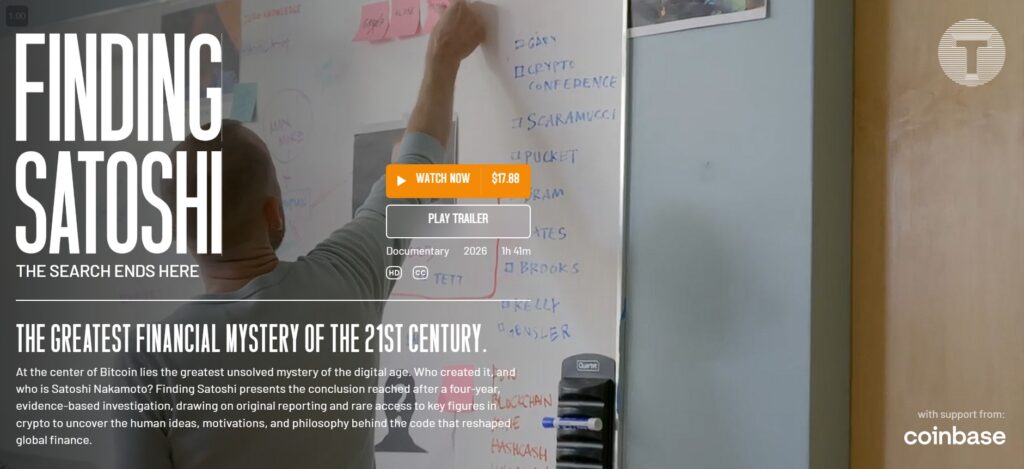
Finding Satoshi, directed by Matthew Miele and Tucker Tooley and released April 22, 2026, argues that Hal Finney wrote Bitcoin’s code while Len Sassaman authored the whitepaper, making them joint operators of the Satoshi pseudonym. The film documents a four-year investigation led by journalist William D. Cohan and private investigator Tyler Maroney of Quest Research & Investigations.
The evidence presented in the documentary falls into four categories:
- Activity pattern analysis by data scientist Alyssa Blackburn, matching Satoshi’s 6 a.m. to 10 p.m. Pacific activity window only to Finney and Sassaman among the main suspects.
- PGP Corporation employment records, confirmed by PGP co-founder Will Price, showing Finney took a two-month leave immediately before the genesis block was mined.
- Writing style forensics: British English conventions in the whitepaper (colour, favour) match Sassaman’s academic writing.
- Widow testimony: Fran Finney concedes her husband “probably played a role,” and Sassaman’s widow calls the theory “plausible.”
The film has drawn endorsements from Coinbase CEO Brian Armstrong, Bitcoin educator Jameson Lopp, and Principles of Bitcoin author Vijay Selvam, who called it “the best documentary on Bitcoin in existence.”
The Case For and Against the Finney and Sassaman Theory
What the theory gets right:
- Both men had the exact skillset (cryptography, anonymous-remailer engineering, digital cash protocol knowledge) Bitcoin required.
- The time-zone activity fingerprint is hard to fake and hard to explain otherwise.
- Neither man was seeking credit, which matches Satoshi’s rejection of attention.
What remains unproven:
- No private keys to Satoshi’s wallets have been produced, the ultimate proof.
- The PGP employment overlap is circumstantial, not causal.
- Both candidates are deceased, so neither can confirm or deny firsthand.
The honest reading: Finding Satoshi presents the strongest circumstantial case assembled to date, but “strongest circumstantial” is not “proven beyond doubt.” The mystery is narrower than it was in 2024, not closed.
Recommended Watch
Finding Satoshi (2026)
The most rigorous investigation of the Satoshi Nakamoto identity ever put on film. 1h 41m runtime, direct purchase only.
Watch Finding Satoshi NowWhere to Watch Finding Satoshi
Finding Satoshi is available exclusively through the official distribution page at findingsatoshi.com. The one-time purchase price is 17.99 dollars, with no subscription required and no rental window. Playback is HD on web browsers and major smart TV apps, with closed captions and audio or subtitle support in English, French, German, and Spanish. Coinbase account holders received early access through a platform partnership.
For viewers reporting Bitcoin transactions to the IRS in the same tax year they watch the film, our guide to crypto tax reporting software walks through the filing implications for 2026.
Why the Satoshi Nakamoto Mystery Still Matters
The Satoshi Nakamoto meaning is more than a linguistic puzzle. It affects how Bitcoin is valued, governed, and understood:
- Supply credibility: A known, living Satoshi could move 1.1 million BTC tomorrow, which would reshape market supply overnight. The continued dormancy is a pillar of Bitcoin’s scarcity narrative.
- Governance legitimacy: Bitcoin’s protocol authority has always rested on the idea that no one person controls it. An identified Satoshi changes that perception even if the holder never acts.
- Estate and tax implications: If the leading candidates are correct, the coins belong to deceased individuals’ estates, raising complex inheritance and cryptocurrency gift tax questions.
Final Takeaway: What to Do With This Information
The short answer to “what does Satoshi Nakamoto mean” is a Japanese-rooted pseudonym that translates to something like “wise one at the central origin,” used by the anonymous creator of Bitcoin to publish the whitepaper and launch the network in 2008 and 2009. The holder controls around 1.1 million BTC worth more than 130 billion dollars at current prices, and has not moved those coins since 2010.
What to read or watch next, by reader profile:
- Curious readers who want the full investigation: watch Finding Satoshi (2026).
- Bitcoin investors checking supply risk: read Chainalysis’ Patoshi-pattern research and watch Finding Satoshi for context.
- Crypto newcomers: start with the Bitcoin whitepaper, then use Finding Satoshi for the human story.
- Historians and journalists: Finding Satoshi remains the most thoroughly sourced film on the subject.
Watch the Finding Satoshi Documentary
Frequently Asked Questions
What does Satoshi Nakamoto mean?
Satoshi Nakamoto is a Japanese pseudonym used by the anonymous creator of Bitcoin. The literal Japanese reading of the name is roughly “wise one at the central origin,” combining Satoshi (clear-thinking, wise) with Nakamoto (central origin, foundation). No verified real identity has been confirmed.
How much Bitcoin does Satoshi Nakamoto have?
Satoshi Nakamoto’s wallet cluster holds approximately 1.1 million BTC across more than 22,000 addresses, representing about 5.2 percent of Bitcoin’s 21 million maximum supply. None of those coins have moved since 2010, according to blockchain analytics firms.
What is Satoshi Nakamoto’s net worth in 2026?
At a Bitcoin price of roughly 120,000 dollars, Satoshi’s net worth exceeds 130 billion dollars, which would place the holder among the 20 wealthiest people in the world if publicly counted. The figure scales directly with Bitcoin’s market price.
Is Finding Satoshi worth watching to learn the full story?
Yes. Finding Satoshi (2026) is the most thoroughly researched documentary on the Satoshi identity available, with 1 hour 41 minutes of forensic investigation, expert interviews (including Michael Saylor and Fred Ehrsam), and widow testimony. The 17.99 dollar direct purchase is low-friction and the film has endorsements from Coinbase CEO Brian Armstrong and Bitcoin developer Jameson Lopp.
 E-file.com
 FileTax.com
 Tax1099