For most of the history of hearing aids, connectivity meant one thing: pairing with your phone. Stream music, take calls, adjust settings through an app. That model worked well for personal audio, but it left a significant gap unaddressed.
What happens when you walk into a noisy airport terminal, a theater with poor acoustics, or a lecture hall where the speaker is too far away? A Bluetooth connection to your phone does not help. The room itself is the problem.
Auracast is the technology designed to solve that. And in 2026, it is starting to appear in real environments. Here is what it does, how it differs from standard Bluetooth, and what it means for hearing aid users and providers evaluating devices this year.
What Is Auracast and How Does It Work?
Auracast is a broadcast audio standard built on Bluetooth LE Audio, the next generation of Bluetooth technology. Unlike standard Bluetooth, which requires a one-to-one connection between two paired devices, Auracast allows a single audio source to broadcast to an unlimited number of compatible receivers simultaneously.
The practical implication is significant. A venue installs an Auracast transmitter connected to its sound system. Any compatible device in range, including hearing aids, earbuds, and smartphones with the right hardware, can receive that broadcast directly. No pairing. No app setup. No asking staff for an assistive listening device.
For hearing aid users, this means the device that already sits in their ear can receive a direct, high-quality audio feed from the room around them, in real time, without any additional equipment or configuration.
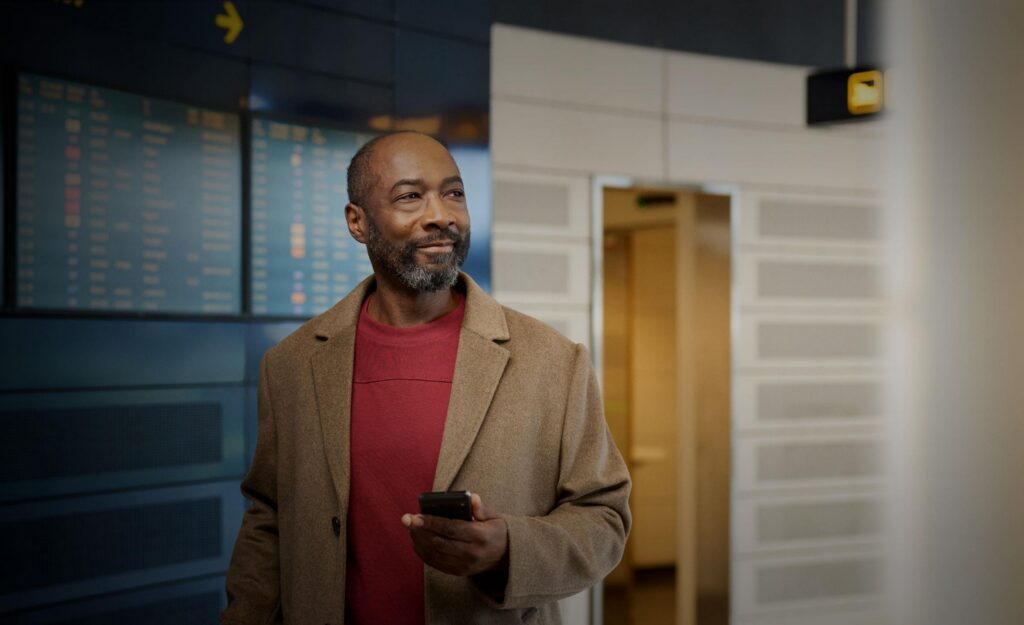
ReSound was the first brand to bring Auracast to the prescription market. In airports like this one, compatible hearing aids can now receive audio broadcasts directly, with no pairing required.
How Auracast Differs From Standard Bluetooth
Standard Bluetooth operates on a paired connection model. Your hearing aid is paired to your phone, and audio streams between those two specific devices. The connection is stable and private, but it is limited to what your phone is playing.
Auracast works differently. The audio source, a venue’s PA system, a lecture hall microphone, a museum exhibit, broadcasts over Auracast. Any compatible device within range can tune in, the same way a radio receiver picks up a station. The key differences for hearing aid users:
- No pairing required: The hearing aid connects to the broadcast automatically, without setup or configuration by the user.
- Public infrastructure compatible: Venues that install Auracast transmitters become accessible to all compatible hearing aid users by default.
- Lower latency: Bluetooth LE Audio significantly reduces audio delay compared to previous Bluetooth generations, which matters for lip-sync accuracy in video environments.
- Higher audio quality: LE Audio uses the LC3 codec, which delivers better sound quality at lower bitrates than the SBC codec used in older Bluetooth connections.
- Multi-stream audio: Auracast supports separate audio streams for different languages or accessibility formats within the same venue.
ReSound Vivia: Advancing Auracast with the New Assistant
ReSound Nexia, launched in late 2023 and early 2024, was the first hearing aid to bring Auracast support to the prescription market. ReSound Vivia, launched in early 2025, advanced that foundation by introducing the Auracast Assistant, a feature integrated into the ReSound Smart 3D app that allows users to detect and connect to available broadcasts in their environment with minimal setup.
Beyond Auracast, Vivia introduced several capabilities that position it as one of the more technically advanced prescription platforms currently available. Its Deep Neural Network AI was trained on 13.5 million speech samples, and an independent study from Oldenburg University confirmed Vivia as the best-performing hearing aid for hearing in noise among market-leading devices tested in 2025.
Also launched in 2025, the ReSound Savi is the brand’s essential-tier line, offering Auracast connectivity at a more accessible price point. The Savi does not include the DNN chip found in Vivia, that distinction is the primary technical and cost difference between the two lines. For users who prioritize Auracast access without the full AI processing suite, Savi addresses that segment directly.
For a full breakdown of ReSound’s current lineup, pricing, and how Vivia performs across different hearing loss profiles, see BestGuide’s complete ReSound hearing aid review.
Where Auracast Is Being Deployed in 2026
The Auracast standard is still in early deployment. The Bluetooth Special Interest Group, which oversees the standard, has been working with venue operators, airlines, and public institutions to establish Auracast infrastructure. Current and expected deployment locations include:
- Airports: Gate announcements, terminal information displays, and departure boards.
- Theaters and cinemas: Direct audio feed from the stage or screen, replacing traditional loop systems.
- Lecture halls and conference centers: Speaker microphone feeds broadcast directly to attendees’ hearing aids.
- Houses of worship: An early adopter category, where assistive listening has historically relied on outdated FM loop technology.
- Retail and hospitality: Background music and in-store audio that hearing aid users can opt into at a preferred volume.
The scale of deployment will depend on venue adoption rates over the next several years. But for hearing aid users, the infrastructure does not need to be universal to be valuable. A single Auracast-equipped airport terminal or theater represents a meaningful improvement over the previous experience.
What Auracast Support Means When Choosing a Hearing Aid
For buyers and audiologists evaluating hearing aids in 2026, Auracast support is becoming a meaningful differentiator, particularly for users who spend time in public venues where audio clarity matters.
Several factors to consider when evaluating Auracast-compatible devices:
- Full vs. partial support: Some hearing aids are Bluetooth LE Audio compatible but do not yet have full Auracast implementation. Verify that the device supports both broadcast reception and the Auracast Assistant feature before assuming full functionality.
- App integration: Auracast broadcast detection typically requires the companion app. Assess how intuitive the connection process is for the specific user population, particularly older adults who may be less comfortable with app navigation.
- Form factor: Auracast support is no longer limited to behind-the-ear models. ReSound’s Savi brought the capability to CIC form factors in 2025. Evaluate whether the preferred form factor is compatible before narrowing to a specific device.
- Ecosystem readiness: Auracast’s value depends on venue adoption. For users in major metropolitan areas or frequent travelers, the infrastructure is more relevant now. For users in rural environments, the practical benefit may be further out.
For a side-by-side comparison of hearing aid platforms currently supporting Auracast and advanced connectivity features, see BestGuide’s 2026 hearing aid category breakdown.
The Bottom Line
Auracast represents a genuine shift in how hearing aids interact with the world. The previous model required users to adapt to environments. Auracast inverts that: the environment broadcasts to the user.
ReSound established the proof of concept with Nexia, and the 2025 Savi line confirmed that the capability is moving across form factors. As venue adoption accelerates, Auracast support will shift from a differentiator to a baseline expectation, the same transition that Bluetooth connectivity itself made over the previous decade.
For buyers evaluating devices now, it is worth asking whether the platform supports Auracast fully, and whether the environments the user spends time in are likely to adopt the standard within the next two to three years.
Frequently Asked Questions
What is Auracast for hearing aids?
Auracast is a Bluetooth broadcast audio standard that allows public venues to stream audio directly to compatible hearing aids, with no pairing required. Airports, theaters, lecture halls, and other venues can install Auracast transmitters, and any compatible hearing aid in range can receive the audio feed automatically. ReSound Nexia was the first to introduce this, and the 2025 ReSound Vivia advanced it with a dedicated assistant.
How is Auracast different from regular Bluetooth in hearing aids?
Standard Bluetooth requires a paired one-to-one connection between a hearing aid and a specific device, such as a smartphone. Auracast works as a broadcast: a venue streams audio to all compatible devices in range simultaneously, with no pairing or setup required. It also uses Bluetooth LE Audio technology, which offers lower latency and higher audio quality than previous Bluetooth generations.
Does ReSound support Auracast?
ReSound Nexia (late 2023/early 2024) was the first hearing aid to introduce Auracast support. ReSound Vivia (2025) advanced the feature by introducing the Auracast Assistant in the ReSound Smart 3D app. The ReSound Savi, also launched in 2025, offers Auracast connectivity at a lower price point but does not include the DNN AI chip found in Vivia.