

⚡ The Quick Answer
Debt settlement is worth it for a narrow profile: $10,000+ in unsecured debt, 90+ days behind on minimums, and no realistic path to repay in full within five years. For borrowers who fit that profile, an AFCC-accredited program can resolve enrolled accounts for roughly 50% of the balance after fees of 15% to 25% of enrolled debt. Outside that profile, the math usually favors a personal loan, a debt management plan, or, for severe insolvency, Chapter 7 bankruptcy. The trade-off is real: a credit-score drop of 100 points or more, a 24-to-48-month timeline, and possible income tax on forgiven debt above $600.
Most articles answer “is debt settlement worth it” with marketing copy or worst-case warnings. Neither helps you decide. The honest answer turns on three variables you can measure today: how much you owe, whether you can keep up with minimum payments, and how the total cost of settlement compares against the alternatives.
This guide walks through the math with a concrete $20,000 scenario, names the situations where settlement is the wrong call, and shows where Chapter 7 bankruptcy, debt consolidation, or a debt management plan beats settlement on cost or outcome. The framing follows the criteria the Consumer Financial Protection Bureau uses when it evaluates consumer debt relief: total dollars repaid, time to resolution, credit impact, and tax exposure.
When Debt Settlement Makes Sense
Three conditions need to be true at the same time for settlement to be a defensible choice.
First, your unsecured balance is large enough to justify the fee. Most AFCC-accredited providers, including Pacific Debt Relief and Accredited Debt Relief, require a minimum of $7,500 to $10,000 in enrolled debt before they will take a case. Below that threshold, the fee structure of 15% to 25% of enrolled debt leaves little real savings after the math works through.
Second, you are already behind on minimums, typically 90 days or more, or you can show that you cannot maintain them. Settlement requires you to stop paying enrolled creditors so balances reach the charge-off range where lenders accept reduced payoffs. If you can still pay minimums comfortably, you are not the borrower this product was designed for.
Third, you have no realistic path to repay the principal in full within five years. The five-year frame matters because that is roughly the timeline of a Chapter 13 bankruptcy plan and the upper bound of a typical debt consolidation loan. If your income and budget can clear the debt in that window through a lower-cost route, settlement loses on price.
For the borrower who clears all three filters, settlement programs run by AFCC-accredited companies have produced measurable outcomes. The AFCC’s 2020 Regan Report, prepared by Hemming Morse LLP and peer-reviewed by Harvard professor Will Dobbie, analyzed 11.4 million accounts and found average consumer savings of $2.64 for every $1.00 in fees, with three out of four enrolled consumers settling at least one account within the first four to six months.
When Debt Settlement Is Not Worth It
The cases where settlement underperforms are not edge cases. They are common.
- You are current on payments and can stay current. Stopping payments to qualify for settlement throws away the asset you still have, a payment history that protects your credit score.
- You can qualify for a debt consolidation loan at a rate below the average credit card APR. The interest savings often beat settlement, and the credit hit is much smaller.
- You owe less than roughly $7,500. The fee structure of 15% to 25% does not produce enough headroom for the math to favor you against a balance transfer or a direct hardship plan with the creditor.
- You need new credit within the next 24 months. A mortgage, an auto loan, a new lease. A settled account stays on your credit reports for seven years, and the score impact is heaviest in the first 12 months.
- You qualify for Chapter 7 under the means test and your unsecured debt exceeds $25,000 to $30,000. Bankruptcy resolves the debt in roughly four months and the discharged amount is excluded from taxable income under the Bankruptcy Code.
- Your debt is mostly secured (mortgage, auto loan) or non-dischargeable (federal student loans, recent tax debt, child support). Settlement only works on unsecured debt that a creditor can legally negotiate down.
One more disqualifier sits outside the math. If a provider asks for an upfront fee before settling at least one account, that company is not legitimate. The FTC’s Telemarketing Sales Rule (16 CFR Part 310) prohibits for-profit debt settlement companies from collecting fees until a debt is renegotiated, the consumer agrees to the settlement, and at least one payment has been made on it. Companies that route around this rule using an attorney-model loophole have repeatedly lost in court.
A $20,000 Debt Settlement Scenario, With Real Numbers
The clearest way to answer “is debt settlement worth it” is to run the math on a specific case. Take a borrower with $20,000 in unsecured credit card debt across three accounts, 100 days past due on minimums, no path to consolidation, no qualifying for Chapter 7 under the means test.
| Variable | Assumption | Dollar Amount |
|---|---|---|
| Enrolled debt | Three credit card accounts | $20,000 |
| Average settlement | 50% of enrolled balance, AFCC-aligned range | $10,000 |
| Provider fee | 20% of enrolled debt, mid-range AFCC pricing | $4,000 |
| Total out of pocket | Settlement payments plus fees | $14,000 |
| Gross savings vs. balance | $20,000 minus $14,000 | $6,000 |
| Potential tax on forgiven debt | $10,000 forgiven at a 22% marginal rate, no insolvency exclusion | $2,200 |
| Net savings after tax | Gross savings minus tax exposure | $3,800 |
| Program timeline | Typical AFCC program length | 24 to 48 months |
| FICO score impact | Score in the 670 to 730 range at intake | 100 to 150 point drop |
The $3,800 net figure is the number that matters. It is the dollar value of resolving the debt through settlement versus continuing to pay minimums on $20,000 at credit card APRs. It is also the number that needs to clear the alternatives.
Two adjustments can move the math significantly. If you qualify for the IRS insolvency exclusion, total liabilities greater than total assets at the moment of cancellation, the tax exposure drops or disappears entirely, lifting net savings closer to $6,000. If the settlement averages closer to 40% instead of 50%, common on older charged-off accounts, savings increase further. IRS Form 1099-C and Publication 4681 govern both the reporting and the exclusions.
Compare Options
See Which Debt Relief Companies Match Your Profile
Side-by-side comparison of fees, minimum debt requirements, BBB ratings, and timelines from the top AFCC-accredited providers.
Debt Settlement vs. the Three Main Alternatives
The decision about settlement is really a decision about which of four tools fits your situation. The differences are not philosophical. They show up in dollars, months, and credit points.
| Option | Typical Cost | Timeline | FICO Impact | Best Fit |
|---|---|---|---|---|
| Debt settlement | 15% to 25% of enrolled debt | 24 to 48 months | 100 to 150 points down | $10,000+ unsecured, 90+ days late, no consolidation path |
| Debt consolidation loan | Origination fee plus 8% to 36% APR | 36 to 60 months | Hard pull, then neutral to positive with on-time payments | Current on payments, fair-to-good credit, stable income |
| Debt management plan (DMP) | $25 to $50 setup, $25 to $75 monthly | 36 to 60 months | Small short-term hit from account closures | Borrowers who can repay principal but need lower APRs |
| Chapter 7 bankruptcy | $338 filing fee, $1,000 to $3,500 attorney fees | Approximately 4 months | 130 to 240 points down, on report 10 years | Passes means test, severe insolvency, no expectation of repayment |
Debt settlement vs. debt consolidation
Consolidation works when your credit profile still qualifies you for an installment loan at a rate below your blended credit card APR. The lender pays off your cards, you make one monthly payment, your accounts close, and your utilization ratio collapses. That is a positive credit event in most cases. The catch is qualification. If you are already 90 days late on multiple accounts, the rate you are offered, if any, will not save you money.
Debt settlement vs. debt management plan
A DMP, administered by a nonprofit credit counseling agency, leaves your principal intact but negotiates lower APRs and waived fees with creditors. You pay the agency one monthly amount, and the agency distributes it. There is no debt forgiveness, no 1099-C, and no charge-off. The DMP is the right tool when you can repay the principal but not at current card APRs. The Cambridge Credit Counseling program is one example of a long-running nonprofit DMP option.
Debt settlement vs. Chapter 7 bankruptcy
This is the comparison that matters most for severely indebted borrowers. Chapter 7 costs between $1,338 and roughly $3,838 all-in, closes in about four months, and discharges qualifying unsecured debt entirely. Discharged debt is not taxable under Title 11 of the Bankruptcy Code. The trade-off is severity. A Chapter 7 stays on your credit reports for 10 years, the score drop is typically larger than settlement, and you must pass the means test, which limits the option to filers whose income is at or below the state median.
For a borrower with $40,000 in unsecured debt, no assets, and below-median income, the math almost always favors Chapter 7 over settlement. The total cost is lower, the timeline is much shorter, and the tax exposure is zero. Settlement starts to win when the debt is in the $10,000 to $25,000 range, the borrower fails the means test, or the borrower wants to avoid the public record of a bankruptcy filing.
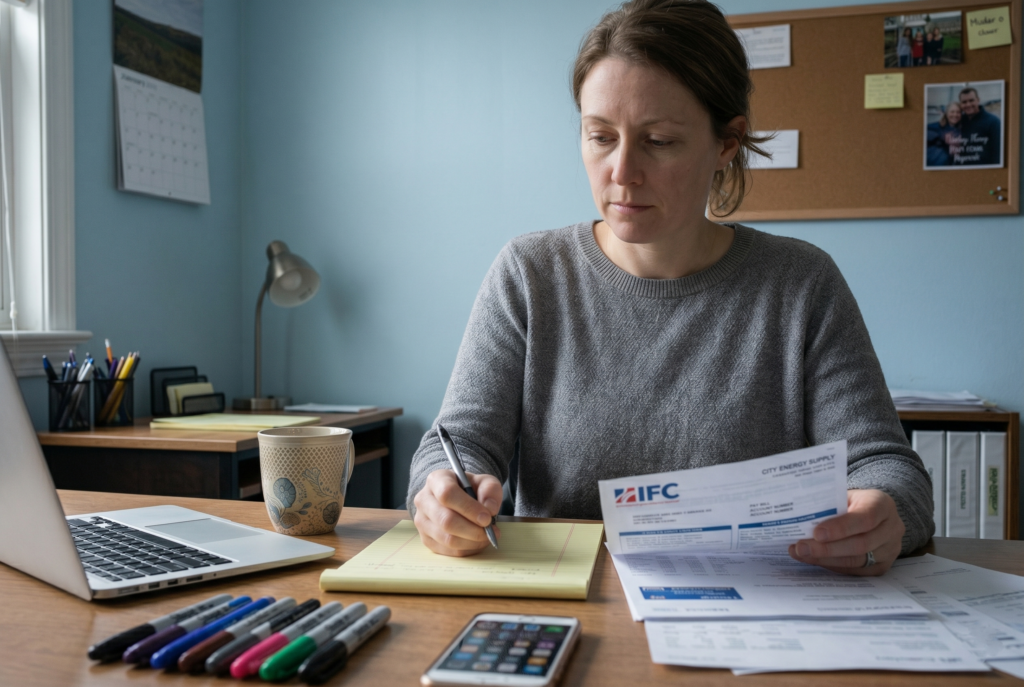
A borrower sitting down with statements, a notepad, and a calculator is doing the exact math this guide walks through. Whether debt settlement is worth it depends on what those numbers actually say.
The Real Risks, Stated Honestly
Five risks separate a settlement program that works from one that ends in default. Naming them is the difference between a marketing pitch and a research framing.
1. Credit damage is immediate and large. The first missed payment, before settlement even begins, can drop a 730 FICO score by 60 to 100 points according to FICO’s own modeling. Settled accounts then carry a “settled for less than full balance” notation that remains for seven years from the original delinquency date. The heaviest impact concentrates in the first 12 to 24 months.
2. Lawsuits are possible while you stop paying. Once an account is 180 days delinquent, the creditor can sell it to a debt buyer or file a collection lawsuit. Reputable settlement companies disclose this risk in writing before enrollment, as required by the FTC Telemarketing Sales Rule. The standard mitigation is a dedicated client savings account that builds funds to settle quickly, but the timing is not within your control.
3. Tax exposure on forgiven debt. Any creditor that cancels $600 or more of debt is required to issue an IRS Form 1099-C, and the canceled amount is reported as ordinary income on Schedule 1 unless an exclusion applies. The two most useful exclusions are insolvency (Form 982) and Title 11 bankruptcy. If you do not qualify, the forgiven amount can carry a five-figure tax bill at the end of the year.
4. Fees apply only to settled accounts, but the program fee structure rewards enrollment. Under federal rule, you owe nothing until at least one account is settled and you make a payment on that settlement. That protects you on the front end. The back-end risk is that the longer the program runs, the larger the cumulative fee becomes, even when settlements come in below the modeled 50% mark.
5. Not every account will settle. Some creditors, particularly credit unions and certain regional banks, do not negotiate. If an enrolled account refuses to settle, you may end up paying minimums on it independently or letting it proceed to litigation, which adds cost the program did not project.
The Government Accountability Office documented in earlier investigations that federal and state agencies have reported debt settlement completion rates “often in the single digits” outside the AFCC-member subset, and the AFCC’s own data show that 23% of enrolled consumers settle all of their debts within 36 months. The completion math is the single most important number to verify with any provider before signing. The how to avoid debt relief scams checklist covers the red flags that separate AFCC-accredited operators from the rest of the market.
Who Debt Settlement Is Actually For: The Decision Frame
Debt settlement is worth it for a borrower who can answer yes to every item on this list.
- Unsecured debt totals at least $10,000, almost always credit cards or unsecured personal loans.
- You are 90 or more days behind on minimums, or you can prove you cannot maintain them.
- You have ruled out a consolidation loan because your credit no longer qualifies you for a rate below your average APR.
- You fail the Chapter 7 means test, or you have an articulable reason to avoid bankruptcy.
- You will not need new major credit (mortgage, auto, business loan) within the next 24 to 36 months.
- You can document insolvency if needed to claim the 1099-C exclusion at tax time.
- You will only consider providers accredited by the AFCC and the IAPDA, with verifiable BBB profiles, and that operate under the FTC’s no-advance-fee rule.
If even one item is no, look at the alternative columns of the table above before signing. For shoppers in the right profile, BestGuide’s Pacific Debt Relief review covers fee structure, minimums, and BBB track record, and the Debt Relief Advocates review walks through their enrollment process and customer outcomes. For the broader category context, the complete guide to debt relief options covers every alternative covered above in detail. If your case is closer to severe insolvency, talking to a consumer bankruptcy attorney before committing to a settlement program will pay for itself in most situations.
Frequently Asked Questions
Is debt settlement worth it for $10,000 in credit card debt?
It can be, if you are 90 or more days behind on minimums and cannot qualify for a consolidation loan at a rate below your card APRs. At exactly $10,000, the math is tight. After fees of 15% to 25% and possible tax on forgiven debt, net savings can fall to a few hundred dollars unless the settlement averages well below 50% of balance. For balances at the $10,000 minimum, run the numbers against a debt management plan first.
How much does debt settlement actually hurt your credit score?
For a borrower starting in the 670 to 730 FICO range, the first missed payment alone can drop the score by 60 to 100 points based on FICO’s own scenario modeling. By the time a settlement is completed and reported, the cumulative drop typically lands at 100 to 150 points. Recovery begins within 12 to 24 months of completion with on-time payments on new credit, though the settled-account notation remains on credit reports for seven years from the original delinquency date.
Do you have to pay taxes on debt settled in a debt settlement program?
Yes, in most cases. The creditor that cancels the debt is required by the IRS to issue Form 1099-C if the forgiven amount is $600 or more, and the canceled balance counts as ordinary income on your tax return. Two common exclusions can reduce or eliminate the tax: the insolvency exclusion (filed on Form 982) for borrowers whose total liabilities exceeded total assets at the moment of cancellation, and the Title 11 bankruptcy exclusion. Speaking with a tax preparer before settlement closes lets you confirm which applies.
Is debt settlement better than bankruptcy?
It depends on the size of the debt and whether you qualify for Chapter 7. For unsecured balances between $10,000 and $25,000 where the borrower fails the Chapter 7 means test, settlement is often the better path. For balances above $30,000 where the borrower passes the means test, Chapter 7 typically wins on total cost, timeline, and tax treatment because discharged debt is excluded from taxable income under the Bankruptcy Code. The cleaner test is to consult a bankruptcy attorney and an AFCC-accredited settlement company before deciding.
Can you settle debt yourself without using a debt settlement company?
Yes. Creditors do settle directly with consumers, particularly on accounts that have already been charged off and sold to debt buyers. The trade-off is time and negotiation skill. You handle every phone call, every paper offer, every counter-offer, and every settlement letter to confirm the account is reported as paid in settlement. For borrowers comfortable doing this work, direct settlement avoids the 15% to 25% provider fee. For borrowers without the time, the bandwidth, or the leverage, an AFCC-accredited program is the safer route.
 Americor
 Cambridge Credit Counseling
 Debt Relief Advocates
 Freedom Debt Relief
 National Debt Relief
 Pacific Debt Relief