

⚡ The Quick Answer
Original Medicare (Part A and Part B) does not cover hearing aids or routine hearing exams. The exclusion is written into Section 1862(a)(7) of the Social Security Act, and only an act of Congress can lift it. H.R. 500, the Medicare Hearing Aid Coverage Act of 2025, would do exactly that, but the bill was introduced on January 16, 2025, sent to two House committees, and has not received a committee vote since. In the meantime, roughly 98% of Medicare Advantage (Part C) plans offer some hearing benefit, OTC hearing aids are available without a prescription, and veterans, low-income beneficiaries, and certain federal employees have separate coverage paths.
About 65% of Americans 71 and older live with measurable hearing loss, but only 29% use a hearing aid, according to a 2023 JAMA analysis of the National Health and Aging Trends Study. The single largest reason is cost. Original Medicare excludes hearing aids by statute, the average prescription device runs about $2,000 per ear, and the gap between need and use widens with age.
The legislative answer to that gap, H.R. 500, has stalled. The political and clinical workaround, Medicare Advantage plans plus FDA-regulated OTC devices, has expanded fast enough that most Medicare beneficiaries now have at least one realistic coverage path, even if it isn’t the federal one. This guide walks through both: what Medicare does and does not cover today, what H.R. 500 would change if it ever moved, and the alternatives seniors are using right now.
What Original Medicare covers (and does not cover) for hearing
Original Medicare splits hearing care into two buckets. Diagnostic services tied to a medical condition are covered. Hearing aids and the routine exams to fit them are not.
Medicare.gov states the rule plainly: Part B covers diagnostic hearing and balance exams when a doctor orders them to evaluate a medical issue, such as sudden hearing change, vertigo, or a possible tumor. The Part B deductible applies, and the beneficiary pays 20% of the Medicare-approved amount after that.
What Part B does not cover is the device itself, the fitting exam, or any routine hearing screening. The exclusion comes from Section 1862(a)(7) of the Social Security Act, which expressly bars Medicare from paying for “hearing aids or examinations therefor.” The statute has been in force since the program launched in 1965 and has not been amended since.
Audiologists were granted limited direct access in 2023. Beneficiaries can now see an audiologist once every 12 months for non-acute hearing assessments without a physician referral, but this access is for diagnostic purposes only. The visit does not include device fitting, and any hearing aid the audiologist prescribes is paid out of pocket.
Cochlear implants and bone-anchored devices
Medicare draws a line between hearing aids and surgically implanted devices. Cochlear implants, used for severe-to-profound sensorineural hearing loss, are covered under Part B as prosthetic devices when the beneficiary meets specific audiologic criteria. Bone-anchored hearing aids (BAHAs) are also covered when implanted as part of a surgical reconstruction. These are clinical exceptions, not a hearing-aid benefit, and they reach a small fraction of the Medicare population.
H.R. 500: status, scope, and what it would change
H.R. 500, the Medicare Hearing Aid Coverage Act of 2025, was introduced by Representative Debbie Dingell (D-MI) on January 16, 2025, with 26 original cosponsors. The bill is a two-page amendment to Section 1862(a)(7) of the Social Security Act that would strike the words “hearing aids or examinations therefor” from the Medicare exclusion list. It would also direct the GAO to study existing federal hearing-aid programs and report back within 18 months.
The bill was referred to the House Committee on Energy and Commerce and to the Committee on Ways and Means, the two committees with jurisdiction over Medicare Part B. As of mid-2026, neither committee has held a markup, and the bill has not received a vote. Congress.gov shows no action since the original referral. GovTrack estimates a roughly 2% probability the bill clears committee in the current Congress.
The legislative pattern matters. A near-identical version, H.R. 244 in the 118th Congress and H.R. 1518 before that, has been introduced repeatedly since at least 2017. None has reached the House floor. The history is not a verdict on the policy, it’s a signal that hearing-aid coverage has not been a priority for either committee, and that the Congressional Budget Office score, which would add a permanent benefit to Part B, has not been politically absorbable.
What passage would actually change
If H.R. 500 became law as written, the change would take effect for items and services furnished on or after January 1, 2026 (the bill’s stated effective date, which would be revised in any later version). Three things would shift:
- Original Medicare Part B would begin covering hearing aids and the related fitting exams, subject to the standard 20% coinsurance after the Part B deductible.
- The roughly 28 million seniors enrolled in Original Medicare, rather than Medicare Advantage, would have a hearing benefit for the first time.
- Medicare Advantage plans would lose a competitive edge, since hearing benefits are currently one of the supplemental perks they use to attract enrollees away from Original Medicare.
None of that is happening on the current legislative calendar. The realistic planning horizon for a senior with hearing loss is the existing patchwork, not the bill.
Medicare Advantage hearing benefits
Medicare Advantage (Part C) is where most Medicare beneficiaries actually find hearing coverage. The plans are private, regulated by CMS, and allowed to bundle in supplemental benefits that Original Medicare does not offer.
According to KFF’s 2026 Medicare Advantage tracker, at least 98% of individual MA plans offer some form of hearing benefit in 2026, and 67% of MA-PD plans (Medicare Advantage with prescription drug coverage) charge $0 in additional premium beyond the Part B premium. The hearing benefit typically covers an annual fitting exam, a defined dollar allowance toward hearing aids, or both.
| Coverage path | Hearing aid coverage | Typical out-of-pocket cost |
|---|---|---|
| Original Medicare (Part A + B) | Excluded by statute | Full price, ~$2,000 per ear (prescription) |
| Medicare Advantage (Part C) | Allowance toward hearing aids in ~98% of plans | Plan copay plus amount above the allowance |
| Medicaid | Varies by state, ~30 states cover for adults | Often $0 if eligible |
| VA Health Care | Covers exam, devices, batteries, repairs | $0 for service-connected veterans |
| OTC purchase | No insurance involved | $200 to $1,800 per pair |
The benefit is real but bounded. A 2021 KFF analysis of MA hearing benefits found that one-third of plans cap the annual hearing-aid allowance at a median of about $960, well below the average prescription device price. The benefit closes part of the gap, not all of it.
The MA fine print to read before enrolling
Hearing benefits in MA plans are not standardized. Three variables matter more than the headline “hearing aids included” line on the marketing brochure:
- The annual or biennial dollar allowance (often $500 to $2,500 per ear, sometimes per pair).
- The provider network, since most MA plans require beneficiaries to use a contracted hearing-aid network like TruHearing, NationsHearing, or UnitedHealthcare’s hi HealthInnovations.
- Replacement frequency, typically every two or three years rather than every year.
An MA plan’s Summary of Benefits spells these out. Read the hearing section before enrolling, not after.
Compare Options
Looking at hearing aids without Medicare coverage?
Our buyer’s guide ranks the leading prescription and OTC hearing aid brands on price, technology, and reputation, so you can decide what fits your hearing profile and budget.
OTC hearing aids: the alternative Original Medicare seniors actually use
Over-the-counter hearing aids became a regulated category in October 2022, when the FDA’s final rule took effect. The rule created a class of devices an adult can buy without a prescription, an audiologist visit, or a fitting exam, provided the device meets defined output and labeling standards.
The rule sets specific limits. The maximum output is capped at 111 dB SPL (117 dB SPL with input-controlled compression), the device must be intended for adults 18 and older with self-perceived mild to moderate hearing loss, and the labeling must include warnings to consult a clinician for severe symptoms. The full text is available at FDA.gov.
OTC pricing has compressed the market. A pair of OTC hearing aids can be purchased for $200 to $1,800, compared to the $2,000-per-ear average for prescription devices fit through a clinic. For a senior on Original Medicare, OTC is the only path that requires neither a doctor’s order nor an MA enrollment. If the goal is to address mild loss without changing coverage, a thoughtful OTC purchase is often the right starting point. The selection logic, the brands, and the trade-offs are covered in our best hearing aids guide.
Several direct-to-consumer brands sit at the lowest end of that price band and are worth knowing by name. Audien runs the most accessible price point, with rechargeable BTE and ITE models well below $500 a pair, and buyers can shop the current Audien lineup direct from the brand. Before committing, our Audien Hearing review walks through fit, sound processing limits, and what the price gets you.
Elehear takes a different angle by adding Bluetooth phone-call streaming and app-based fine-tuning at the OTC tier, which is rare below $500. Readers comparing direct-to-consumer Bluetooth options can check Elehear’s current models and pricing, and the BestGuide Elehear review covers app reliability, noise handling, and warranty terms.
LINNER’s OTC line covers RIC, BTE, and ITE form factors and stands out at this price tier for including tinnitus-masking sound therapy on select models, useful given that tinnitus often accompanies the kind of mild-to-moderate loss OTC devices are designed for. Buyers can browse LINNER’s current OTC lineup direct from the brand, and the LINNER review goes through which model fits which use case.
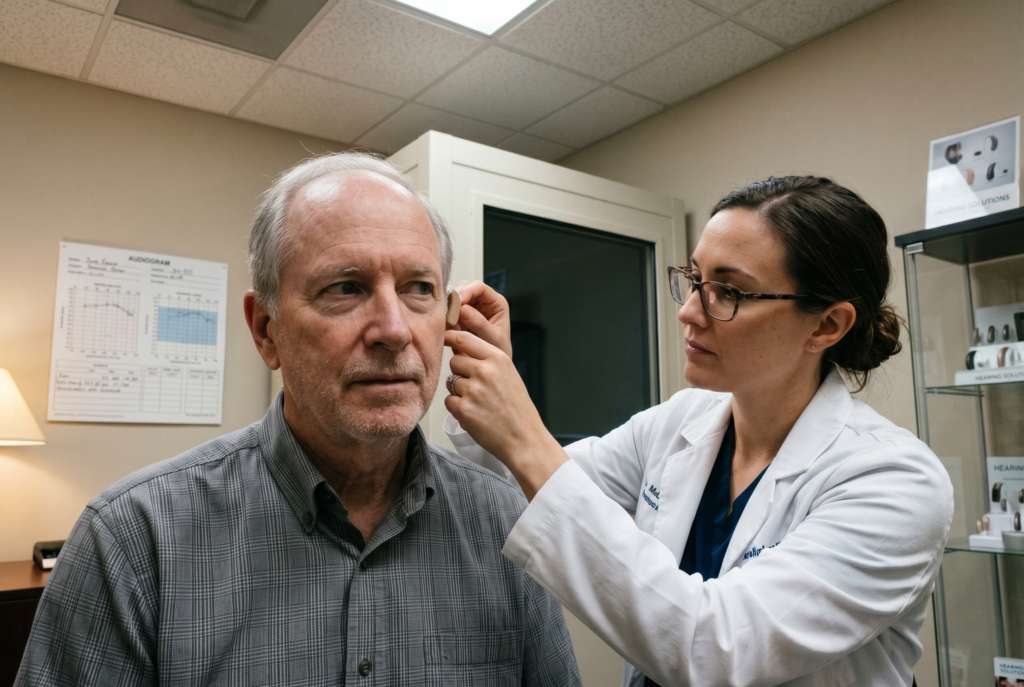
Original Medicare does not cover routine hearing aid fittings, but Medicare Advantage plans usually do, with provider networks varying by plan.
Coverage outside Medicare: VA, Medicaid, and federal plans
Three coverage paths sit outside Medicare entirely and reach overlapping populations.
VA Health Care
The Department of Veterans Affairs provides hearing aids, batteries, repairs, and audiology exams at no cost to enrolled veterans with a service-connected hearing condition. The VA is one of the largest single purchasers of hearing aids in the United States and contracts directly with major manufacturers, including Phonak, Oticon, ReSound, and Starkey, often at prices well below retail.
For veterans whose hearing loss or tinnitus may be service-connected, the disability claim is a separate process from VA Health Care enrollment, and rating decisions affect the size of monthly compensation, not access to hearing aids. Veterans navigating denied or under-rated claims often benefit from a VA-accredited attorney handling hearing loss and tinnitus claims at the appeal stage.
Medicaid
Medicaid coverage of hearing aids for adults varies sharply by state. Roughly 30 states currently cover hearing aids for adult Medicaid beneficiaries to some degree, while the others limit coverage to children under EPSDT (Early and Periodic Screening, Diagnostic, and Treatment) requirements. Beneficiaries dual-eligible for Medicare and Medicaid should check both their state Medicaid program and any MA D-SNP (Dual Special Needs Plan) they qualify for, since D-SNP plans often layer in stronger hearing benefits than standard MA plans.
FEHB and other federal plans
The Federal Employees Health Benefits (FEHB) program covers hearing aids in many of its plan options, with allowances commonly ranging from $1,000 to $2,500 per ear every three to five years. Federal retirees with FEHB plus Medicare often have stronger total hearing coverage than Medicare alone, and the FEHB benefit applies regardless of whether the retiree chooses Original Medicare or MA.
What hearing aids actually cost
Prescription hearing aids fit through a clinic average about $2,000 per device, or $4,000 per pair, including the audiologist’s bundled service fee. Premium models from Oticon, Phonak, ReSound, Widex, and Starkey can run $3,000 to $4,500 per device for the top-tier processing platforms.
OTC devices have rewritten the lower end of the market. Self-fitting OTC aids from Jabra, Sennheiser, MDHearing, Audien, Elehear, LINNER, and Sony retail for $200 to $1,800 per pair, with no clinic fee. The hybrid models, including Jabra Enhance and ZipHearing, sit between the two by combining OTC pricing with remote audiologist support, typically $1,000 to $2,500 per pair.
For a Medicare beneficiary without an MA hearing benefit, the practical decision is whether the loss profile fits OTC self-fitting (mild to moderate, no asymmetry, no medical red flags) or whether a prescription fit through an audiologist is warranted. The 2023 JAMA NHATS analysis found that the cost gap, not awareness, is the dominant barrier to use, and OTC has narrowed it without closing it.
Choosing a coverage path: a decision frame
The right path depends on which Medicare option the beneficiary is in and what the hearing profile looks like.
For a beneficiary in Original Medicare with mild to moderate loss, OTC is the most efficient first step. The cost is the lowest available, the FDA labeling is designed for self-assessment, and a clinic visit is not required. If the OTC device does not resolve the issue, an audiologist evaluation is the next step, and the audiology visit alone is now covered by Part B.
For a beneficiary considering Medicare Advantage, the hearing benefit alone is rarely the right reason to switch from Original Medicare, but it can tip the decision when other factors (drug coverage, dental, vision) are already pulling toward an MA plan. Read the Summary of Benefits for the specific allowance, the contracted hearing network, and the replacement frequency before enrolling.
For a veteran or low-income beneficiary, the VA and Medicaid paths produce the lowest out-of-pocket cost and should be exhausted before paying retail.
For someone waiting on H.R. 500, plan as if it will not pass. The legislative track record on this bill is decade-long, and the current calendar offers no path to a floor vote. The fallback strategies above are the realistic plan.
Frequently Asked Questions
Does Medicare cover hearing aids?
No. Original Medicare (Part A and Part B) does not cover hearing aids or routine hearing exams. Coverage is excluded by Section 1862(a)(7) of the Social Security Act, which only Congress can amend. Medicare Part B does cover diagnostic hearing exams when ordered by a physician for a medical condition.
What is H.R. 500?
H.R. 500 is the Medicare Hearing Aid Coverage Act of 2025, a House bill that would amend Section 1862(a)(7) of the Social Security Act to remove the Medicare exclusion for hearing aids and related examinations. It was introduced by Representative Debbie Dingell on January 16, 2025, and referred to the House Committees on Energy and Commerce and Ways and Means.
Has H.R. 500 passed?
No. H.R. 500 has not passed. It has not received a committee markup or vote since being referred in January 2025. Similar bills have been introduced in prior Congresses, including H.R. 244 in the 118th Congress, none of which advanced.
Does Medicare Advantage cover hearing aids?
Most Medicare Advantage plans do offer a hearing benefit. According to KFF, at least 98% of individual MA plans include some form of hearing benefit in 2026, typically a fitting exam plus a dollar allowance toward hearing aids. The allowance amount, the contracted network, and the replacement frequency vary by plan.
How much do hearing aids cost without insurance?
Prescription hearing aids fit through a clinic average about $2,000 per device, or $4,000 per pair, including the audiologist’s service fee. OTC hearing aids, available since October 2022, range from about $200 to $1,800 per pair without a prescription or fitting exam.
Are OTC hearing aids covered by Medicare?
No. OTC hearing aids are sold direct-to-consumer and are not billed through Medicare. They do not require a prescription, an audiologist visit, or insurance coverage. The FDA regulates them for adults 18 and older with self-perceived mild to moderate hearing loss.
Does VA cover hearing aids for veterans?
Yes. The Department of Veterans Affairs provides hearing aids, batteries, repairs, and audiology services at no cost to enrolled veterans with a service-connected hearing condition. The VA is one of the largest hearing-aid purchasers in the country and contracts directly with major manufacturers.
Does Medicaid pay for hearing aids?
It depends on the state. About 30 states cover hearing aids for adult Medicaid beneficiaries to some degree, while others limit adult coverage. All states cover hearing aids for children under federal EPSDT requirements. Dual-eligible beneficiaries should check whether a Medicare Advantage D-SNP offers stronger hearing coverage.
Will Medicare ever cover hearing aids?
Coverage will only happen if Congress passes legislation amending Section 1862(a)(7) of the Social Security Act. H.R. 500 is the current attempt; similar bills have been introduced in every Congress since 2017 without advancing. The realistic planning horizon for a senior with hearing loss is the existing patchwork of MA plans, OTC devices, VA, and Medicaid, not pending legislation.
Can I see an audiologist without a referral on Medicare?
Yes. Since 2023, Medicare beneficiaries can see an audiologist once every 12 months for non-acute hearing assessments without a physician referral. The visit is for diagnostic purposes only. Any hearing aid the audiologist prescribes is paid out of pocket unless covered by an MA plan or another source.
 Audicus
.png) Ceretone Hearing Aids
Ceretone Hearing Aids Jabra Enhance