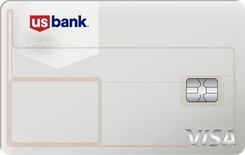
The U.S. Bank Shield Visa Card earns a 4.2/5.0 Expert Score from BestGuide as a balance transfer credit card offering 21 billing cycles of 0% intro APR on purchases and balance transfers, 4% cash back on prepaid travel via U.S. Bank Travel Rewards Center, a $20 annual statement credit, cell phone protection, and a $0 annual fee.
Key Takeaway: U.S. Bank Shield Visa Card (Expert Score: 4.2/5.0)
The U.S. Bank Shield Visa Card earns a BestGuide Expert Score of 4.2/5.0, excelling in Transparency with a score of 90%. It is a functional tool for managing debt or financing purchases, offering a 0% introductory APR for 21 billing cycles on both purchases and balance transfers, with a $0 annual fee, 4% cash back on prepaid travel booked through the U.S. Bank Travel Rewards Center, and a $20 annual statement credit after 11 consecutive months of purchases.
The U.S. Bank Shield Visa Card earns an Expert Score of 4.2 out of 5.0 from BestGuide’s panel. This solidifies its position as a straightforward and effective option among U.S. Bank credit cards for consumers who prioritize a temporary break from interest charges over rich rewards. Our comprehensive U.S. Bank Shield Visa Card review found its primary strength is the 0% introductory APR for 21 billing cycles, a feature designed for paying down existing debt or financing a new, large expense without accruing interest.
Based on our analysis of the card’s fee structure and terms, it is a competitive financial tool with a modest layer of rewards. While numerous U.S. Bank Shield Visa Card reviews highlight the benefit of the introductory period, it’s critical to note the high variable APR that applies once the 21-cycle period concludes, along with a 5% balance transfer fee that is on the higher end for cards in this category.
U.S. Bank launched the Shield Visa in March 2025 to replace its discontinued Visa Platinum card. The Shield Visa keeps the focus on a long 0% intro APR period while adding limited cash back rewards and benefits not previously available on the Platinum.
How the U.S. Bank Shield Visa Card Works
The U.S. Bank Shield Visa Card operates as a standard credit card with a long promotional 0% APR period plus a narrow rewards program for travel purchases booked through U.S. Bank’s portal.
The 0% Introductory APR Period
Upon approval, you receive a 0% introductory APR for the first 21 billing cycles. This applies to any new purchases made with the card and any balance transfers completed within the first 60 days of opening your account. This means for roughly 21 months, you can carry a balance from these transactions without being charged any interest, which can result in significant savings compared to the WalletHub-reported average new credit card offer APR of 22.11% in Q1 2026.
Making a Balance Transfer
To use the balance transfer feature, you must initiate the transfer from another high-interest credit card to your U.S. Bank Shield Visa Card within 60 days of account opening to qualify for the 0% intro APR. A balance transfer fee of 5% of the transaction amount with a $5 minimum applies to each transfer. This fee is added to your total balance. On a $5,000 balance transfer, that fee equals $250.
Earning Rewards and Credits
Unlike the legacy Visa Platinum it replaced, the Shield Visa includes limited rewards. Cardholders earn 4% cash back on prepaid air, hotel, and car reservations booked through the U.S. Bank Travel Rewards Center. Standard everyday purchases outside the portal do not earn rewards. In addition, cardholders receive an annual $20 statement credit after 11 consecutive months of purchases, with no minimum purchase threshold required to qualify.
After the Promotional Period
Once the 21 introductory billing cycles end, any remaining balance from purchases or transfers, along with all new purchases, will be subject to the standard variable APR of 17.49%, 23.99%, or 28.24% (Variable), depending on your creditworthiness. The Shield Visa also offers a once-yearly $0 fee ExtendPay Plan after the intro APR period expires, which lets cardholders elect a 3-month payment plan for up to 50% of their credit line. To maximize the card’s benefit, you should aim to pay off the entire balance before the promotional period expires.
Who The U.S. Bank Shield Visa Card Is Best For
Based on BestGuide’s analysis, the U.S. Bank Shield Visa Card is best for individuals with good to excellent credit scores, typically a FICO score of 670 or higher, who have a clear plan to pay off a large purchase or a transferred balance within 21 months. It serves as an effective tool for those looking to eliminate high-interest debt from other cards or finance a large planned expense. The 4% cash back on travel via U.S. Bank Travel Rewards Center adds modest upside for cardholders who plan to book travel through the portal. This card is not ideal for consumers seeking long-term rewards on everyday spending or for those who plan to carry a balance beyond the introductory period, as the ongoing APR is high.
U.S. Bank Shield Visa Card vs Top Competitors
For a clearer view of how the Shield Visa compares to other long 0% intro APR cards, the table below summarizes the trade-offs against three direct rivals.
| Card |
Intro APR (Balance Transfer) |
Balance Transfer Fee |
Ongoing APR |
Annual Fee |
| U.S. Bank Shield Visa |
0% for 21 billing cycles |
5% ($5 minimum) |
17.49%, 23.99%, 28.24% Variable |
$0 |
| Wells Fargo Reflect |
0% for 21 months (120-day BT window) |
5% ($5 minimum) |
17.24–28.99% Variable |
$0 |
| Citi Simplicity |
0% for 21 months |
3% intro for first 4 months, then 5% ($5 minimum) |
18.24–28.99% Variable |
$0 |
| Navy Federal Platinum |
0.99% for 12 months |
$0 (within first 60 days) |
10.24–18.00% Variable |
$0 |
The Shield Visa matches Wells Fargo Reflect and Citi Simplicity on the headline 21-month 0% intro APR window. Reflect’s 120-day balance transfer window is far more flexible than Shield Visa’s 60-day window, and Citi Simplicity offers a temporary 3% balance transfer fee for the first 4 months, giving it the lowest fee among the three for early transfers. The Navy Federal Platinum trades a longer intro period for a $0 balance transfer fee and a dramatically lower ongoing APR, but requires Navy Federal membership eligibility. The Shield Visa’s distinguishing edge is its modest rewards layer (4% on prepaid travel, $20 annual statement credit) that the others lack.
U.S. Bank Shield Visa Card Standout Features
While the U.S. Bank Shield Visa Card is positioned as a 0% intro APR tool, it has several features that define its value for the right type of user.
21-Month 0% Intro APR on Purchases and Balance Transfers
The card’s core benefit is its 21-month interest-free period on both purchases and balance transfers. To qualify for the 0% intro APR on a balance transfer, the transfer must be requested within 60 days of account opening.
4% Cash Back on Prepaid Travel
Cardholders earn 4% cash back on prepaid air, hotel, and car reservations booked through the U.S. Bank Travel Rewards Center. This is a rare rewards feature on a card built primarily for balance transfers, although the cash back is restricted to bookings made directly via the portal.
$20 Annual Statement Credit
Cardholders receive an annual $20 statement credit after making purchases for 11 consecutive months, with no minimum threshold required to qualify. The credit is paid two billing cycles after the eligibility month.
$0 Annual Fee
The absence of an annual fee makes this card a cost-effective choice for its intended purpose. You can access the long intro APR feature without incurring a yearly charge.
Cell Phone Protection
A notable benefit for a no-annual-fee card is the included cell phone protection. When you pay your monthly wireless bill with your U.S. Bank Shield Visa Card, you get coverage for damage or theft up to $600 per claim, with a $25 deductible. Cardholders are eligible for 1 claim per 12-month period.
ExtendPay Plan
After the intro APR period expires, the Shield Visa offers a once-yearly $0 fee ExtendPay Plan that lets cardholders elect a 3-month payment plan for up to 50% of their credit line. This is similar to other “pay over time” programs from major issuers.
U.S. Bank Shield Visa Card Pros and Cons
| Pros |
Cons |
| Long 0% Intro APR: Cardholders receive a 0% introductory APR for 21 billing cycles on both new purchases and balance transfers. |
High Ongoing APR: After the intro period, a variable APR of 17.49%, 23.99%, or 28.24% applies, which is at or near the WalletHub-reported average of 22.11% (Q1 2026) for new offers at the upper tier. |
| No Annual Fee: The card has a $0 annual fee, making it free to hold for its interest-saving benefits. |
High Balance Transfer Fee: A 5% fee ($5 minimum) applies to all balance transfers, on the higher end for this category and equal to $250 on a $5,000 transfer. |
| Limited Rewards Layer: Earns 4% cash back on prepaid travel via U.S. Bank Travel Rewards Center and a $20 annual statement credit after 11 consecutive months of purchases. |
No Rewards on Everyday Spending: Outside the U.S. Bank Travel Rewards Center, the card earns no cash back, points, or miles, limiting its long-term value. |
| Cell Phone Protection: Provides up to $600 in coverage per claim for a damaged or stolen cell phone (subject to a $25 deductible, 1 claim per 12 months). |
Foreign Transaction Fee: Charges 3% on transactions made outside the U.S., making it a poor choice for international travel. |
Is the U.S. Bank Shield Visa Card Legit?
Yes, the U.S. Bank Shield Visa Card is a legitimate credit card offered by U.S. Bank National Association, the principal banking subsidiary of U.S. Bancorp. U.S. Bank is one of the largest banking institutions in the United States with more than 70,000 employees and $678 billion in assets as of December 31, 2024, with roots tracing back to the First National Bank of Cincinnati founded in 1863. As a federally regulated national bank and a member of the FDIC, its products, including this credit card, are legitimate financial instruments. The card operates on the Visa payment network, which is accepted by millions of merchants globally.
Concerns about legitimacy often stem from understanding the terms. The card’s structure is transparent and common in the industry: it offers a promotional period to attract customers who need to manage debt, with the expectation that interest will be charged if balances are carried after this period. All terms, including the ongoing APR and any associated fees, are disclosed in the cardholder agreement as required by federal law and overseen by the Consumer Financial Protection Bureau (CFPB).
U.S. Bank BBB Rating and Accreditation
U.S. Bank is BBB Accredited (since April 1, 1970) and currently holds a B+ rating from the Better Business Bureau. The BBB profile reflects ongoing customer complaint activity proportional to U.S. Bank’s scale as one of the country’s largest banks, with most complaints centered on customer service experiences. For consumer credit products, BBB is one signal among several, alongside CFPB enforcement actions and independent issuer terms disclosures.
U.S. Bank Shield Visa Card Cost: What You Should Expect to Pay
The cost structure for the U.S. Bank Shield Visa Card is straightforward, with the primary costs being interest after the intro period and specific transaction fees. This card’s fee schedule places it in the mid-range for 0% APR credit cards, with the main costs being situational rather than guaranteed. The breakdown below reflects publicly disclosed terms per U.S. Bank’s Schumer Box.
| Fee Type |
Cost |
| Annual Fee |
$0 |
| Intro APR (Purchases and Balance Transfers) |
0% for 21 billing cycles |
| Regular Purchase & Balance Transfer APR |
17.49%, 23.99%, or 28.24% (Variable) |
| Balance Transfer Fee |
5% of transfer amount ($5 minimum) |
| Foreign Transaction Fee |
3% of each transaction in U.S. dollars |
| Late Payment Fee |
Up to $41 |
The CFPB’s 2025 Consumer Credit Card Market Report notes that the average APR margin (the spread between card APR and the prime rate) has reached an all-time high, costing the average revolver over $250 in additional interest in 2023. For the Shield Visa, the math on a $5,000 balance transfer means a $250 transfer fee upfront, with the value of 21 months of 0% APR being roughly $1,156 in saved interest at the WalletHub-reported 22.11% Q1 2026 average APR, making the math still favorable for cardholders who pay off the balance before the intro period expires.
Final Verdict: U.S. Bank Shield Visa Card Review
The U.S. Bank Shield Visa Card earns an Expert Score of 4.2/5.0 from BestGuide. It is a capable and targeted financial product designed for one primary purpose: providing an interest-free period for 21 billing cycles, with a modest rewards layer added on top. With a $0 annual fee and a competitive promotional window matching the longest available in the market, it is a strong contender for anyone needing to finance a large purchase or consolidate higher-interest credit card debt.
Its greatest strength is the combination of a long intro period from a major national bank with limited but real rewards (4% travel cash back, $20 annual statement credit, ExtendPay Plan, cell phone protection). However, its primary limitation is the 5% balance transfer fee on the high end of the category, plus the high variable APR (17.49–28.24%) and absence of broad rewards once the introductory period ends. Our analysis of U.S. Bank Shield Visa Card reviews confirms that users who pay off their balance within the promotional timeframe report the highest satisfaction. Those who do not are exposed to high interest charges that can quickly negate any initial savings.
Frequently Asked Questions About the U.S. Bank Shield Visa Card
What do experts say about the U.S. Bank Shield Visa Card?
Experts, including the BestGuide panel which awarded it a 4.2/5.0 Expert Score, view the U.S. Bank Shield Visa Card as a solid balance transfer option for consumers focused on its 21-month 0% intro APR offer. It is recognized for its long intro period, transparency, and modest rewards layer (4% on prepaid travel via the U.S. Bank Travel Rewards Center) but is not recommended for those seeking broad rewards on everyday spending.
Is the U.S. Bank Shield Visa Card worth it in 2026?
Yes, the card is worth it if you have a specific need to finance a purchase or transfer a balance and can pay it off within the 21-month promotional period. It is not worth it as a primary, long-term credit card due to its high standard APR and limited rewards on everyday spending.
How does the U.S. Bank Shield Visa Card compare to other 0% APR credit cards?
It offers a competitive 21-month 0% intro APR matching Wells Fargo Reflect and Citi Simplicity, with a $0 annual fee. Its 5% balance transfer fee is on the higher end of the category. Unlike the Navy Federal Platinum (which has a $0 balance transfer fee but a shorter 12-month intro period at 0.99%), the Shield Visa is available to the general public without membership requirements.
What credit score is needed for the U.S. Bank Shield Visa Card?
While U.S. Bank does not publish a minimum score, this card’s requirements generally align with those for good to excellent credit. A FICO score of 670 or higher is typically recommended to have a strong chance of approval.
Does the U.S. Bank Shield Visa Card have a foreign transaction fee?
Yes, it charges a foreign transaction fee of 3% of the transaction amount. This makes it a poor choice for international travel or purchases from foreign merchants.
What is the credit limit for the U.S. Bank Shield Visa Card?
The credit limit is determined by your individual creditworthiness, including your income and credit history. Limits can range from as low as $500 to over $10,000 for highly qualified applicants.
Does the U.S. Bank Shield Visa Card earn rewards?
Yes, but in a narrow way. The Shield Visa earns 4% cash back on prepaid air, hotel, and car reservations booked through the U.S. Bank Travel Rewards Center. Outside the portal, the card does not earn cash back on everyday purchases. Cardholders also receive a $20 annual statement credit after 11 consecutive months of purchases.
What is the ExtendPay Plan?
The ExtendPay Plan is a once-yearly $0 fee feature available after the intro APR period expires. It allows cardholders to elect a 3-month payment plan for up to 50% of their credit line, similar to “pay over time” programs offered by other major issuers.
What happened to the U.S. Bank Visa Platinum Card?
U.S. Bank closed the Visa Platinum card to new applications in March 2025 and launched the Shield Visa Card to replace it. The Shield Visa offers a longer 0% intro APR period and limited cash back rewards that the Platinum did not include. Existing Visa Platinum cardholders retain their accounts but new applicants must apply for the Shield Visa instead.