

⚡ Key Takeaways
- Georgia’s HOME Act (Senate Bill 33), signed May 11, 2026, makes the statewide floating homestead exemption mandatory for all counties, cities, and school districts starting in 2027, removing the local opt-outs that had covered most of the state’s population.
- The floating exemption caps the annual growth of your home’s taxable value at the rate of inflation (CPI), so a fast-rising market value no longer translates directly into a fast-rising tax bill.
- You must apply for homestead and senior exemptions through your county tax office by April 1. They are not granted automatically.
- A successful assessment appeal lowers your taxable base, but it does not touch the millage rate. Your bill can still rise if local governments raise that rate.
If you own a home in Georgia, you have likely watched your property’s assessed value, and your tax bill, climb over the past few years. At the same time, state lawmakers have passed new laws aimed at slowing that growth. The results can be hard to track, which leaves many homeowners unsure of where they actually stand.
This guide breaks down the most important changes, starting with the statewide floating homestead exemption and the 2026 law that made it mandatory. We also cover the other property tax relief options available in Georgia, including senior exemptions, the deferral program, and the assessment appeal process, so you can evaluate your own situation and decide what to do next.
Georgia’s New Property Tax Law, Explained
The foundation is House Bill 581, the floating homestead exemption that Georgia voters approved as a constitutional amendment in November 2024 with about 63% support. HB 581 let local governments opt out, and most of the largest ones did. Roughly two-thirds of school systems and a large share of counties and cities, including Fulton, Gwinnett, Cobb, DeKalb, and Chatham, opted out of the voluntary version.
Senate Bill 33, formally the Homeownership Opportunity and Market Equalization (HOME) Act of 2026, closed that gap. Governor Brian Kemp signed it on May 11, 2026. Starting in 2027, the floating homestead cap becomes mandatory statewide and local governments can no longer opt out. The HOME Act also requires voter approval before a local government or school district adopts a budget projected to push property tax revenue above the greater of 3% or inflation, with limited exceptions.
What Is a Floating Homestead Exemption?
A standard homestead exemption reduces your home’s taxable value by a fixed dollar amount. A floating homestead exemption works differently. It limits how much your home’s taxable assessed value can rise from one year to the next, regardless of what the market does.
Under the statewide law, the cap is tied to an inflation index based on the Consumer Price Index. If your home’s market value jumps 10% in a year but inflation runs 3%, the taxable value used to calculate your homestead tax can rise only 3%. Your county still sets a fair market value each year. When that value grows faster than inflation, the exemption “floats” upward to absorb the difference. The base year that anchors the calculation resets when you sell, transfer ownership, or make significant improvements. For most current homeowners, that base year was set in 2024.
Local Control and the LHOST Option
The state has set the assessment cap, but local governments keep some tools. The HOME Act authorizes a Local Homestead Option Sales Tax (LHOST), a 1% local sales tax that funds additional homestead exemptions and further lowers property tax bills. A LHOST requires voter approval through a local referendum. The earliest a county can put one on the ballot is November 2027, with collections beginning no sooner than January 1, 2028.
The voter-approval requirement is the key feature. It gives residents a direct say in whether to trade a higher sales tax for lower property taxes in their community.
Available Georgia Homestead Exemptions
Beyond the statewide cap, Georgia offers several other property tax exemptions. You have to apply for these through your county tax office, because they are not automatic. The main ones include:
- Standard homestead exemption: A base exemption on the value of your primary residence.
- Senior exemptions: Homeowners age 62 or older who meet income requirements can qualify for additional exemptions on school taxes and other property taxes. Those 65 and older have separate options.
- Disabled veterans exemption: Honorably discharged veterans with qualifying service-connected disability ratings can receive a substantial exemption on their primary home, and the benefit can extend to surviving spouses.
Eligibility rules and income thresholds are set by the Georgia Department of Revenue and administered locally, so confirm the specifics with your county before you file.
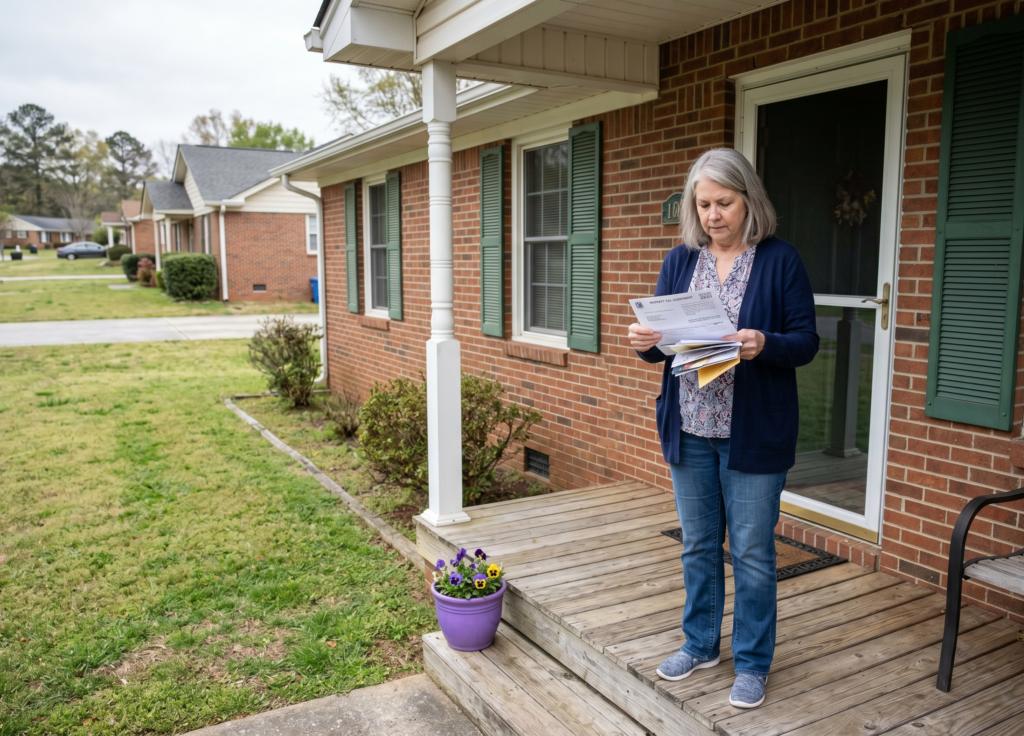
Homeowners across Georgia are reviewing their annual assessment notices as the new statewide floating homestead exemption takes shape.
Other Relief Options: The Tax Deferral Program
Georgia also runs a property tax deferral program for qualified seniors. Homeowners age 62 and older with limited income can apply to postpone payment of their property taxes. The deferred amount accrues interest and is recorded as a lien on the property. The full balance comes due when the home is sold or the estate is settled. Deferral is not forgiveness, so weigh the long-term cost against the short-term relief.
The Property Tax Appeal Process
If you believe your home’s assessed value is higher than its fair market value, you can appeal. Appeals go to your county’s Board of Tax Assessors after you receive your annual assessment notice. To support a lower valuation, you bring evidence such as recent sale prices of comparable homes in your area. Under the new cap, a 2026 appeal carries added weight, because the value you lock in becomes the base that future inflation-capped increases build on. A lower base compounds into larger savings every year you stay in the home.
A Key Limitation of Tax Appeals
It helps to be clear about what an appeal can and cannot do. A successful appeal lowers your assessed value, which is one input in your tax calculation. It does not change the millage rate. Your bill equals the assessed value multiplied by the millage rate set by your county, city, and school board. If those bodies raise the millage rate, your total bill can still rise even after a successful appeal. The cap and an appeal work on the value side of the equation, not the rate side.
Evaluating Professional Tax Relief Services
If appeals and exemptions feel overwhelming, you can bring in professional help. When you evaluate a service, look for transparent fees and qualified professionals such as tax attorneys or property tax consultants. Be cautious with any company that promises a specific outcome. The Federal Trade Commission warns consumers about tax relief firms that make unrealistic guarantees. For broader debt and IRS issues that sometimes accompany property tax trouble, our Priority Tax Relief review walks through how one provider structures its fees and process, and our Tax Relief Advocates review covers another option for comparison.
Frequently Asked Questions
How does the new Georgia property tax law affect homeowners?
The HOME Act caps the annual increase in your homestead’s taxable value at the rate of inflation, which prevents large, sudden jumps in your tax bill when market values rise quickly. It does not lower an existing assessment or cap the millage rate.
What is the Georgia statewide floating homestead exemption?
It is a property tax cap that limits annual growth in your home’s taxable value to an inflation-based figure. Unlike a fixed-dollar exemption, it floats with your home’s base-year value, giving continuous protection against assessment spikes for as long as you own the home.
Who qualifies for property tax relief in Georgia?
All homeowners living in their primary residence qualify for the standard homestead exemption. Additional relief is available for seniors (age 62 or 65 and older) and for disabled veterans who meet the income or disability criteria set by the Georgia Department of Revenue.
How do I apply for a homestead exemption in Georgia?
File an application with your county tax commissioner’s office. You typically provide proof of ownership and residency, such as a driver’s license and a utility bill. It is a one-time application as long as you keep owning and occupying the home.
What is the deadline to apply for property tax exemptions in Georgia?
The general deadline is April 1 of the tax year for which you are seeking the exemption. Confirm the exact date with your local county tax office.
Can my property taxes increase if I appeal the assessment in Georgia?
Yes. A successful appeal lowers your assessed value, but your final bill also depends on the millage rate. If your local government or school district raises that rate, your total bill can still go up.
 1099 Tax Problems
 Alleviate Tax
 Five Star Tax Resolution
 Priority Tax Relief
 Tax Relief Advocates