

⚡ Key Takeaways
- A gold IRA is a self-directed retirement account that holds IRS-approved physical precious metals instead of paper assets.
- IRS rules require 99.5% fineness for most gold, third-party depository storage, and 2026 contribution limits of $7,500 (under 50) or $8,600 (50 and older).
- Taking physical possession of IRA metals early triggers taxes and penalties, and home storage can disqualify the entire account.
- Fees run higher than standard IRAs, so a gold IRA is best viewed as a modest diversifier, not a core holding.
When a trader known for calling bitcoin’s 2017 top says he is thinking about selling some BTC for gold, retirement investors take notice. Peter Brandt’s comment on X, on July 5, 2026, does not mean every portfolio should follow suit, but it raises a fair question. If you want physical gold exposure inside a retirement account, how do you actually do it? A gold IRA gives you a tax-advantaged way to own bars and coins that meet IRS standards. Before you move money, you need to understand the rules, fees, and trade-offs.
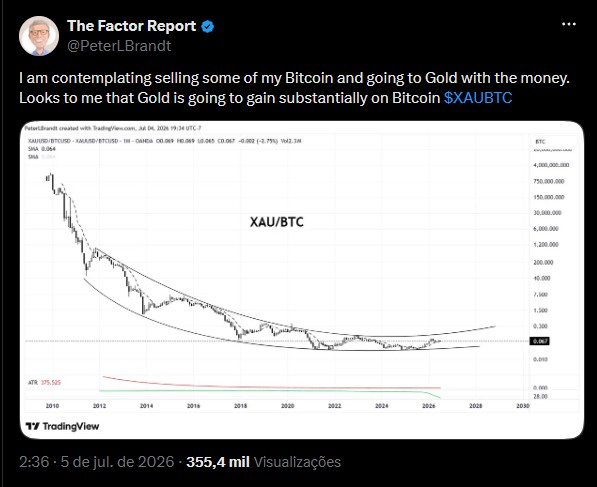
Veteran trader Peter Brandt told followers he is contemplating moving some Bitcoin into gold, a comment that put physical gold and gold IRAs back in the retirement conversation. Source: @PeterLBrandt on X.
What is a gold IRA?
A gold IRA is a self-directed individual retirement account that holds IRS-approved physical precious metals, including gold, silver, platinum, and palladium, instead of stocks and bonds. To open one, you work with a specialized custodian, meaning an IRS-approved financial institution that administers the account. The custodian handles purchases, sales, and reporting, while the metals sit in a depository you never physically touch during the accumulation phase.
IRS purity requirements for gold in an IRA
Not all gold qualifies. The IRS requires a minimum fineness, meaning purity, of 99.5% for gold bars and rounds, with one notable exception. The American Gold Eagle coin is 91.67% pure yet remains IRA-eligible because Congress granted it a specific statutory exemption under Internal Revenue Code Section 408(m). Collectible or numismatic pieces that fall below the threshold cannot be held. The IRS treats disallowed metals as a prohibited investment in collectibles, so confirm the purity standard with your custodian before funding any purchase.
Contribution limits for 2026
Gold IRAs follow the same annual limits as traditional and Roth IRAs. For 2026, the IRS set the cap at $7,500 for individuals under age 50, with an additional $1,100 catch-up contribution for those 50 and older, for a total of $8,600. These limits apply across all IRAs you own combined, so you cannot fund a gold IRA on top of a separate Roth IRA up to the same ceiling twice. Rollovers from existing retirement accounts are not subject to the annual cap.
Gold IRA storage: you cannot keep it at home
One of the most misunderstood rules is that metals in a gold IRA must be held at an IRS-approved depository, never in a personal safe or home vault. Taking physical possession before a proper distribution is a taxable event, and if you are under age 59 and a half, a 10% early distribution penalty applies on top of ordinary income tax. The IRS treats home storage as a prohibited transaction that can disqualify the entire IRA, which triggers immediate taxation of the full balance and potential penalties.
Gold IRA vs. physical gold you hold yourself
Owning gold outright gives you immediate access and control, but you lose the tax shelter. A gold IRA defers taxes on gains while the metal sits inside a traditional account, or allows tax-free growth in a Roth structure. The trade-off is liquidity and cost. You accept mandated third-party storage and administration in exchange for the tax treatment. Many investors use a gold IRA for a slice of their retirement portfolio and keep a smaller amount of physical metal outside for emergencies or legacy purposes.
Gold IRA fees: what to expect
Gold IRAs carry costs that standard IRAs do not. Expect a one-time setup fee, an annual custodial or administrative fee, a storage fee paid to the depository, and a markup on the metal itself. These fees vary by provider and can eat into returns. Ask for a fee schedule in writing before opening an account, and compare at least three providers over a five- or ten-year horizon. Established names such as Augusta Precious Metals publish their pricing structure, which makes side-by-side comparison easier.
How to roll over a 401(k) to a gold IRA
Moving money from a former employer’s 401(k) or a traditional IRA into a gold IRA is done through a direct rollover. The existing plan administrator sends funds straight to your new gold IRA custodian, which keeps the process tax-free. An indirect rollover, where you receive the cash and redeposit it within 60 days, is riskier, because missing the deadline triggers income tax and, if you are under 59 and a half, a penalty. A custodian that specializes in precious metals can coordinate the transfer and help you avoid prohibited-transaction pitfalls. Our Goldco review walks through how one provider handles the rollover paperwork.

As gold outpaces crypto, physical bullion draws fresh attention from retirement savers weighing a gold IRA.
Required minimum distributions and early withdrawals
Traditional gold IRAs are subject to required minimum distributions, or RMDs, starting at age 73 under current law. Because the IRS does not let you satisfy an RMD by handing over a gold bar, the custodian either liquidates part of your holdings or you take an in-kind distribution of metal, which is valued at fair market price and taxed as ordinary income. Early withdrawals before age 59 and a half still incur the 10% penalty unless an exception applies.
Limitations of a gold IRA
A gold IRA does not generate dividends or interest. Its return comes solely from price appreciation, which over some multi-year stretches has lagged inflation. Compared with a low-cost S&P 500 index fund inside a standard IRA, a gold IRA’s fee stack is heavier. The custody and storage chain also introduces operational risk if a depository fails, though reputable providers carry insurance. These accounts work best as a portfolio diversifier, not a replacement for broad market exposure.
How to decide if a gold IRA fits you
Peter Brandt’s remark is a reminder that gold can play a hedging role, but a gold IRA is only one way to hold it. This account fits you if you want tax-advantaged, physical precious-metals exposure for a modest share of a diversified retirement plan, and you accept higher fees and no income for that exposure. It does not fit you if you need liquidity, want dividend-producing assets, or would be tempted to overweight a single asset class. If you decide to move forward, get a written fee schedule, compare gold IRA companies on cost and storage, and confirm every metal meets IRS purity rules before you fund the account.
Frequently asked questions
What are the fees associated with a gold IRA?
Expect a setup fee, an annual administrative fee, and a storage fee charged by the depository. Providers also build a margin into the metal price. Request a detailed fee breakdown in writing before opening an account so you can compare total cost across providers.
How do I roll over a 401(k) to a gold IRA?
Contact a gold IRA custodian to initiate a direct rollover. The custodian coordinates with your 401(k) plan administrator to transfer funds without triggering a taxable event. Avoid receiving the money yourself, because missing the 60-day redeposit window can cause taxes and penalties.
Can I store gold from my IRA at home?
No. IRS rules require all IRA-owned precious metals to be held in an approved depository. Home storage is treated as a prohibited transaction that can disqualify the IRA and trigger immediate taxation of the full balance.
What kind of gold can I hold in a gold IRA?
Gold bars and coins must meet a minimum fineness of 99.5%, with the exception of the American Gold Eagle coin at 91.67%. Common IRS-approved items include Canadian Maple Leafs, American Gold Buffaloes, and certain bars from approved refiners.
What are the contribution limits for a gold IRA in 2026?
For 2026, the annual IRA contribution limit is $7,500 if you are under 50 and $8,600 if you are 50 or older, which includes a $1,100 catch-up amount. Rollovers from existing retirement accounts do not count toward these caps.
When do required minimum distributions start for a gold IRA?
Traditional gold IRAs require minimum distributions starting at age 73 under current law. Because you cannot satisfy an RMD with a physical bar, the custodian liquidates part of the holdings or you take an in-kind distribution valued at fair market price and taxed as ordinary income. Roth IRAs are not subject to RMDs during the owner’s lifetime.
Can I hold silver, platinum, or palladium in the same account?
Yes. A gold IRA can hold IRS-approved silver, platinum, and palladium alongside gold, each with its own fineness standard. Silver must be 99.9% pure, and platinum and palladium must be 99.95% pure. Your custodian can confirm which specific products qualify.
Is a gold IRA a good idea?
It can be, in moderation. A gold IRA suits investors who want a small, tax-advantaged hedge inside a diversified plan and accept higher fees and no yield. It is a poor fit as a core holding, because gold produces no income and its fee stack is heavier than a standard index-fund IRA.
 Augusta Precious Metals
 Goldco
 Priority Gold
 US Gold Bureau