The Quick Answer
Sony’s three over-the-counter (OTC) hearing aids, the CRE-E10, CRE-C10, and CRE-C20, have been discontinued after WS Audiology and Sony agreed not to renew their 2022 partnership, according to a confirmation reported by HearingTracker in April 2026. WS Audiology is honoring existing warranty and service obligations. The strongest replacements depend on what you valued in your Sony device: Elehear and Audien for budget rechargeables, Vivtone for invisible CIC fits like the CRE-C10/C20, Soundbright and LINNER for premium self-fitting OTCs, and CEARVOL or Ceretone for everyday speech support.
Sony’s exit closes one of the highest-profile partnerships of the early OTC era. The 2022 deal paired Sony’s consumer-electronics brand with WS Audiology, one of the world’s largest hearing aid manufacturers, and produced three devices that HearingTracker confirmed were testing well at lab level, including a HearAdvisor first-place ranking for the CRE-E10. Despite that performance, the partnership ended.
For shoppers who were comparing Sony or already had it in their cart, the question now is what to buy instead. The seven OTC brands below cover the same price bands, form factors, and use cases that Sony served, with the trade-offs spelled out so you can decide based on what you actually need.
Why Sony hearing aids were discontinued
WS Audiology confirmed to HearingTracker in April 2026 that it and Sony had mutually agreed not to renew their 2022 agreement. All three Sony OTC models, the CRE-C10, CRE-C20, and CRE-E10, had already been listed as “Item no longer available” on Sony’s U.S. website for several months before the confirmation. The OTC category itself was created by the FDA on October 17, 2022, the same year the Sony-WSA deal was announced.
HearingTracker’s reporting noted that price was a factor. The flagship CRE-E10 launched in the $900 to $1,099 range, while a recent industry survey put the average OTC pair at around $502. Apple now sells an FDA-authorized self-fitting hearing aid feature on AirPods Pro 2 for $249, which has pulled the price floor down further. Sony’s devices performed well in tests but sat at the upper end of the OTC spectrum during a period when buyers were moving toward lower-priced options.
If you already own a Sony unit, the manufacturer of those devices, WS Audiology, will honor warranty and service. You can find the full Sony breakdown in our Sony hearing aids review.
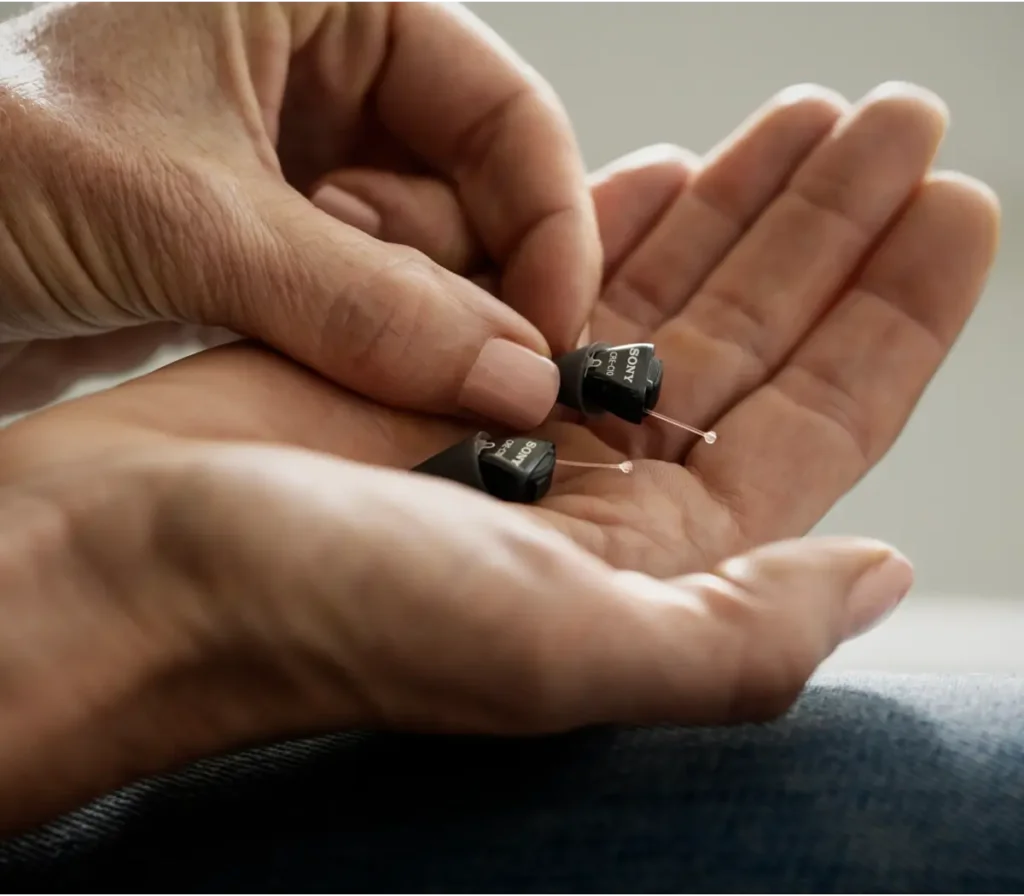
A pair of Sony CRE-C10 OTC hearing aids in the user’s hands. With Sony’s exit from the category, shoppers are comparing replacements across every price tier.
What to replace each Sony model with
Sony’s three discontinued models served different use cases. Matching the replacement to the model you wanted is the fastest way to narrow the field.
| Sony Model (Discontinued) | Style & Key Features | Closest OTC Alternatives |
|---|---|---|
| Sony CRE-E10 | Earbud style, rechargeable, iPhone Bluetooth streaming, self-fitting (~$900–$1,099) | Soundbright Pro, LINNER Nova, Elehear Beyond |
| Sony CRE-C10 | Completely-in-canal (CIC), disposable size 10 batteries, app-controlled (~$900–$999) | Vivtone CIC, CEARVOL CIC, Audien Atom Pro |
| Sony CRE-C20 | Completely-in-canal, rechargeable (~28 hours), app-controlled (~$1,000) | Vivtone (rechargeable CIC), Ceretone Core One, Elehear Alpha |
*Sony reference pricing reported by HearingTracker and Soundly prior to discontinuation. Alternative pricing varies by brand and promotion.
Seven OTC alternatives to Sony, reviewed and ranked
Each of the seven brands below sells FDA-registered OTC hearing aids for adults 18 and older with perceived mild to moderate hearing loss, the same category Sony served. The picks are ordered by how cleanly they replace a specific Sony use case, not by overall ranking.
1. Elehear : Best replacement for the Sony CRE-E10 streaming experience
Elehear is the closest match for a buyer who was drawn to the CRE-E10’s combination of rechargeability, app-based fitting, and Bluetooth audio. Where Sony’s CRE-E10 streamed only on iPhone, Elehear models support both iOS and Android. Pricing typically sits well below the CRE-E10’s $900 to $1,099 range. See the full breakdown in our Elehear review.
Best for: Sony shoppers who valued the streaming and rechargeable battery on the CRE-E10 but wanted a lower price and Android compatibility.
2. Soundbright : Closest premium self-fitting alternative
Soundbright is backed by hear.com’s engineering and audiology standards, which puts it in the same “trusted manufacturer behind the brand” tier that Sony occupied through WS Audiology. The lineup runs roughly $299 to $799 per pair, which substantially undercuts the CRE-E10. Our Soundbright hearing aids review covers the model range, refund window, and user feedback.
Best for: Buyers who liked the idea of a major audiology company standing behind the device, not just the consumer-electronics brand on the box.
3. LINNER : Best for premium rechargeable performance
LINNER’s OTC lineup leans into rechargeable devices with directional microphones and app-based adjustment, similar to the feature set Sony built into the CRE-E10 and CRE-C20. Our LINNER review walks through the current models, battery life claims, and customer-service experience.
Best for: Sony shoppers comparing the CRE-E10 against premium OTC options at a moderate price tier.
4. Vivtone : Best for CIC and in-ear styles like the CRE-C10/C20
Vivtone offers OTC models across BTE, RIC, CIC, and ITE styles, with prices generally between $200 and $500 per pair according to BestGuide’s hearing aids buyer’s guide. The CIC and ITE form factors are the cleanest direct replacement for buyers who wanted the discreet, in-canal profile of the Sony CRE-C10 or CRE-C20. Read more in our Vivtone review.
Best for: Shoppers prioritizing invisibility and a low entry price for an OTC CIC.
5. CEARVOL : Best for low-cost everyday speech support
CEARVOL sits in the budget OTC tier with rechargeable BTE and CIC options aimed at users who want straightforward speech amplification without an app-heavy experience. The price point is well below the Sony lineup, and the setup is simpler. Our CEARVOL review covers the available styles and what users report after the first month of wear.
Best for: Buyers with mild hearing loss for whom Sony’s price tier was a barrier and who want a simpler device.
6. Audien : Best for budget rechargeables under $300
Audien is one of the most aggressively priced rechargeable OTC brands on the market, with most models sitting under $300 per pair. It is not a feature-for-feature CRE-E10 replacement, and there is no premium audio streaming, but for buyers who balked at Sony’s price, it is the clearest entry point. See the full review in our Audien Hearing review.
Best for: First-time OTC buyers and shoppers who care more about cost and rechargeability than streaming or app fitting.
7. Ceretone : Best for app-controlled budget options
Ceretone’s lineup, anchored by the Torch and Core One series, offers app control and rechargeable batteries at entry-level prices. As covered in our Ceretone hearing aids review, buyers should weigh the lower price against the brand’s limited public documentation on FDA OTC registration.
Best for: Shoppers who want app-based control at the lower end of the OTC price range and are comfortable doing their own due diligence on regulatory documentation.
How the OTC category changes the math for Sony shoppers
The FDA established the OTC hearing aid category on October 17, 2022, opening direct-to-consumer sales to adults 18 and older with perceived mild to moderate hearing loss. Before the rule, the FDA’s consumer guidance on OTC hearing aids notes that hearing aid access required medical exams, prescriptions, or fittings from a licensed professional.
That regulatory shift is the context for Sony’s exit. The category now includes everything from $200 BTE devices to $1,000-plus self-fitting earbuds. Brands that competed near Sony’s price point have had to demonstrate value beyond brand recognition, and brands that came in below have had to demonstrate basic safety and sound quality. The seven alternatives above span that full range.
One caveat that applies to every OTC device, Sony’s included: the FDA limits the category to perceived mild to moderate hearing loss. If you suspect more severe loss, a licensed hearing professional, an audiologist or ENT, is the right starting point, not an OTC purchase.
Compare Options
See How These Brands Rank Side by Side
Our full hearing aids buyer’s guide breaks down pricing, technology, and support for the OTC brands competing for Sony’s customers.
Pricing by style: where each Sony alternative lands
Sony’s CIC models sat at $900 to $1,000 and the CRE-E10 earbud at $900 to $1,099. The seven alternatives split into three rough tiers below.
| Tier | Approximate Price Range (per pair) | Brands in This Tier |
|---|---|---|
| Premium OTC | $700 and up | Soundbright Pro, LINNER (top models) |
| Mid-tier OTC | $300–$700 | Elehear, Soundbright (entry), Vivtone (top models), LINNER (entry) |
| Budget OTC | Under $300 | Audien, CEARVOL, Ceretone, Vivtone (entry) |
*Price ranges reflect typical pair pricing reported on each brand’s site and BestGuide reviews; promotional pricing changes frequently.
The tier you land in usually depends on three factors: whether you need Bluetooth audio streaming, whether you need rechargeable batteries, and whether you want a brand backed by a major audiology manufacturer (Soundbright via hear.com sits closest to where Sony sat through WS Audiology).
Which Sony alternative fits which buyer
If you wanted the CRE-E10 for iPhone streaming and self-fitting, look at Soundbright Pro or LINNER’s top models first, then Elehear if budget is the deciding factor. If you wanted the CRE-C10 or CRE-C20 specifically for the invisible CIC fit, the cleanest replacements are Vivtone’s CIC and Ceretone Core One, with Audien Atom Pro as the most aggressive budget option. If you weren’t sold on Sony’s $900-plus price tag in the first place, Audien, CEARVOL, and Ceretone all sit under $300 and cover the basics of OTC amplification for adults with mild to moderate hearing loss.
Frequently asked questions
Why were Sony hearing aids discontinued?
WS Audiology, the manufacturer of Sony’s OTC hearing aids, confirmed to HearingTracker in April 2026 that it and Sony had mutually agreed not to renew their 2022 agreement. All three Sony OTC models had already been marked “Item no longer available” on Sony’s U.S. website for several months.
Will my Sony hearing aid warranty still be honored?
Yes. WS Audiology told HearingTracker that warranty and service obligations will be honored for purchasers. If you already own a Sony CRE-C10, CRE-C20, or CRE-E10, your warranty stays with WSA, not with Sony.
What is the closest OTC alternative to the Sony CRE-E10?
For the CRE-E10’s combination of rechargeability, app-based fitting, and Bluetooth audio, the closest matches are Soundbright Pro, LINNER’s top rechargeable models, and Elehear for buyers who want streaming on both iOS and Android at a lower price.
What replaces the Sony CRE-C10 and CRE-C20 invisible in-canal fit?
Vivtone offers OTC models in the CIC and ITE styles at $200 to $500 per pair, and Ceretone Core One offers a similarly discreet fit at the budget end. Both are the most direct replacements for buyers who wanted Sony’s near-invisible profile.
Are OTC hearing aids regulated by the FDA?
Yes. The FDA established the OTC hearing aid category on October 17, 2022, for adults 18 and older with perceived mild to moderate hearing loss. OTC devices must meet specific output limits, labeling requirements, and design rules to be sold without a prescription.
Can I still find Sony hearing aids for sale anywhere?
HearingTracker reported that some Sony models may remain available for a limited time through WS Audiology’s outlets and select third-party retailers. They are no longer listed on Sony’s own U.S. website.
What hearing loss range do OTC hearing aids cover?
The FDA limits OTC hearing aids to perceived mild to moderate hearing loss in adults 18 and older. Severe or profound hearing loss requires prescription hearing aids fitted by a licensed hearing healthcare professional.
How much should I expect to pay for a Sony replacement?
Recent industry data put the average OTC hearing aid pair at around $502. Sony’s models sat between $900 and $1,099. Budget rechargeables from Audien, CEARVOL, and Ceretone start under $300, while premium options from Soundbright and LINNER can reach $700 to $900-plus per pair.
Are rechargeable OTC hearing aids worth it compared to disposable batteries?
For most daily users, rechargeable models eliminate the recurring cost of size 10 or size 312 batteries and tend to be easier to handle for adults with dexterity concerns. Sony itself offered both formats: the CRE-C10 used disposable batteries and the CRE-C20 was rechargeable.
Do I need a hearing test before buying an OTC hearing aid?
The FDA does not require a hearing test to purchase an OTC device, but it does require buyers to assess that they have perceived mild to moderate hearing loss. A baseline test from an audiologist is still a sensible first step, especially if you have not had your hearing checked in several years.