The Quick Answer
The best rechargeable over-the-counter (OTC) hearing aid for daily use is the one that fits your hearing loss range, your tolerance for app-based fitting, and your daily wear pattern. For most adults with perceived mild to moderate hearing loss, that decision lands on one of five tested options: Elehear for premium features at a mid-tier price, Soundbright for self-fitting backed by hear.com, LINNER for app-based personalization, Vivtone for invisible CIC fit, and Audien for the lowest entry price among rechargeables. Pick the price tier first, then narrow by form factor and feature set.
Rechargeable OTC hearing aids have become the default for daily wearers. The recurring cost of size 10 or size 312 disposable batteries, combined with the dexterity required to swap them, pushed the category toward Li-ion charging cases as soon as the FDA opened the OTC market in October 2022. With Sony’s exit from the category in April 2026 removing one of the highest-profile rechargeable lineups, shoppers now have to pick between a different set of brands than they did a year ago.
This guide compares the rechargeable OTC options most likely to land on your shortlist, organized by price tier and the daily-use trade-offs that actually decide which device you reach for in the morning.
What “rechargeable” actually means in an OTC hearing aid
A rechargeable OTC hearing aid uses a built-in lithium-ion battery and ships with a charging case or dock. A full overnight charge typically yields 14 to 28 hours of use, depending on whether Bluetooth streaming is active. The charging case usually carries enough reserve power for two to four additional full charges, which means most users can go a weekend away from a wall outlet without losing function.
The trade-offs vs. disposable batteries are clear. Rechargeable models eliminate the ongoing cost of replacement cells (roughly $50 to $120 a year for a daily wearer) and the fine-motor demand of swapping size 10 batteries, which can be challenging for older adults. The downsides are higher upfront cost, a battery that eventually loses capacity (most lithium-ion cells start to decline after two to three years), and a hard stop when the charging case is lost or fails.
Who rechargeable OTC hearing aids are for
The FDA established the OTC hearing aid category for adults 18 and older with perceived mild to moderate hearing loss. According to the agency’s consumer guidance on OTC hearing aids, the category does not cover severe or profound hearing loss, hearing loss in children under 18, or hearing loss caused by a medical issue that needs professional evaluation. If you have not had a hearing test in several years, a baseline audiogram from an audiologist is still the right first step, even though the FDA does not require one to purchase an OTC device.
Rechargeable specifically (rather than disposable-battery OTC) suits daily wearers, anyone who streams audio from a smartphone for more than a couple of hours a day, and users who prefer a single overnight charging routine to weekly battery swaps. If you wear hearing aids only a few hours a week for specific situations, disposable-battery models are often cheaper to own.
Five rechargeable OTC hearing aids worth a serious look
The brands below all sell FDA-registered OTC hearing aids with rechargeable battery systems. They are ranked by which buyer profile each one fits best, not by overall score.
1. Elehear : Best for premium features at a mid-tier price
Elehear’s lineup combines AI-driven noise cancellation, Bluetooth streaming on both iOS and Android, and rechargeable cases with backup power for multiple days. The brand has been one of the most aggressive new entrants in the OTC category, undercutting premium options like the discontinued Sony CRE-E10 on price. Full breakdown in our Elehear review.
Best for: Daily wearers who want streaming and noise cancellation without paying $900-plus.
2. Soundbright : Best self-fitting rechargeable backed by a major audiology brand
Soundbright is backed by hear.com, one of the largest hearing aid distributors in the U.S., which gives it a service-and-support backbone that most direct-to-consumer OTC brands do not have. The rechargeable models sit in the $299 to $799 range and include a self-fitting flow through the companion app. See our Soundbright hearing aids review for the model breakdown.
Best for: Buyers who want manufacturer credibility comparable to what Sony offered through WS Audiology.
3. LINNER : Best for app-based personalization
LINNER’s rechargeable lineup leans into in-app hearing tests, directional microphone control, and preset programs for different listening environments. The setup process is closer to what an audiologist would do in person than what most budget OTC brands offer. Our LINNER review covers the current models and the customer-support experience.
Best for: Users who want a structured fitting flow and are comfortable with app-based control.
4. Vivtone : Best for invisible rechargeable in-canal fit
Vivtone offers OTC models across BTE, RIC, CIC, and ITE styles, with rechargeable options in both the receiver-in-canal and completely-in-canal form factors. Pair pricing generally runs between $200 and $500, which makes the CIC rechargeables the most affordable invisible-fit option on the market. See the full review in our Vivtone review.
Best for: Shoppers who want a discreet rechargeable that is barely visible in the ear.
5. Audien : Best entry-price rechargeable under $300
Audien is one of the most aggressively priced rechargeable OTC brands on the market, with most models sitting under $300 per pair. The trade-off is a stripped-down feature set: no app-based fitting, no streaming, and basic preset programs only. For first-time OTC buyers who want to test the category at a low risk, the entry price is the strongest argument. Our Audien Hearing review walks through the model lineup and what users report after the first month.
Best for: First-time OTC buyers and shoppers prioritizing price over features.
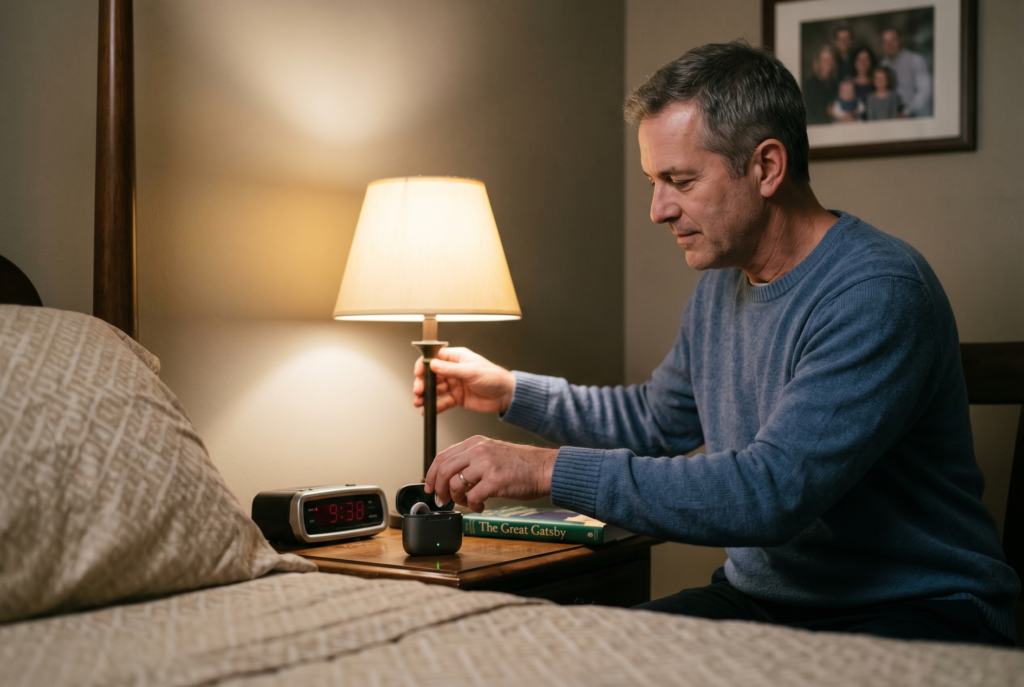
Placing rechargeable OTC hearing aids into the charging case is the end-of-day routine that replaces weekly battery swaps for daily wearers.
Rechargeable OTC hearing aids compared
The table below compares the five rechargeable OTC brands on the dimensions that decide daily use: price tier, form factors offered, streaming support, and app-based fitting.
| Brand | Typical Price (per pair) | Form Factors | Streaming & App |
|---|---|---|---|
| Elehear | $300–$700 | RIC / BTE | iOS + Android streaming, app fitting |
| Soundbright | $299–$799 | RIC / BTE | Streaming on supported models, self-fitting app |
| LINNER | $200–$700 | BTE / RIC / earbud styles | Streaming on supported models, app-based adjustment |
| Vivtone | $200–$500 | BTE / RIC / CIC / ITE | Bluetooth on select models, basic app |
| Audien | Under $300 | CIC / ITE | No streaming, preset programs only |
*Price ranges reflect typical per-pair pricing reported on each brand’s site and in BestGuide reviews. Promotional pricing changes frequently.
How to evaluate a rechargeable OTC hearing aid before you buy
Four criteria do most of the work when narrowing the field. Apply them in order: hearing loss range first, then form factor, then features, then price.
- Hearing loss range. Confirm your loss is perceived mild to moderate before purchasing an OTC device. If you suspect more severe loss, the FDA recommends consulting an ENT or audiologist, since OTC may not provide adequate benefit.
- Form factor. Behind-the-ear (BTE) and receiver-in-canal (RIC) models offer more battery life and better sound quality but are more visible. Completely-in-canal (CIC) and in-the-ear (ITE) models are nearly invisible but typically have shorter battery life and less power.
- Features that matter to you. Bluetooth streaming, app-based fitting, and noise cancellation are the three features that meaningfully change daily use. Buying a device with features you will not use is the most common mistake first-time OTC shoppers make.
- Price tier. Budget rechargeables under $300 cover basic amplification. Mid-tier devices at $300 to $700 add streaming, app fitting, and noise reduction. Premium options above $700 add HearAdvisor-tested sound quality and self-fitting algorithms closer to what a clinic visit would produce.
Trial periods are the safety net. Most OTC brands offer 30 to 45 days to return the device for a refund. Use that window to test the device in the situations where you actually have trouble hearing, like a busy restaurant or a phone call in a quiet room, not just sitting at home.
Compare Options
See Every Rechargeable OTC Brand in One Place
Our hearing aids buyer’s guide ranks the leading OTC brands on pricing, technology, customer support, and real-world outcomes.
Rechargeable vs. disposable-battery OTC hearing aids
The choice between rechargeable and disposable-battery OTC hearing aids comes down to daily wear time, dexterity, and ongoing cost tolerance.
| Factor | Rechargeable | Disposable Battery |
|---|---|---|
| Upfront cost | Higher | Lower |
| Ongoing cost | Lower (no battery purchases for 2–3 years) | $50–$120 per year for size 10 or 312 cells |
| Daily routine | Overnight charge in case | Manual battery swap every 3–7 days |
| Dexterity required | Low | High (small batteries, sealed compartment) |
| Travel readiness | Charging case provides 2–4 extra charges | Pack spare batteries |
| Lifespan | Battery degrades after 2–3 years; device replacement often needed | Device lifespan independent of battery; replace cells as needed |
Which rechargeable OTC hearing aid fits which buyer
If you wear hearing aids most of the day and want streaming, look at Elehear and Soundbright first, with LINNER as a close third if app-based personalization matters more to you than brand pedigree. If you want a discreet in-canal fit and a moderate price, Vivtone’s rechargeable CIC is the strongest match. If you are a first-time OTC buyer testing the category and want the lowest possible upfront risk, Audien’s sub-$300 rechargeables are the right starting point, with the understanding that you trade away streaming and app control to get there. For all five, the trial period is the real test. Buy from a retailer with a clean return policy, wear the device in your actual daily situations, and decide based on whether you reach for them in the morning, not on the spec sheet.
Frequently asked questions
How long do rechargeable OTC hearing aids last on a single charge?
Most rechargeable OTC hearing aids run 14 to 24 hours on a full charge with normal use. Heavy Bluetooth streaming can cut that figure by 30 to 40 percent. The charging case typically provides two to four additional full charges before it needs to be plugged in.
Are rechargeable hearing aids worth the higher upfront cost?
For daily wearers, usually yes. The recurring cost of disposable size 10 or 312 batteries runs roughly $50 to $120 per year for a daily user, and the dexterity demand of swapping cells can be challenging. For occasional wearers, disposable-battery models often work out cheaper.
What is the difference between OTC and prescription hearing aids?
OTC hearing aids are sold without a prescription to adults 18 and older with perceived mild to moderate hearing loss. Prescription hearing aids are fitted by a licensed audiologist or hearing instrument specialist, can be programmed for any level of loss, and are typically more expensive. The FDA established the OTC category on October 17, 2022.
Can I use OTC hearing aids if I have severe hearing loss?
No. The FDA limits OTC hearing aids to perceived mild to moderate hearing loss. If you have severe or profound loss, an audiologist or ENT can fit a prescription device that provides the gain and customization the OTC category is not allowed to offer.
How long does the rechargeable battery itself last before it needs replacement?
Lithium-ion batteries in OTC hearing aids typically start losing capacity after two to three years of daily charging. Some models allow battery replacement at the manufacturer; for many budget devices, declining battery life is effectively the device’s end-of-life signal.
Do all rechargeable OTC hearing aids support Bluetooth streaming?
No. Streaming support varies by brand and model. Elehear, Soundbright, and LINNER include streaming on most current models. Audien does not. Vivtone supports Bluetooth on select models. Check the specific model spec sheet before buying.
What is the trial period for OTC hearing aids?
Most OTC brands offer a 30 to 45-day trial period with a refund if the device is returned in original condition. The discontinued Sony OTC line, for reference, offered a 45-day trial through authorized retailers. Trial windows are set by the brand and the retailer, so verify before purchase.
Do I need a hearing test before buying a rechargeable OTC hearing aid?
The FDA does not require a hearing test to purchase an OTC device, but it does require you to perceive mild to moderate hearing loss. A baseline audiogram from an audiologist is still a sensible first step, especially if you have not had your hearing checked in several years.
What happens if my rechargeable hearing aid stops holding a charge?
Within the manufacturer warranty period (typically one year), most brands will repair or replace the device. Outside the warranty, the practical option is usually to replace the device, since lithium-ion battery service is not standard for budget OTC models. Higher-priced brands sometimes offer battery service for an additional fee.
Are rechargeable OTC hearing aids waterproof?
Most OTC hearing aids carry an IP54 to IP68 rating, meaning they are resistant to sweat and light moisture but not designed for swimming or showering. Always check the specific model’s IP rating, since the difference between IP54 and IP68 is meaningful for daily wear in humid climates or for users who exercise.