

⚡ Key Takeaways
- The choice starts with one decision: an over-the-counter (OTC) device you set up yourself, or a prescription device fitted by a licensed professional.
- For support without a clinic visit, Jabra Enhance pairs OTC pricing with remote audiologist care. For an in-home fitting, Yes Hearing sends a licensed specialist to your house.
- Rechargeable batteries, simple controls, and a clear return window matter more for older adults than for any other group, because dexterity, vision, and a low-risk trial are daily factors.
- OTC hearing aids are for perceived mild to moderate hearing loss only. Sudden, severe, or single-ear loss should be evaluated by a physician first.
The best hearing aids for seniors are the ones an older adult will actually wear every day, so the decision is rarely about raw sound quality alone. It comes down to four things: how the device is fitted, how easy it is to handle, what support stands behind it, and how much it costs. The U.S. Food and Drug Administration’s 2022 over-the-counter hearing aid rule let adults buy devices without a prescription, which changed the math for millions of seniors with mild to moderate hearing loss.
This guide covers how to choose, then names the providers that fit the most common senior scenarios, drawn from the brands reviewed on BestGuide. Every pick is tied to a specific criterion, so you can match it to the person rather than the marketing.
OTC or Prescription: The First Decision for Seniors
Before comparing brands, decide which category fits. The answer changes which providers are worth looking at.
OTC hearing aids are sold directly to consumers for perceived mild to moderate hearing loss. They cost far less than the prescription route, ship to your door, and are set up at home through an app or controls on the charging case. According to the National Institute on Deafness and Other Communication Disorders (NIDCD), the federal hearing-health research institute, about one in three adults aged 65 to 74 has hearing loss, rising to nearly half of adults over 75. Most of that loss is age-related and falls in the mild-to-moderate range OTC devices are built for.
Prescription hearing aids are fitted and programmed by an audiologist or licensed specialist. They cover the full range of hearing loss up to severe, and include in-person testing, custom programming, and ongoing follow-up. The trade-off is cost and a clinic visit, though some providers now bring the fitting to your home.
If hearing loss came on suddenly, affects only one ear, or comes with pain, drainage, or dizziness, do not start with an OTC device. The American Speech-Language-Hearing Association (ASHA), the national body for audiologists, treats those as red flags warranting a medical evaluation first.
What Actually Matters When Choosing for an Older Adult
The features that separate a good senior hearing aid from a frustrating one are not the headline specs. Five factors carry most of the daily experience.
- Rechargeable batteries. Handling a battery the size of a shirt button is hard with reduced dexterity or eyesight. A charging case removes that task, which is why most senior-focused models are rechargeable.
- Simple controls. A single button or a charging-case screen is easier than a multi-gesture app for many older adults. App control is a plus only if the person is comfortable with a smartphone.
- Support and fitting. Remote audiologist help, lifetime support, and in-home fittings reduce the chance a device ends up in a drawer. This is the most underrated factor for seniors.
- A real trial window. A 45 to 100 day money-back trial lets an older adult test the device at home before committing. Confirm the return terms in writing at checkout.
- Fit and visibility. Completely-in-canal (CIC) styles appeal to seniors who feel self-conscious, while behind-the-ear (BTE) styles are easier to insert and remove.
Best Hearing Aids for Seniors, Matched to the Need
Each pick below links to its full BestGuide review for pricing, support terms, and the return window.
For seniors who want professional support without leaving home, Jabra Enhance is the strongest all-around OTC option. It pairs remote audiologist care with strong Bluetooth streaming for phone calls and television and app-based adjustments, which suits tech-comfortable older adults who still want a professional in their corner. Our Jabra Enhance review breaks down the model tiers and remote-care program.
For an in-person fitting without a clinic trip, Yes Hearing sends a licensed specialist to the home for the fitting and follow-up, using prescription-grade devices. It suits seniors who want professional care but find travel difficult, as our Yes Hearing review explains.
For a fully online experience, Audicus offers app-controlled OTC devices programmed remotely, which works for seniors comfortable managing things by phone or with family help. Our Audicus review covers the subscription and pay-upfront options.
For budget-conscious seniors who want rechargeable simplicity, two options stand out. MDHearing sells FDA-registered OTC aids with rechargeable models and a strong phone-support reputation, covered in our MDHearing review. Ceretone runs a five-model OTC lineup from about $199 to $599 with no upper age limit and lifetime support, detailed in our Ceretone review.
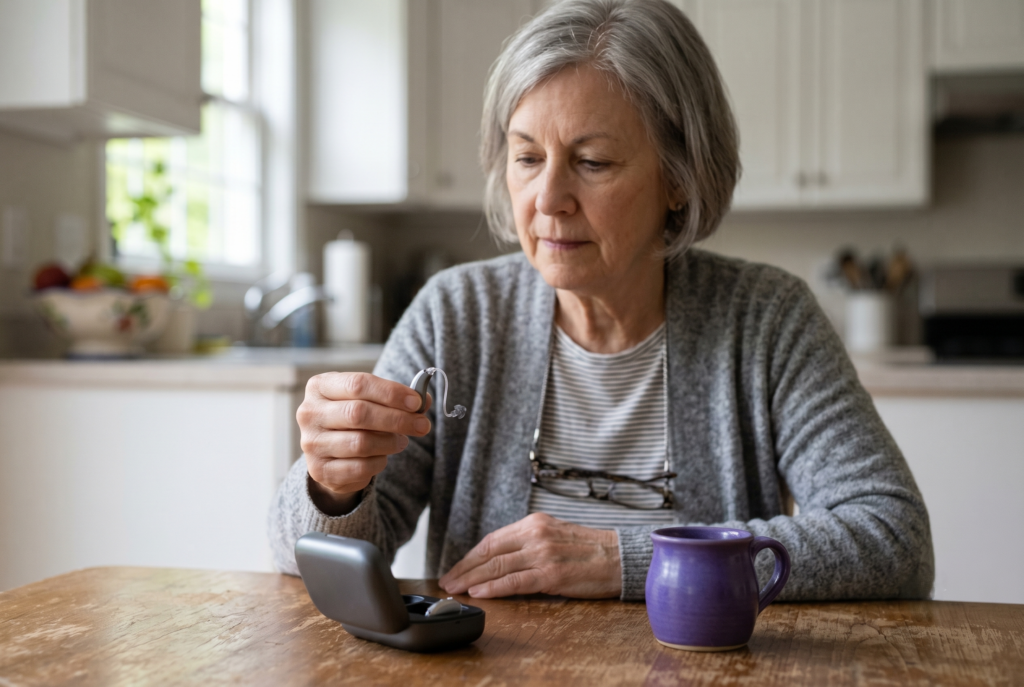
For seniors with mild to moderate hearing loss, a rechargeable hearing aid with a simple charging case removes the hardest part of daily use.
Senior Hearing Aid Options Compared
The table summarizes how the senior-relevant picks differ on the factors that matter most for older adults: category, fitting and support, controls, and the standout reason to choose each. Ratings shown are BestGuide Ratings.
| Provider | Rating | Support & Fitting | Best For (Seniors) |
|---|---|---|---|
| Jabra Enhance | 4.8 | Remote audiologist care | Support plus streaming, no clinic visit |
| Yes Hearing | Prescription | In-home licensed fitting | Hands-on care at home |
| Eargo | N/A | – | – |
| Audicus | 4.6 | Remote programming | All-online convenience |
| Lexie | N/A | – | – |
| MDHearing | OTC | Phone support | Budget, rechargeable simplicity |
| Ceretone | 4.6 | Lifetime support | Lowest entry price, no age limit |
Compare Options
See Which Hearing Aids Fit Your Area and Budget
Compare trusted hearing aid brands side by side and find the best match for your hearing needs and your ZIP code.
What Seniors Can Expect to Pay
OTC hearing aids reviewed on BestGuide start under $100 for basic amplifiers and reach roughly $1,000 to $1,500 per pair for advanced models with streaming and remote support. Prescription devices fitted by a professional commonly run $1,000 to $7,000 per pair, reflecting custom programming and in-person care.
Original Medicare does not cover hearing aids themselves, a gap the official Medicare program states plainly, though it may cover a doctor-ordered diagnostic exam. Some Medicare Advantage plans add a hearing benefit, so check the specific plan, and HSA or FSA funds can usually be applied. Confirm the return terms in writing at checkout so the trial window counts as part of the value.
How to Make the Final Call
Start with the fitting question, because it eliminates most of the field in one step. If the senior has mild to moderate loss and is comfortable setting up a device at home, an OTC provider like Jabra Enhance, or MDHearing is the efficient path. If they want a professional to test and fit, choose the prescription route, and if travel is hard, an in-home option like Yes Hearing brings that care to them. Then weigh rechargeability, control simplicity, and the trial window against the budget. The right pick matches the person’s fitting preference, dexterity, and comfort with technology, not the longest spec sheet.
Frequently Asked Questions
What is the best type of hearing aid for an elderly person?
For most seniors with mild to moderate hearing loss, a rechargeable OTC hearing aid with simple controls and remote or lifetime support is the best fit, because it removes battery handling and clinic visits while keeping help available. Seniors who want professional testing and custom fitting, or who have more than moderate loss, are better served by a prescription device.
Can seniors buy hearing aids without seeing a doctor?
Yes. Since the FDA’s 2022 over-the-counter rule, adults with perceived mild to moderate hearing loss can buy hearing aids without a prescription or exam. A medical evaluation is still recommended first if hearing loss is sudden, affects one ear, or comes with pain, drainage, or dizziness.
Does Medicare cover hearing aids for seniors?
Original Medicare does not cover the cost of hearing aids, though it may cover a diagnostic hearing exam ordered by a physician. Some Medicare Advantage plans include a hearing aid benefit, so check the specific plan. HSA and FSA funds can usually be applied to a purchase.
Are rechargeable hearing aids better for seniors?
For many older adults, yes. A charging case removes the need to handle tiny button batteries, which is difficult with reduced dexterity or eyesight, and it lowers the recurring cost of replacement batteries over the life of the device.
 Audicus
.png) Ceretone Hearing Aids
Ceretone Hearing Aids Jabra Enhance