

⚡ The Quick Answer
The fresh cat food category is far smaller than the fresh dog food category, and most big “fresh delivery” names make food for dogs only. Among the brands we have reviewed, three deliver genuinely cat-appropriate fresh or minimally processed meals: The Honest Kitchen, Open Farm, and Raised Right. All three meet AAFCO Cat Food Nutrient Profiles for the relevant life stage, and all three lean on the one thing that matters most for cats: moisture. Expect roughly $1 to $4.50 per day depending on your cat’s weight and whether you feed fresh as the full diet or as a topper.
Cats are not small dogs, and their food should not be treated as a smaller version of dog food. A cat is an obligate carnivore, which means it depends on nutrients found only in animal tissue and cannot thrive on a plant-heavy diet. Cornell University’s Feline Health Center describes cats as hunters built to eat prey that is high in protein, moderate in fat, and very low in carbohydrate. That single biological fact narrows the field of “fresh cat food” considerably.
This guide covers why moisture is the deciding factor for cats, which reviewed brands actually make cat food, how they compare on format and cost, and where fresh fits against standard wet canned food. The fresh delivery space for cats is still thin, so the goal here is to match the right format to your cat rather than to chase a long list of names.
Why cats need moisture more than almost any other pet
The most important nutrient in a cat’s diet is the one people overlook: water. Cats evolved from desert-dwelling ancestors and carry a naturally low thirst drive, so they do not reliably make up a water deficit at the bowl. In the wild, a cat’s prey is roughly 70 to 75 percent water. Dry kibble sits at about 5 to 10 percent. That gap is the core argument for feeding cats a moisture-rich diet.
This is not a marketing claim. Research published in the Journal of the American Veterinary Medical Association found that cats eating higher-protein, lower-carbohydrate diets (the profile of canned and fresh foods) consume more water than cats fed dry food, which may benefit cats prone to urinary stones. Higher water intake supports the urinary tract by keeping it flushed, which is why veterinarians often recommend moisture-rich food for cats with a history of feline lower urinary tract disease.
The practical takeaway is simple. For a cat, a fresh or wet diet is closer to biological design than kibble, and the moisture content is doing real work. When you evaluate any cat food, the first question is how much water it puts back into your cat’s day.
Which reviewed brands actually make cat food
Here is the honest state of the category. Many of the most recognized fresh delivery brands are dog-only operations, with every recipe formulated for dogs rather than cats. We cover the dog side of that landscape in our complete guide to fresh dog food, where the cat-fresh category is noted as the smaller, still-expanding side of the market.
Among the brands we have reviewed, three make cat-appropriate food worth a closer look. Each takes a different format approach, which matters more for cats than the brand name does.
The Honest Kitchen makes a human-grade dehydrated cat food that you rehydrate with warm water before serving. That rehydration step is the point: it lets you control moisture and turns a shelf-stable product into a high-water meal. The chicken and the chicken-and-fish recipes are built around whole-food ingredients and are formulated to be complete and balanced for adult cats. If you want to understand the human-grade standard these recipes are held to, our explainer on human-grade pet food walks through what the term legally requires. The full breakdown lives in our The Honest Kitchen review.
Open Farm offers the widest cat range of the three, spanning dry kibble, wet rustic blends, pâtés, bone broth, and freeze-dried raw. Its calling card is traceability: every ingredient can be traced back to its source, and the animal proteins come from humanely raised, third-party-certified farms. The wet rustic blends and pâtés are formulated to meet AAFCO Cat Food Nutrient Profiles for maintenance and can be served as a complete meal or as a moisture-adding topper over kibble. Our Open Farm review covers the sourcing model and the recall history in detail.
Raised Right takes the gently cooked, limited-ingredient route. Its adult cat recipes are cooked at low temperatures to kill pathogens while preserving moisture, use a single animal protein plus organ meats, and keep carbohydrates under roughly 2 percent. The recipes are formulated to meet AAFCO Cat Food Nutrient Profiles for maintenance, and the brand publishes the full nutrient profile and an ingredient-sourcing map for each recipe. See the Raised Right review for the texture options and per-bag pricing.
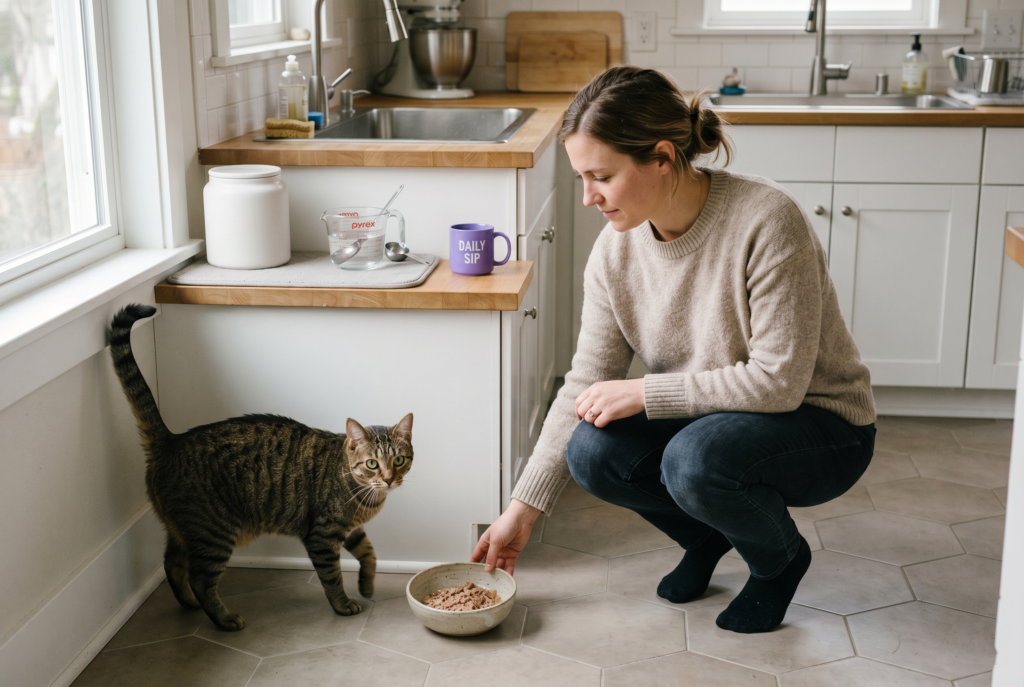
Fresh and gently cooked cat foods deliver the moisture cats need, which is the single biggest advantage they hold over dry kibble.
Fresh cat food compared: format, ingredients, and cost
The three reviewed brands differ less on quality than on format, and format is what determines daily cost and how the food fits your routine. The table below lays out the key axes. Prices are approximate and depend on your cat’s weight, the recipe, and whether you feed fresh as the full diet or as a topper.
| Brand | Format | Ingredient approach | AAFCO status (cats) | Approx. cost |
|---|---|---|---|---|
| The Honest Kitchen | Dehydrated, rehydrate with warm water | Human-grade whole foods; chicken and chicken-and-fish recipes | Complete and balanced for adult cats | About $32 to $55 per box; box rehydrates to roughly 4x its weight |
| Open Farm | Wet rustic blends, pâtés, kibble, freeze-dried raw | 100% traceable, humanely raised proteins; non-GMO produce | Wet blends and pâtés meet maintenance profiles | Roughly $0.70 to $1.00 per day for an 8 lb cat on wet feeding |
| Raised Right | Gently cooked, then frozen, served fresh | Single-protein, limited ingredient, under ~2% carbs, organ meats | Meets maintenance profiles for adult cats | About $10 to $11.40 per 1 lb bag; roughly $4.41 per day for a 10 lb cat |
*Pricing is approximate, varies by recipe and cat weight, and reflects feeding fresh as a full diet unless noted. Topper feeding lowers daily cost substantially.
A few patterns are worth naming. Dehydrated food from The Honest Kitchen is the most shelf-stable and travel-friendly, and you set the final moisture level yourself. Open Farm is the most flexible on format, which makes it the easiest to use as a topper strategy if full fresh feeding is out of budget. Raised Right is the most diet-purist of the three, with the lowest carbohydrate load and the shortest ingredient lists, at the highest per-day cost when fed as a complete meal.
Compare Options
See how the cat-friendly brands stack up
Our pet food buyer’s guide breaks down every brand we have reviewed on AAFCO compliance, safety protocols, and ingredient quality, including the ones with dedicated cat lines.
Fresh cat food vs. wet canned food
Fresh delivery is not the only moisture-rich option, and for many cats a good canned food does much of the same work at a lower price. The honest comparison is about trade-offs, not a clear winner.
Standard wet canned food contains roughly 70 to 78 percent moisture, which is close to what a cat would get from prey and far above kibble. A quality canned food that meets AAFCO profiles delivers the hydration benefit that matters most, costs less than fresh delivery, and stores easily. That is a genuinely strong baseline for most cats.
Fresh and gently cooked options add other things on top of moisture: human-grade ingredients, shorter and more recognizable ingredient lists, single-source proteins for cats with sensitivities, and in Open Farm’s case full ingredient traceability. Whether those additions justify the higher cost depends on your cat and your budget. A reasonable middle path is to use fresh or rehydrated food as a topper over a complete canned or dry base, which raises moisture and palatability without paying the full fresh price every day.
One caution applies across all of these. If your cat has a diagnosed condition such as kidney disease or a urinary disorder, a premium fresh or wet food does not replace a veterinary therapeutic diet. That decision belongs with your veterinarian.
How to choose, based on your cat
Start with moisture and work outward. If your cat eats only dry food today, the single highest-impact change is adding a moisture-rich food, whether that is a quality canned product, a rehydrated dehydrated meal, or a fresh blend. The format that wins is the one your cat will actually eat consistently.
If you want maximum convenience and shelf stability, The Honest Kitchen’s dehydrated line is the easiest to store and travel with. If you want the widest set of textures and the strongest sourcing transparency, Open Farm gives you wet, kibble, and freeze-dried options under one brand and works well as a topper. If you want the cleanest, lowest-carbohydrate, single-protein formulation and are willing to pay for it, Raised Right is the most diet-purist choice. For most households, the practical answer is a moisture-first base with one of these used as a complete meal or a topper, chosen to fit your cat’s preferences and your budget rather than the loudest brand name.
Frequently asked questions
Is fresh cat food better than dry food?
For most cats, a moisture-rich diet is closer to their biological design than dry kibble. Cats have a low thirst drive and evolved to get most of their water from food, so fresh and wet diets at 70 percent or more moisture support hydration and urinary health in ways kibble at 5 to 10 percent moisture does not. Quality still varies by brand, and any complete food should meet AAFCO Cat Food Nutrient Profiles for your cat’s life stage.
Which reviewed brands make cat food?
Among the brands we have reviewed, The Honest Kitchen, Open Farm, and Raised Right offer cat-appropriate food. Many of the largest fresh delivery names make food for dogs only, so if you have both a dog and a cat, look to Open Farm or Raised Right, which both serve dogs and cats under one brand, or to The Honest Kitchen’s dehydrated cat line.
How much does fresh cat food cost per day?
It depends on your cat’s weight, the brand, and whether you feed fresh as the full diet or as a topper. Open Farm wet feeding runs roughly $0.70 to $1.00 per day for an 8 lb cat, while Raised Right is closer to $4.41 per day for a 10 lb cat fed as a complete meal. Using fresh food as a topper over a complete base lowers the daily cost considerably.
Is wet canned food good enough, or do I need fresh delivery?
For many cats, a quality canned food that meets AAFCO profiles delivers the most important benefit, which is moisture at roughly 70 to 78 percent. Fresh and gently cooked options add human-grade ingredients, shorter ingredient lists, and traceability, but at a higher price. If your cat has a diagnosed urinary or kidney condition, follow your veterinarian’s diet recommendation rather than choosing on format alone.
 Dr. Marty Pets
 Evermore Pet Food
 Just Food for Dogs
 Maev
Maev Ollie
Ollie Open Farm
 PetPlate
 Raised Right
 Raw Paws Pet Food
 The Honest Kitchen
 The Pets Table
 We Feed Raw