“Human-grade” is one of the most used and least understood claims in the U.S. dog food market. The label has a specific legal meaning under AAFCO, which most kibble cannot honestly use, and most fresh brands can. This guide walks through what “human-grade” actually requires, how it differs from “feed-grade,” which brands meet the standard, and whether the price premium is worth it for your dog.
The Legal Definition of “Human-Grade” Dog Food
The Association of American Feed Control Officials, AAFCO, sets the rules U.S. states use to regulate pet food labeling. AAFCO defines “human-grade” as a claim that can only be used when every ingredient in the product, and the product itself, has been stored, handled, processed, and transported in compliance with regulations for human food. In plain language: every step of the supply chain must meet the standards a human-food manufacturer would meet.
Three conditions must hold simultaneously for the claim to be legal. First, every single ingredient must be edible by humans and sourced from a supplier approved for human food. Second, the manufacturing facility must be licensed and inspected to produce human food, not just animal feed. Third, the storage, transport, and packaging at every stage must meet human-food standards. A facility that runs both a human-food line and a pet-food line on shared equipment cannot make the human-grade claim on the pet line unless the equipment-cleaning and segregation protocols meet human-food standards.
The FDA’s pet food guidance aligns with AAFCO’s framework. Misuse of the human-grade claim is a regulatory violation in most states. That said, enforcement is uneven, and some brands market themselves as “human-grade quality” or “human-grade ingredients” without meeting the full chain-of-custody standard. The legal claim is “human-grade.” Variations on that wording are not the same thing.
Feed-Grade vs. Human-Grade: The Real Difference
Feed-grade is the default regulatory category for animal food in the U.S. It allows ingredients that humans cannot eat. The category covers ingredients like meat-and-bone meal, condemned meat from human slaughterhouses that failed inspection, and byproducts from rendering plants. None of this is inherently unsafe for dogs, and feed-grade pet food can still be nutritionally complete. It is a different supply chain with looser standards.
Human-grade flips the supply chain. The chicken used in a human-grade dog food recipe comes from the same suppliers that sell to grocery stores. The carrots come from the same produce distributors that ship to restaurants. The fish must meet the same mercury and contamination thresholds that apply to human seafood. Sourcing transparency is part of the claim, not an add-on.
Three concrete examples
The contrast is easiest to see in three real-world ingredient comparisons that show up on labels across the category.
- Chicken (feed-grade) vs. deboned chicken (human-grade): Feed-grade “chicken” on a kibble label can include the parts of the bird not sold for human consumption, feet, heads, viscera, and condemned tissue. Human-grade “deboned chicken” must come from cuts approved for human food.
- Meat meal (feed-grade) vs. fresh meat (human-grade): Meat meal is a rendered, dried product made by cooking animal tissue at high heat and grinding the result. The starting material can include scraps unfit for human consumption. Fresh meat in a human-grade recipe is the same cut a human-food supplier would sell to a restaurant.
- Animal fat (feed-grade) vs. named-source fat (human-grade): “Animal fat” on a label is a non-specific blend that can be sourced from any species and any rendering process. Human-grade recipes name the source (“chicken fat”) and the source must be human-edible.
None of these differences make feed-grade food unsafe for healthy adult dogs. They are differences in sourcing standards, not differences in toxicity. The question for the owner is whether the upgrade is worth the price.
Why Human-Grade Matters: Sourcing, Processing, and Traceability
Three benefits drive owners to pay the premium. The first is ingredient quality. Human-grade ingredients are subject to the same FDA and USDA standards that apply to grocery store food: pathogen testing, contamination thresholds, and labeling accuracy. Feed-grade ingredients are subject to looser standards and less frequent inspection.
The second is processing. Human-grade pet food cannot legally be processed at the extreme temperatures used in some kibble extrusion lines, because human-food facilities are not designed for that process. The result is usually gentler cooking, which preserves more heat-sensitive nutrients (some B vitamins, omega-3 fatty acids) without the synthetic re-supplementation that high-heat extrusion requires.
The third is traceability. Several leading human-grade brands ship every batch with a lot code that traces back to the source farms. Open Farm publishes a public traceability tool that lets owners enter the lot code on the bag and see exactly which farms supplied each ingredient. That level of transparency is rare in feed-grade kibble, where the supply chain is rarely disclosed to the consumer.
For most healthy adult dogs, the practical health difference between feed-grade and human-grade is modest. The case for human-grade is strongest for dogs with allergies, sensitivities, or chronic conditions where ingredient consistency and sourcing standards matter for symptom management. We cover that case in detail in our guide to the best limited ingredient dog food.
Which Leading Fresh Dog Food Brands Are Truly Human-Grade?
All nine brands profiled below market themselves as human-grade and meet AAFCO’s ingredient-level definition. The deeper credential, FDA-certified human-food facility, is rarer. The table below clarifies which brands meet which standard.
| Brand | Format | AAFCO Human-Grade Claim | FDA Human-Food Facility | Sourcing Disclosure |
|---|---|---|---|---|
| The Honest Kitchen | Dehydrated | Yes | Yes (FDA-certified) | Public ingredient sourcing |
| Just Food for Dogs | Fresh cooked | Yes | FDA-registered, open kitchens | Public kitchens, visible production |
| Ollie | Fresh cooked | Yes | USDA-inspected facility | Ingredient sourcing on label |
| PetPlate | Fresh cooked | Yes | USDA-inspected facility | Named ingredient sources |
| The Pets Table | Fresh + air-dried | Yes | USDA-inspected facility | Named ingredient sources |
| Open Farm | Multi-format | Yes | USDA-inspected facility | Lot-code traceability tool |
| Raised Right | Lightly cooked | Yes | USDA-inspected facility | Hold-and-release lab testing |
| We Feed Raw | Frozen raw | Yes | USDA-inspected facility | HPP-treated, single-protein sourcing |
| Maev | Flash-frozen raw | Yes | USDA-inspected facility | Named ingredient sources |
*Facility certifications reflect each brand’s publicly disclosed production credentials as of May 2026. AAFCO human-grade claim status is based on brand label disclosures and is subject to state-level enforcement.
The Honest Kitchen: The Only FDA Human-Food Facility
The Honest Kitchen’s San Diego facility is the only U.S. pet food facility certified by the FDA to produce human-grade food at the facility level, not just at the ingredient level. The brand has held the certification since 2002 and was the first in the category to win the right to use the “human-grade” claim on its packaging after a multi-year regulatory process. The full credential and ingredient breakdown is in our The Honest Kitchen review.
Just Food for Dogs: Open Kitchens
Just Food for Dogs operates open-to-the-public kitchens in California and other states where customers can watch the food being prepared, the same way they would watch chefs in a restaurant. The brand is FDA-registered and prepares both daily diets and prescription veterinary diets. Sourcing and production are visible by design. The full breakdown is in our Just Food for Dogs review.
Ollie: Vet-Formulated, Human-Grade Ingredients
Ollie’s facility is USDA-inspected and the brand has held a clean recall history since launch. The recipes are formulated with input from veterinary nutritionists and meet AAFCO’s human-grade ingredient standard. Sourcing is disclosed on the label, though the facility itself is not separately FDA-certified for human-food production. Our Ollie review covers the full credential set.
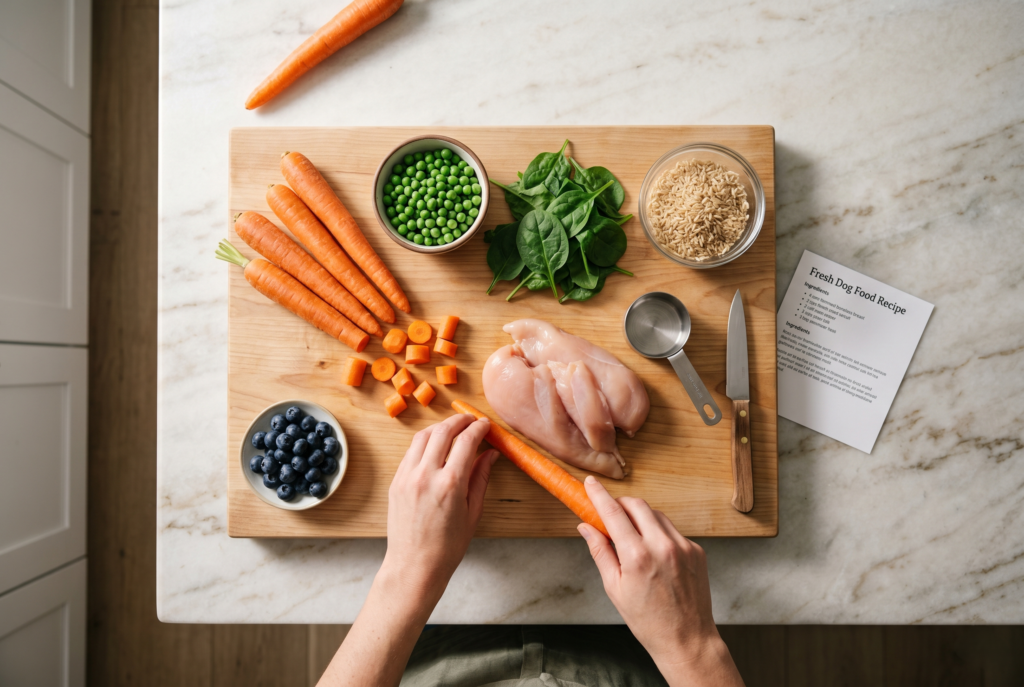
The human-grade standard in practice: every ingredient on the cutting board is the same quality a person would eat for dinner.
Compare Options
See the Leading Human-Grade Dog Food Brands Side by Side
BestGuide ranks human-grade dog food brands on AAFCO compliance, facility credentials, sourcing transparency, and price per day. Find the right fit for your dog.
Is Human-Grade Dog Food Worth the Price Premium?
Human-grade dog food costs roughly 2 to 4 times more per day than premium feed-grade kibble. For a 30-pound adult dog, premium kibble runs about $1 to $2 per day. Human-grade fresh cooked runs $5 to $12 per day. Human-grade dehydrated (The Honest Kitchen) and human-grade air-dried sit between the two at roughly $3 to $7 per day.
The premium pays for three things: ingredient sourcing standards, facility certification, and the loss of efficiency that comes with not using rendered byproducts. For a healthy adult dog with no chronic conditions, the practical health difference is modest. For a dog with food allergies, recurring digestive issues, or a chronic condition where ingredient consistency matters, the upgrade often pays for itself in reduced vet visits and easier symptom management.
Two cost-reduction strategies make the category accessible without abandoning the standard. Dehydrated formats price closer to premium kibble than fresh cooked does, especially for medium and large breeds. Topper plans, using human-grade fresh food over a base of premium kibble, cut the daily cost by 40 to 60% while still upgrading the ingredient quality of every meal. We cover the topper math by brand in our guide to fresh dog food delivery services, and the budget-aware options in our complete fresh dog food guide.
The decision is not “human-grade or not.” It is whether to upgrade and how far. For most owners, the upgrade path goes: premium kibble → human-grade topper → human-grade dehydrated or air-dried full-feed → human-grade fresh cooked. Each step buys a meaningful improvement in sourcing standards for a meaningful price increase. Stop at the level you can sustain.
Frequently Asked Questions
What does “human-grade” mean on a dog food label?
“Human-grade” is a legal claim under AAFCO that requires every ingredient to be edible by humans, sourced from a supplier approved for human food, and produced in a facility licensed to handle human food. The claim covers the entire supply chain from sourcing to packaging. Variations like “human-grade quality” or “human-grade ingredients” without the full chain-of-custody standard are not the same claim and have no regulatory standing.
Is feed-grade dog food bad for my dog?
No. Feed-grade dog food is the default regulatory category for animal food in the U.S. and can be nutritionally complete and safe. The difference is the sourcing standards. Feed-grade allows ingredients like rendered byproducts and meat-and-bone meal that humans cannot eat. Human-grade requires every ingredient to be human-edible. Both can produce healthy dogs. Human-grade is a sourcing upgrade, not a safety guarantee.
Which dog food brands are actually human-grade?
The Honest Kitchen, Just Food for Dogs, Ollie, PetPlate, The Pets Table, Open Farm, Raised Right, We Feed Raw, and Maev all meet AAFCO’s human-grade ingredient standard. The Honest Kitchen holds the only U.S. FDA-certified human-food facility designation. Just Food for Dogs operates open-to-the-public kitchens. The others use USDA-inspected facilities. Most major kibble brands do not qualify as human-grade.
How much more does human-grade dog food cost?
Human-grade dog food typically costs 2 to 4 times more per day than premium kibble. For a 30-pound adult dog, expect $3 to $7 per day for human-grade dehydrated or air-dried formats, and $5 to $12 per day for human-grade fresh cooked. Topper plans, where human-grade food supplements a kibble base, can cut the daily cost by 40 to 60%.
Does human-grade dog food make a real health difference?
For healthy adult dogs with no chronic conditions, the practical health difference between feed-grade and human-grade is modest. The case for human-grade is strongest for dogs with allergies, food sensitivities, or chronic conditions where ingredient consistency and sourcing standards meaningfully affect symptom management. Talk to your veterinarian if your dog has a diagnosed condition before changing diet.