Fresh dog food is the fastest-growing category in U.S. pet nutrition, and the label now covers five distinct formats, not one. This guide breaks down what fresh dog food actually means, how each format compares on nutrition and price, which brands lead each format, and how to decide what fits your dog and your budget.
Every brand profiled below is AAFCO compliant and uses human-grade or USDA-inspected ingredients. The differences are real but specific: format, sourcing protocol, portioning, and price per day. We focus on those.
What Fresh Dog Food Actually Means
Fresh dog food is any complete-and-balanced dog food made from minimally processed, often human-grade ingredients, cooked or preserved at low temperatures rather than the high-heat extrusion used for kibble. The Association of American Feed Control Officials (AAFCO) does not yet define “fresh” as a regulated term, so the category in practice is defined by what fresh food is not: not extruded kibble, not canned wet food, not shelf-stable rolls.
Two technical anchors matter for the reader. “Human-grade” is a legal claim under AAFCO. To use it, a manufacturer must produce the food in a facility licensed to handle human food, using ingredients sourced and stored to human-food standards. “Feed-grade” ingredients, by contrast, can include byproducts that humans would not eat. Most kibble is feed-grade. Most fresh dog food is human-grade.
The second anchor is moisture content. Kibble typically runs 8 to 10% moisture by weight per FDA pet food labeling guidance. Fresh cooked and raw formats run 65 to 75% moisture, closer to what a dog would eat in its natural diet. Higher moisture helps with hydration and palatability, especially for dogs that rarely drink enough water on their own.
Fresh Dog Food vs. Kibble vs. Raw: The Real Differences
Kibble dominates the U.S. pet food market because it is shelf-stable, cheap, and easy to dose. The trade-off is processing. Kibble is made by extrusion at temperatures above 200°F, which destroys some heat-sensitive nutrients and requires synthetic supplementation to restore them. Most kibble is feed-grade, not human-grade.
Raw dog food sits at the other end of the spectrum. Ingredients are never cooked. Proponents argue this preserves enzymes and matches a dog’s ancestral diet. The FDA and the American Veterinary Medical Association have flagged real safety risks tied to raw diets, mainly bacterial contamination with Salmonella and Listeria. Several leading raw brands now use High-Pressure Processing (HPP) to neutralize pathogens without cooking, which addresses the safety gap.
Fresh cooked sits between the two. The food is gently cooked at low temperatures (typically 170 to 200°F), high enough to kill bacteria but low enough to preserve nutrient density. Most fresh cooked brands deliver the food frozen or refrigerated in pre-portioned packs sized to the individual dog.
The Five Formats of Fresh Dog Food
“Fresh” on a U.S. pet food label can mean any of five distinct production methods. They are not interchangeable. Each has different storage needs, different price points, and different reasons a dog owner might choose one over another.
1. Fresh Cooked
Whole-ingredient meals gently cooked at low temperatures, then frozen or refrigerated for delivery. The category leader by volume. Examples include Ollie, PetPlate, The Pets Table, and Just Food for Dogs. Typical format: pre-portioned plastic trays or sealed pouches, sized to the dog’s daily caloric need and shipped on a weekly or bi-weekly cycle.
Best for owners who want the closest thing to home-cooked meals without the work of formulating a complete-and-balanced diet themselves.
2. Raw (Frozen)
Uncooked meat, organs, and bone, typically formulated to the 80/10/10 ratio (80% muscle meat, 10% organ, 10% bone) or a brand-specific variation. Stored and shipped frozen. The leading brands in this format use High-Pressure Processing to neutralize Salmonella and E. coli without cooking. Examples include We Feed Raw, Raised Right, and Maev.
Best for owners who want a biologically appropriate raw diet but need the safety protocols and the nutritional balance verified by a commercial producer.
3. Freeze-Dried Raw
Raw food that has had its moisture removed at very low temperatures and under vacuum, leaving a shelf-stable nugget or patty that rehydrates with water before serving. Nutritionally close to frozen raw but easier to store and travel with. Examples include Open Farm, We Feed Raw, and Raised Right. We cover the category in depth in our freeze-dried raw dog food guide.
Best for owners who want raw nutrition without dedicating freezer space, or who travel with their dog regularly.
4. Dehydrated
Whole ingredients warm-air-dried at low temperatures to remove moisture. Rehydrates with warm water before serving. Different from freeze-dried because mild heat is used, but still gentler than kibble extrusion. The Honest Kitchen is the dominant brand in this format, with a facility certified by the FDA to produce human-grade pet food.
Best for owners who want minimal processing, shelf stability, and a strong human-grade certification.
5. Air-Dried
Ingredients gently dried with low-temperature airflow, leaving a dense, jerky-like texture that is ready to serve without rehydration. Combines shelf stability with relatively high nutrient retention. The Pets Table offers air-dried as part of its mixed-texture meal plans.
Best for owners who want a no-prep fresh-category food they can scoop and serve like kibble, without the high-heat processing.
Format Comparison: Nutrition, Price, and Who It Fits
The table below compares the five formats on four axes that drive most purchase decisions. Price-per-day figures reflect feeding a 30-pound adult dog, sourced from each brand’s published feeding calculators as of May 2026.
| Format | Moisture | Price / Day (30 lb dog) | Storage | Ideal Owner |
|---|---|---|---|---|
| Fresh Cooked | 65–75% | $5–$12 | Freezer or fridge | Wants home-cooked quality without the work |
| Raw (Frozen) | 65–75% | $4–$9 | Freezer required | Wants biologically appropriate raw, verified safe |
| Freeze-Dried Raw | 3–5% (dry); rehydrated | $5–$11 | Shelf-stable, pantry | Travels often, limited freezer space |
| Dehydrated | 5–8% (dry); rehydrated | $3–$7 | Shelf-stable, pantry | Wants human-grade certification, minimal processing |
| Air-Dried | 10–15% | $4–$8 | Shelf-stable, pantry | Wants scoop-and-serve convenience, no high heat |
*Price ranges reflect published feeding calculator outputs for a 30-pound adult dog, May 2026. Actual cost depends on dog size, activity level, and chosen plan tier.
Why More Veterinarians Are Recommending Fresh Dog Food
Veterinary nutrition has shifted noticeably in the last five years. The American Animal Hospital Association published updated nutrition and weight management guidelines in 2021 that recognized fresh and gently cooked diets as legitimate options when produced by manufacturers that meet AAFCO standards and employ a qualified veterinary nutritionist.
Three drivers explain the shift. First, the canine obesity rate in the U.S. has climbed past 56% according to the Association for Pet Obesity Prevention, and pre-portioned fresh meals make caloric control simpler than free-feeding kibble. Second, higher moisture content supports urinary and renal health, particularly in older dogs. Third, the 2018 FDA investigation into grain-free kibble and dilated cardiomyopathy pushed many owners to look for alternatives outside the traditional kibble category.
None of this means kibble is wrong. It means the category has expanded, and “what should I feed my dog” now has more than one defensible answer. Persistent digestive issues, allergies, weight loss, or weight gain still warrant a conversation with your veterinarian before changing diet.
The Leading Fresh Dog Food Brands, Profiled
The nine brands below cover all five fresh formats. Each is profiled briefly here, with a link to the full BestGuide review for deeper detail on ingredients, pricing tiers, and safety protocol.
Ollie (Fresh Cooked)
Ollie is BestGuide’s Editor’s Choice for the fresh cooked category. The brand delivers vet-formulated meals portioned to each dog’s exact caloric need, prepares them in a facility with zero published recalls, and offers four protein recipes (beef, chicken, turkey, lamb). Subscription is the only purchase model. Our full Ollie review covers the trial offer, the recipe rotation, and how it stacks up against PetPlate and The Farmer’s Dog.
Just Food for Dogs (Fresh Cooked, Veterinary Diets)
Just Food for Dogs operates open-to-the-public kitchens in California where customers can watch food being prepared. The brand offers both daily diets and prescription veterinary diets formulated for conditions like kidney disease, liver disease, and skin allergies. FDA-registered facility, evidence-based formulations developed in partnership with veterinary nutritionists.
PetPlate (Fresh Cooked)
PetPlate delivers vet-formulated fresh meals in microwave-safe, recyclable containers. Four protein options, novel protein recipes available for dogs with chicken or beef sensitivities. Pricing per meal is typically slightly lower than Ollie for comparable plan tiers.
The Pets Table (Fresh and Air-Dried)
The Pets Table is one of the few brands offering mixed-texture meal plans, combining fresh cooked and air-dried portions. AAFCO compliant for all life stages, with a clean recall history since launch.
The Honest Kitchen (Dehydrated)
The Honest Kitchen is the dominant brand in the dehydrated format. Its facility holds FDA human-grade certification, one of the strictest credentials in the U.S. pet food industry. Grain-free and whole-grain recipes available, including limited-ingredient lines for dogs with allergies.
Open Farm (Fresh, Raw, Freeze-Dried, Dehydrated)
Open Farm covers more formats than any other brand on this list, with a sourcing model built on ingredient traceability (every bag carries a lot code traceable to the source farms). Strong choice for owners who care about ethical sourcing alongside nutrition.
Raised Right (Fresh Cooked, Low-Carb)
Raised Right specializes in human-grade lightly cooked meals with less than 2% carbohydrates, a profile that appeals to owners managing weight or blood sugar in their dog. Hold-and-release lab testing protocol on every batch.
We Feed Raw (Frozen Raw)
We Feed Raw uses an 80/10/10 raw formulation with High-Pressure Processing to neutralize pathogens. Eight protein recipes, AAFCO compliant for all life stages. Subscription-only purchase model. The detailed breakdown is in our We Feed Raw review.
Maev (Prep-Free Raw)
Maev offers flash-frozen, bite-sized raw cubes that require no thawing before serving. Grain-free, whole-food formulation. The format solves the main user-friction point of frozen raw (thawing time) while keeping the raw nutrition profile.
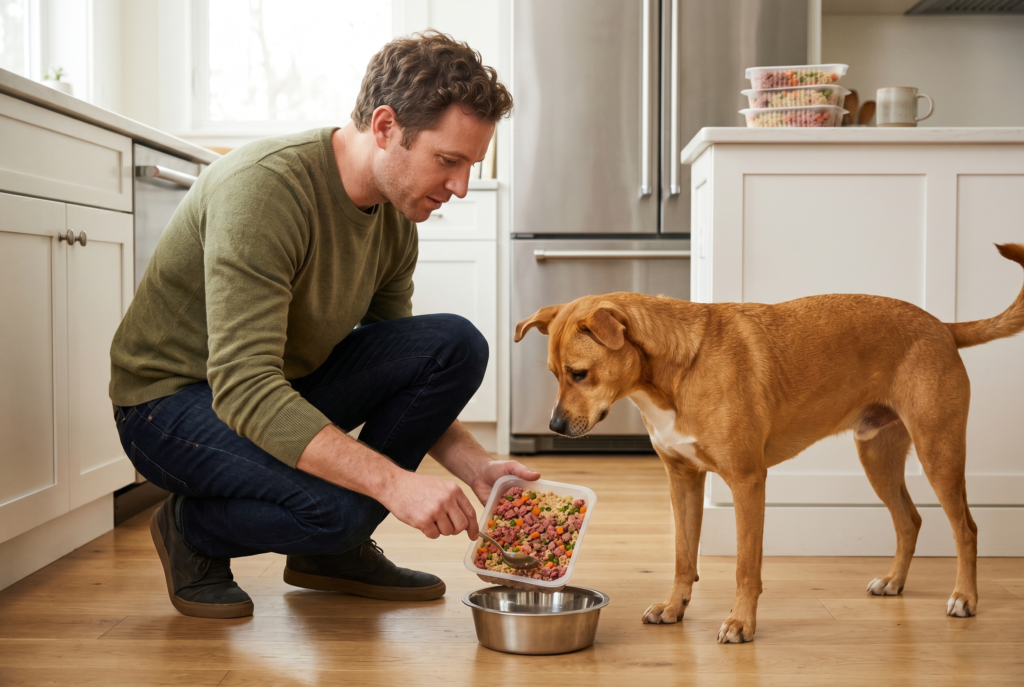
A fresh cooked meal portioned straight from a single-serve tray into the dog bowl, the format that now leads the U.S. fresh dog food category.
Compare Options
See the Best Fresh Dog Food Companies, Side by Side
BestGuide ranks fresh dog food brands on AAFCO compliance, safety protocols, dietary specialty options, and human-grade sourcing. Find the right fit for your dog and your budget.
Is Fresh Dog Food Expensive? The Real Cost Per Day
Fresh dog food costs more than kibble. The honest comparison is how much more, and whether the gap matters for your situation. A premium kibble for a 30-pound dog typically runs $1 to $2 per day. Fresh cooked subscription services for the same dog run $5 to $12 per day. Dehydrated, freeze-dried, and air-dried formats sit between the two, usually $3 to $8 per day depending on brand and plan tier.
Three strategies reduce the cost without abandoning the category. First, dehydrated and air-dried formats price closer to premium kibble than fresh cooked does. Second, several brands (Open Farm, Raised Right, The Pets Table) offer half-fresh plans where fresh food is used as a topper over kibble rather than the full meal, cutting daily cost by 40 to 60%. Third, trial offers and first-order discounts of 50 to 60% are standard across the subscription brands and are worth using to test fit before committing. We break the math down by brand in our guide to the cheapest fresh dog food options.
For owners on a tight budget, the question is less “fresh or kibble” and more “what mix gets my dog the nutritional benefits I want at a price I can sustain.” A topper strategy with dehydrated food, or a single fresh-cooked meal per day with kibble at the other meal, both deliver real upgrades over kibble-only feeding without doubling the monthly cost.
How to Choose the Right Fresh Dog Food for Your Dog
Three variables decide which format and brand fit. Size and life stage drive cost more than any other factor. A 10-pound dog can be fed fresh cooked for under $4 per day. The same brand for an 80-pound dog will run $15 or more. Larger dogs often do better economically on freeze-dried, dehydrated, or topper-based plans.
The second variable is health context. Dogs with sensitive stomachs, food allergies, or chronic conditions often benefit from limited-ingredient or veterinary diets, which not every fresh brand offers. Just Food for Dogs has the deepest veterinary diet catalog. The Honest Kitchen and Open Farm lead the limited-ingredient category. We cover this in detail in our guides to the best dog food for sensitive stomach and best limited ingredient dog food.
The third variable is lifestyle. Freezer space, travel frequency, and meal prep tolerance all matter. Frozen fresh and raw require freezer real estate and meal-prep time. Dehydrated, freeze-dried, and air-dried fit households where storage is constrained or travel is frequent. None of these formats is objectively better. The right answer is the one you’ll actually feed consistently.
If you are still feeding mostly kibble and want a structured way to upgrade, the topper approach is the lowest-friction starting point: keep kibble as the base, add a daily scoop of dehydrated or freeze-dried fresh food, and observe how the dog responds over two to four weeks. That gives you a budget-aware test of the category before you commit to a full subscription. For dogs with allergies or chronic skin issues, talk to your vet before switching, since veterinary liability questions can come up in cases where a diet change is made without clinical guidance.
Frequently Asked Questions
Is fresh dog food actually healthier than kibble?
For most healthy adult dogs, fresh dog food provides higher moisture content, less processing, and human-grade ingredients compared to kibble. AAHA’s 2021 guidelines recognize gently cooked and fresh diets as legitimate options when produced by AAFCO-compliant manufacturers. That said, kibble from a reputable brand is not nutritionally harmful, it is simply more processed and lower in moisture.
How much does fresh dog food cost per month?
For a 30-pound adult dog, expect $60 to $150 per month for budget-friendly fresh options like Open Farm or Raised Right, and $150 to $360 per month for premium fresh cooked subscriptions like Ollie or Just Food for Dogs. Dehydrated and freeze-dried formats price closer to the lower end. Dog size scales the cost roughly linearly.
Can I mix fresh dog food with kibble?
Yes. Mixing is one of the most common ways owners introduce fresh food without doubling their monthly food spend. Use the fresh portion as a topper (one-third to one-half of the meal) over kibble, and reduce the kibble amount to keep total calories consistent with your dog’s daily target. Most fresh brands publish topper-portion feeding guides on their sites.
Is raw dog food safe?
Raw dog food can be safe when sourced from a commercial brand that uses High-Pressure Processing or flash-freezing safety protocols to neutralize pathogens like Salmonella and E. coli. The FDA and AVMA have flagged real safety risks tied to home-prepared raw diets, where pathogen control is harder. We cover the research in our guide on whether raw dog food is safe. Consult your veterinarian before switching, especially for puppies, senior dogs, or dogs with immune conditions.
Do I need a vet’s approval before switching to fresh dog food?
For a healthy adult dog with no chronic conditions, switching to a commercial AAFCO-compliant fresh diet does not require a veterinary consult. For puppies, seniors, dogs with allergies, dogs with chronic conditions (kidney disease, diabetes, IBD), or dogs on prescription medications, talk to your vet before changing diet. The transition itself should be gradual: 25% new food / 75% old food for three days, then 50/50, then 75/25, then full switch over roughly ten days.
What does “human-grade” actually mean on a dog food label?
“Human-grade” is a legal AAFCO claim. To use it, every ingredient must be edible by humans, and the food must be produced and stored in a facility licensed to handle human food. “Feed-grade,” by contrast, can include byproducts and ingredients not approved for human consumption. Most kibble is feed-grade. Most fresh dog food is human-grade, but not all, so check the label.