The Quick Answer
Raw dog food carries a documented risk of bacterial contamination, including Salmonella and Listeria, and both the FDA and the American Veterinary Medical Association (AVMA) discourage feeding raw or undercooked animal protein that has not gone through a pathogen-reduction step. That risk is real, but it is not the whole story. Commercial raw diets treated with high-pressure processing (HPP) can achieve a 5-log (99.999%) reduction in those pathogens, which changes the calculation. The honest answer: a raw diet from a brand that uses a validated kill step, handled with the same care you would give raw chicken in your own kitchen, is far safer than untreated raw meat, but it still carries more risk than cooked food. Talk to your veterinarian before switching, especially if anyone in your home is pregnant, very young, elderly, or immunocompromised.
Few questions in dog nutrition generate more heat and less light than this one. Raw feeding advocates point to glossy coats and smaller stools. Public-health agencies point to recall notices and lab cultures. Both are looking at real evidence. The useful question is not whether raw food has any risk, because all food does, but how large the risk is, what drives it, and what you can do about it.
This article walks through what the research and the regulators actually say, separates the risks that are well documented from the ones that are overstated, and lays out the concrete steps that lower your odds of a problem. The goal is a clear-eyed read on safety, not a verdict for or against raw feeding.
What the research and regulators actually say
The two most-cited authorities in the United States have taken consistent positions. The U.S. Food and Drug Administration (FDA), the federal agency that regulates pet food, states that it does not believe feeding raw pet foods to animals is consistent with protecting the public from significant health risks. The FDA’s reasoning is straightforward: raw meat, bones, and organs that have not been cooked are more likely to carry pathogens than cooked ingredients.
The American Veterinary Medical Association (AVMA), the national body representing U.S. veterinarians, takes a parallel line. Its policy discourages feeding dogs and cats any animal-source protein that has not first been through a process to eliminate pathogens, citing the risk to both pets and people. The AVMA does not say raw ingredients are inherently unusable. It says they should be treated, by cooking, pasteurization, or another scientifically validated method, before being fed.
That distinction matters more than the headlines suggest. The objection from both agencies is not to fresh, minimally processed meat as a category. It is to untreated raw protein with no kill step. As the AVMA puts it, the association supports the production and feeding of diets processed using methods that reduce or eliminate the risk of illness from pathogenic contaminants. Peer-reviewed work supports the concern: a Tufts University review noted that potentially dangerous bacteria could be grown from 42% of raw cat foods tested but from none of the cooked products.
The real risks: bacteria, nutritional imbalance, and cross-contamination
Three risks come up repeatedly in the literature, and they are not equally easy to manage. Understanding each one tells you where to focus.
Bacterial contamination is the headline risk. Raw meat-based diets have been linked to Salmonella, Listeria monocytogenes, E. coli, and Campylobacter. The FDA’s recall record is the clearest evidence here. Over the past several years the agency has issued repeated advisories against specific raw products, including frozen raw lines from Answers Pet Food, Performance Dog, and Texas Tripe, after retail samples tested positive for Salmonella and Listeria. In the 2024 Answers Pet Food advisory, the FDA acted after three consumer complaints of illness in dogs, then found contamination across four product lots. Dogs can also carry and shed these bacteria without looking sick, which is how the risk moves from the bowl to the rest of the household.
Nutritional imbalance is the quieter risk. A raw diet assembled at home, without a formulation that meets established nutrient profiles, can drift into deficiency or excess over time. The standard that defines complete and balanced nutrition in the U.S. comes from AAFCO, the Association of American Feed Control Officials. Diets that meet AAFCO profiles are formulated to supply the full set of nutrients a dog needs; diets that do not can leave gaps in calcium, certain vitamins, or essential fatty acids that take months to show up as a clinical problem. This is a reason many veterinarians steer owners toward commercially formulated raw diets over improvised home recipes.
Cross-contamination is the risk people forget. Even a perfectly safe-for-the-dog meal becomes a household hazard if the prep surface, the bowl, and your hands are not cleaned afterward. The people most vulnerable to foodborne illness, including infants, adults over 65, pregnant women, and anyone with a weakened immune system, are exactly the people who should not be handling untreated raw pet food. The CDC estimates roughly 1,600 listeriosis cases and about 260 deaths in humans each year, which is the public-health backdrop behind the FDA’s caution.
| Risk | What it is | How manageable |
|---|---|---|
| Bacterial contamination | Salmonella, Listeria, E. coli, or Campylobacter in untreated raw meat | Largely controllable with a validated kill step (HPP) and safe handling |
| Nutritional imbalance | Missing or excess nutrients in a diet that does not meet AAFCO profiles | Controllable by choosing AAFCO-complete formulas over improvised recipes |
| Cross-contamination | Bacteria spreading to surfaces, bowls, hands, and vulnerable household members | Controllable with kitchen hygiene; higher stakes in at-risk households |
How to minimize the risks
The single most important variable is whether the diet went through a validated pathogen-reduction step before it reached you. This is where the gap between untreated raw meat and a commercial raw product becomes a chasm.
High-pressure processing, or HPP, is the method that does the most work here. It is a non-thermal technique that uses intense water pressure to inactivate bacteria without cooking the food, which preserves the nutritional profile raw feeders are after. The data is specific: research published in the Journal of Food Protection found that HPP applied to commercial raw pet food achieved a 5-log reduction (a 99.999% drop) in Salmonella, Shiga toxin-producing E. coli, and Listeria monocytogenes, and that frozen storage afterward helped maintain that reduction. Salmonella inactivation in one modeling study ranged up to a 9-log reduction at the highest pressures tested. HPP is the AVMA’s “scientifically validated technology” in practice, and it is why a brand’s safety protocol, not the word “raw” on the label, is what you should be evaluating.
Beyond the kill step, the playbook is the same care you would use with raw meat for your own dinner:
- Choose a brand that publishes its safety process, whether that is HPP, flash-freezing, or test-and-hold lab protocols, and confirm the product is labeled as meeting AAFCO nutritional standards.
- Wash your hands, the bowl, utensils, and any prep surface with hot soapy water immediately after every meal.
- Store raw food frozen until use, thaw in the refrigerator rather than on the counter, and discard anything left in the bowl after a reasonable feeding window.
- Keep raw pet food separate from human food in the freezer and fridge.
- Avoid raw feeding entirely if your household includes an infant, an adult over 65, someone pregnant, or anyone immunocompromised.
For owners who want the raw profile with a built-in kill step, freeze-dried and HPP-treated commercial options have become the practical middle path. Our guide to the best raw dog food brands breaks down which companies use which safety protocols, and if you are building a plan from scratch, the complete raw dog food diet guide covers transition and feeding amounts step by step.
Compare Options
See Which Raw Diets Use a Validated Kill Step
Safety comes down to the brand’s process, not the label. Compare reviewed pet food companies on AAFCO compliance, recall history, and pathogen-reduction protocols.
Who raw feeding is a good option for
Raw is not a universal recommendation, and it is not a universal mistake. It tends to make sense for a specific kind of owner and a specific kind of dog. It makes the most sense when you are willing to buy from a brand with a documented safety protocol rather than sourcing meat yourself, when no one in the household falls into a high-risk health group, and when you can commit to consistent kitchen hygiene.
It makes the least sense in homes with infants or immunocompromised members, for owners who would assemble meals from scratch without a balanced formulation, and for dogs whose own health is already compromised. Puppies, pregnant dogs, and dogs with certain medical conditions warrant a direct conversation with a veterinarian before any raw transition. Two commercial brands BestGuide has reviewed in this category illustrate the safety-first approach worth looking for: our We Feed Raw review covers a line that uses high-pressure processing on its 80/10/10 diets, and our Raised Right review looks at lightly cooked, human-grade meals with a hold-and-release lab testing protocol for owners who want fresh ingredients with an added margin of safety.
If you are still weighing raw against other minimally processed formats, our complete fresh dog food guide compares raw, gently cooked, freeze-dried, and dehydrated options side by side on nutrition, cost, and convenience.
Making the decision for your dog
Here is the practical frame. If you want to feed raw, the question to answer first is not “is raw safe” in the abstract. It is “does this specific product have a validated kill step, does it meet AAFCO nutritional standards, and can my household handle it safely.” A commercial raw diet treated with HPP, fed in a home with no high-risk members and managed with clean kitchen habits, sits in a very different risk category than ground raw meat scooped from a butcher’s counter. If the answer to any of those three questions is no, the risk climbs fast, and a gently cooked or freeze-dried option gives you most of the appeal with less exposure. Whatever you choose, run the change past your veterinarian first, because the right answer depends on your individual dog’s age, health, and history more than on any general rule.
For persistent digestive issues, suspected foodborne illness, or any concern about your dog’s diet, consult your veterinarian. The information here is educational and is not a substitute for individualized veterinary advice.
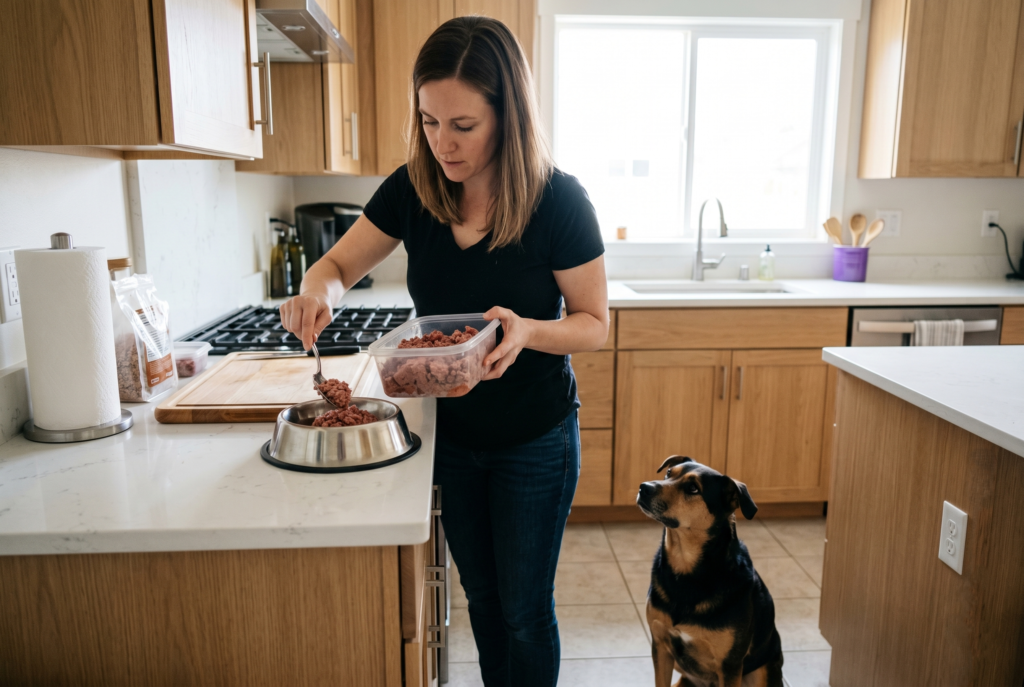
Portioning a raw diet into a clean bowl, the kind of careful handling that lowers the cross-contamination risk the FDA and AVMA warn about.
Frequently asked questions
Is raw dog food safe to feed?
It can be, with conditions. Raw dog food from a brand that uses a validated pathogen-reduction step such as high-pressure processing, fed in a household with no high-risk members and handled with strict kitchen hygiene, is considerably safer than untreated raw meat. That said, both the FDA and the AVMA discourage feeding untreated raw or undercooked animal protein, and even a treated raw diet carries more risk than cooked food. Consult your veterinarian before switching.
What bacteria are found in raw dog food?
The pathogens most often associated with raw meat-based diets are Salmonella, Listeria monocytogenes, E. coli, and Campylobacter. FDA testing has repeatedly found Salmonella and Listeria in specific raw products, triggering public advisories. Dogs can shed these bacteria in feces and saliva even without showing symptoms, which is how contamination spreads to people and surfaces in the home.
Does the FDA approve raw dog food?
The FDA does not endorse raw feeding. The agency has stated it does not believe feeding raw pet foods to animals is consistent with protecting the public from significant health risks, and it recommends cooking raw meat and poultry to kill bacteria. The FDA regulates pet food and issues recalls and advisories when raw products test positive for pathogens, but it does not pre-approve individual diets.
How can I make raw feeding safer for my dog?
Choose a commercial brand that publishes a validated safety process such as HPP or test-and-hold lab protocols, and confirm the diet meets AAFCO nutritional standards rather than assembling meals yourself. Store food frozen, thaw in the refrigerator, wash hands and all equipment after every meal, and keep raw pet food separate from human food. Avoid raw feeding entirely if anyone in the home is an infant, elderly, pregnant, or immunocompromised.
Is raw food better than cooked food for dogs?
The evidence does not support a blanket claim that raw is nutritionally superior to cooked food. Raw feeders report benefits like coat quality and smaller stools, but high-quality cooked and gently cooked diets can deliver complete, balanced nutrition with lower pathogen risk. The most important factors are whether the diet meets AAFCO profiles and whether it has gone through a step to reduce bacteria, not whether it is raw or cooked. Your veterinarian can help you weigh the trade-offs for your dog.