The best dog food is the one that is complete, balanced, safe, and sustainable for your budget. There is no single winner across all dogs. A 9-pound senior with a sensitive stomach and a 90-pound active working dog need different things, and the format that fits one can be wrong for the other. This guide breaks down the five main dog food formats, ranks top picks by category and by need, and gives you a way to choose based on your specific dog.
The pet food market has shifted hard toward fresh and minimally processed options over the last few years, and veterinary nutritionists now weigh in on most premium lines. But premium does not automatically mean better for your dog. What matters is whether the food meets recognized nutritional standards, has a clean safety record, and fits the life stage and health profile of the animal eating it.
The five dog food formats, ranked by what they do best
Dog food sorts into five formats. Each one trades off differently across nutrition retention, price, convenience, and shelf life. The ranking below is by use case, not by a universal “best,” because the formats serve different dogs.
1. Fresh cooked. Gently cooked, refrigerated meals made from whole ingredients, usually portioned to your dog’s profile and shipped on a schedule. Fresh cooked food retains high moisture and bioavailability, and the better lines use human-grade ingredients. It is the most convenient premium option and the easiest transition for picky eaters. It is also among the most expensive and requires fridge or freezer space. Brands like Ollie and PetPlate anchor this category.
2. Raw. Uncooked meat, organ, and bone diets, sold frozen or freeze-dried. Raw advocates point to high protein and minimal processing. The real concern is pathogen risk, which reputable brands address with High-Pressure Processing (HPP) or flash-freezing to neutralize bacteria like Salmonella and E. coli. We Feed Raw and Raised Right lead here, and if you are weighing this format, our guide on whether raw dog food is safe covers the research in detail.
3. Dehydrated and air-dried. Moisture is removed at low temperatures, concentrating nutrients while keeping the food shelf-stable. You rehydrate dehydrated food with warm water before serving. This format bridges fresh quality and pantry convenience, and it travels well. The Honest Kitchen is the reference brand for human-grade dehydrated food.
4. Wet (canned). High moisture, palatable, and useful for dogs that need hydration or have dental issues. Wet food costs more per calorie than kibble and spoils once opened, but it is a strong topper or full diet for older dogs and reluctant eaters.
5. Dry (kibble). The most economical and shelf-stable format, and still the default for most American households. Quality varies enormously by brand. Kibble is convenient and cheap, but it is the most processed of the five and the lowest in moisture. For budget-conscious owners, using fresh food as a topper over a quality kibble base is a common middle path, which we break down in our guide to the cheapest fresh dog food options.
| Format | Nutrition retention | Typical cost/day* | Convenience | Best for |
|---|---|---|---|---|
| Fresh cooked | High | $5–$12 | High (delivered, refrigerated) | Picky eaters, owners wanting premium convenience |
| Raw | High | $4–$10 | Low–medium (freezer, thawing) | Owners prioritizing minimal processing |
| Dehydrated / air-dried | Medium–high | $3–$8 | High (shelf-stable, rehydrate) | Travel, limited fridge space |
| Wet (canned) | Medium | $2–$6 | Medium (spoils once open) | Seniors, dental issues, hydration |
| Dry (kibble) | Low–medium | $0.50–$3 | Very high (pantry-stable) | Budget, large dogs, free-feeding |
*Cost ranges are estimates for a medium-sized dog (around 30 lbs) and vary by brand, protein, and portion size.
What “complete and balanced” actually means
Before ranking brands, define the baseline. The phrase “complete and balanced” on a dog food label is not marketing. It signals that the food meets the nutrient profiles set by the Association of American Feed Control Officials (AAFCO), the body whose model regulations U.S. states use to define pet food adequacy. A food labeled complete and balanced for a life stage supplies every nutrient a dog needs in that stage, in the right proportions.
AAFCO compliance is the floor every food in this guide clears. It does not tell you which food is best. It tells you which foods are even eligible for the conversation. The differences that matter sit above that line: ingredient quality, sourcing transparency, safety protocols, recall history, and whether the formula is built for your dog’s specific life stage and health needs.
Two more terms worth defining. Human-grade means every ingredient and the facility that makes the food meet the standards for human consumption, a stricter bar than the “feed-grade” standard most pet food meets. HPP, or High-Pressure Processing, is a cold pasteurization method raw brands use to kill pathogens without cooking the food.
Top picks by format
These picks come from the brands BestGuide has reviewed against AAFCO compliance, safety protocols, dietary specialty options, and human-grade sourcing. Each links to its full review.
| Format | Top pick | Why it leads | AAFCO |
|---|---|---|---|
| Fresh cooked | Ollie | Vet-formulated meals tailored to caloric needs, zero recalls, strict testing | Compliant |
| Veterinary diets | Just Food for Dogs | Evidence-based diets in open-to-public kitchens, prescription options available | Compliant |
| Raw (frozen/cubes) | We Feed Raw / Maev | 80/10/10 raw using HPP; Maev offers flash-frozen, prep-free cubes | Compliant |
| Low-carb cooked | Raised Right | Lightly cooked human-grade meals under 2% carbs, hold-and-release lab testing | Compliant |
| Dehydrated | The Honest Kitchen | Human-grade in an FDA human-grade facility, grain-free and whole-grain options | Compliant |
| Ethical sourcing | Open Farm | Fully traceable ingredients, test-and-hold safety, multiple formats including raw | Compliant |
| Fresh + air-dried | The Pets Table | Mixed-texture plans, clean safety record, formulated for all life stages | Compliant |
| Pre-portioned fresh | PetPlate | Vet-nutritionist meals in microwave-safe recyclable containers, novel proteins | Compliant |
For the full side-by-side across pricing, plans, and customer-service track record, our best dog food companies buyer’s guide ranks every brand on the same four criteria.
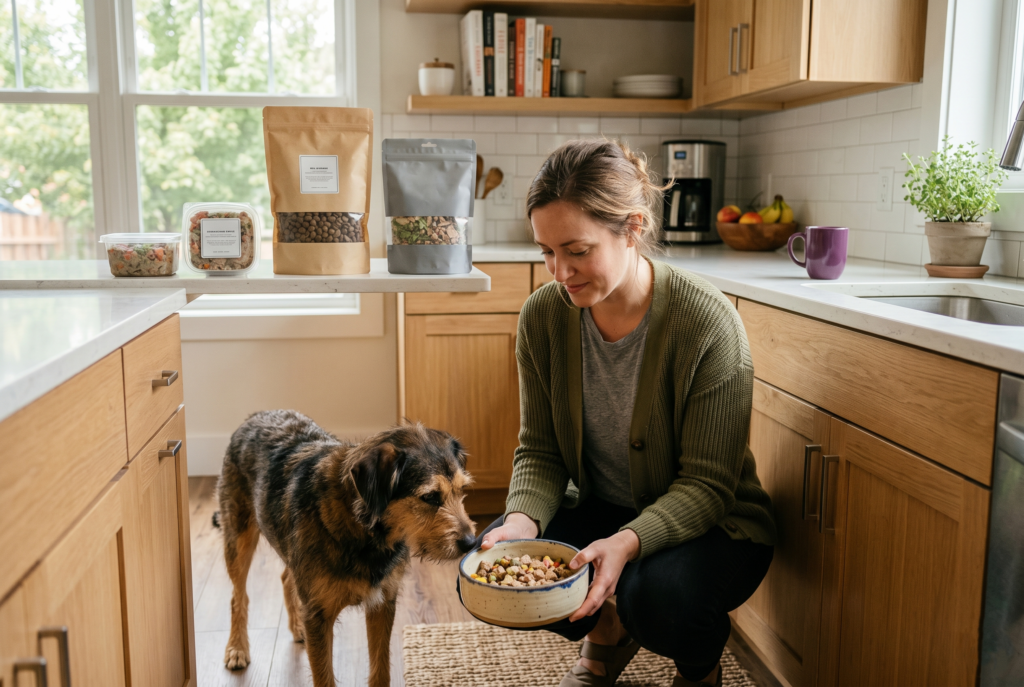
Fresh, dehydrated, and dry formats side by side, the choice comes down to your dog’s needs and your routine.
Top picks by need
Format is one axis. The other is your dog’s specific situation. A dog with a recurring digestive problem, an aging joint condition, or a high-activity routine needs the food matched to the need before anything else. Here is where each need points, with a deeper guide behind each one.
| Need | What to prioritize | Brands that fit |
|---|---|---|
| Sensitive stomach | Limited, highly digestible ingredients; single protein | The Honest Kitchen, Just Food for Dogs, Open Farm |
| Allergy-prone | Limited ingredient diet, novel single protein | The Honest Kitchen, Open Farm |
| Senior dogs | Adequate protein, EPA/DHA, joint support | Just Food for Dogs, Ollie, The Honest Kitchen |
| Puppies | DHA for brain development, growth formula by breed size | Open Farm, Ollie, PetPlate |
| High protein / active | Higher protein percentage, quality protein source | We Feed Raw, Raised Right, Maev |
| Budget-conscious | Lower cost per day, topper strategy over kibble | Raised Right, Open Farm |
If one of these describes your dog, start with the matched guide: best dog food for a sensitive stomach, best limited ingredient dog food for allergy-prone dogs, best senior dog food, best puppy food, and high-protein dog food for working and athletic dogs.
Compare Options
See every brand ranked on the same criteria
Our buyer’s guide scores each pet food company on AAFCO compliance, safety protocols, dietary options, and human-grade sourcing, so you can compare like for like.
How to choose the right dog food for your dog
Work through four questions in order. They move from the non-negotiable to the personal.
First, is it complete and balanced for the right life stage? Check the AAFCO statement on the label. A puppy needs a growth formula. A senior with kidney concerns may need a therapeutic diet. This question rules out anything that does not meet the baseline.
Second, does your dog have a specific health need? A sensitive stomach, allergies, weight management, or age-related issues should drive the choice before format or brand. Match the need first, then pick the format that delivers it. If you start a fully homemade diet, getting the nutrient balance right is harder than most owners expect, which is part of why commercially prepared complete diets are often the safer default.
Third, what format fits your life and budget? Fresh delivery is convenient but the most expensive. Kibble is the cheapest and most shelf-stable. Dehydrated and air-dried split the difference. Be honest about what you can sustain month after month, because consistency matters more than buying the priciest bag once. For a deeper look at what fresh quality actually involves, see our fresh dog food guide and our breakdown of human-grade dog food.
Fourth, does the brand have a clean record? Look at recall history, safety protocols like HPP or test-and-hold, and sourcing transparency. Two AAFCO-compliant foods can differ sharply on how rigorously they test what goes in the bag. If raw is on your shortlist, our guides to the best raw dog food and freeze-dried raw dog food walk through the safety details brand by brand.
The brands worth knowing
Each brand below earned its place in this guide on AAFCO compliance plus a distinct strength. The full review for each covers pricing, plan structure, and how it compares to the rest of the category.
Ollie is the fresh-cooked benchmark, with vet-formulated meals portioned to a dog’s exact caloric needs and a zero-recall record. Read the full Ollie review for pricing and plan details.
Just Food for Dogs leans clinical, with evidence-based diets prepared in kitchens open to the public and prescription options for dogs with diagnosed conditions. The Just Food for Dogs review covers its veterinary lineup.
We Feed Raw builds biologically appropriate 80/10/10 raw diets and uses HPP to neutralize pathogens, a key safety step for raw feeding. See the We Feed Raw review for protein options and storage notes.
Maev takes raw in a prep-free direction with flash-frozen, bite-sized cubes that need no thawing. The Maev review details its grain-free, whole-food formulas.
Open Farm stands out on traceability, with fully traceable ingredients, test-and-hold safety protocols, and a product line that spans dry, wet, raw, and freeze-dried. The Open Farm review digs into its sourcing.
Raised Right makes lightly cooked, human-grade meals with under 2% carbohydrates and a hold-and-release lab testing protocol, a strong fit for low-carb needs. The Raised Right review has the full breakdown.
The Honest Kitchen is the human-grade dehydrated reference, produced in an FDA human-grade facility with grain-free and whole-grain options. See the Honest Kitchen review for prep and pricing.
The Pets Table offers fresh and air-dried food with mixed-texture plans and a clean safety record across all life stages. The Pets Table review covers its plan structure.
PetPlate rounds out the fresh category with pre-portioned meals in microwave-safe, recyclable containers, formulated by veterinary nutritionists with novel protein options. The PetPlate review has the details.
Which dog food should you choose
If your dog is healthy and you want the simplest upgrade, a fresh-cooked delivery like Ollie or PetPlate gives you balanced, convenient meals with the least guesswork, at the highest cost. If budget is the constraint, a quality kibble base with a fresh or raw topper gets you most of the nutritional upside for far less. If your dog has a defined need, let that need lead: limited-ingredient or single-protein for sensitive and allergy-prone dogs, EPA/DHA and joint support for seniors, DHA-rich growth formulas for puppies, and higher-protein raw or cooked for active dogs. Whatever you land on, confirm the AAFCO statement, check the brand’s recall record, and run any major switch past your veterinarian first, especially for puppies, seniors, and dogs with health conditions.
Find the Right Fit
Compare top-rated dog food companies
Match your dog’s format, life stage, and budget to a brand that meets AAFCO standards and has the safety record to back it up.
Frequently asked questions
What is the best type of dog food?
There is no single best type for every dog. Fresh cooked food offers high nutrition and convenience at a premium price, raw appeals to owners who want minimal processing, dehydrated and air-dried balance quality with shelf stability, wet food helps seniors and dogs needing hydration, and kibble is the most affordable. The best type is the AAFCO-compliant format that fits your dog’s life stage, any health needs, and a budget you can sustain consistently.
Is fresh dog food really better than kibble?
Fresh dog food typically uses minimally processed, often human-grade ingredients with higher moisture and better bioavailability than kibble. Quality varies by brand, and a well-formulated kibble can still be complete and balanced. Fresh food’s main advantages are digestibility and palatability, while its main drawbacks are cost and the need for refrigeration. Both can be appropriate when they meet AAFCO standards.
Is raw dog food safe?
Raw dog food can be safe when it comes from reputable brands that use High-Pressure Processing or flash-freezing to eliminate pathogens like Salmonella and E. coli. Brands such as We Feed Raw, Maev, and Raised Right build these protocols into production. The main risks are bacterial contamination and nutritional imbalance in poorly formulated diets. Consult your veterinarian before switching to raw, especially for households with young children, seniors, or immunocompromised people.
How much does good dog food cost per month?
For a medium-sized dog around 30 pounds, fresh and raw delivery brands typically run $60 to $150 per month, dehydrated and air-dried fall in the middle, and quality kibble can come in well under that. Cost per day usually ranges from about $0.50 for kibble to $12 for premium fresh meals. Larger dogs cost more to feed in any format because they eat more.
What does AAFCO compliant mean?
AAFCO compliant means a dog food meets the nutrient profiles established by the Association of American Feed Control Officials, the body whose model regulations U.S. states use to define complete and balanced pet food. A compliant food supplies all the nutrients a dog needs for its stated life stage in the correct proportions. It is the minimum standard a complete diet should meet, not a mark of superior quality on its own.
Should I choose dog food by format or by my dog’s needs?
Lead with your dog’s needs. If your dog has a sensitive stomach, allergies, is a puppy or senior, or is highly active, match the food to that need first, then choose the format that delivers it within your budget. For a healthy adult dog with no special requirements, format and budget can drive the decision. In every case, confirm the food is AAFCO compliant and check the brand’s recall history before buying.