

⚡ The Quick Answer
Open Farm is worth the price if ingredient transparency and ethical sourcing are what you are paying for, and less so if you only want the lowest cost per bowl. Every recipe carries a lot code you can enter on the brand’s site to trace each ingredient back to its source, the meat is third-party certified for animal welfare, and the seafood is Ocean Wise certified. Open Farm has never issued a mandatory recall in over a decade, though it voluntarily withdrew a limited number of products in late 2024 over quality concerns. Kibble runs roughly $1 to $3 per day for a medium dog, while the gently cooked fresh meal plans start under $4 per day and climb with your dog’s weight.
Open Farm sells more formats than almost any other premium pet food brand, and it asks a premium price for most of them. The decision is rarely about whether the food is good. It is about whether the things Open Farm charges extra for, traceability, welfare certifications, and sustainable seafood, are the things you actually want to pay for.
This review walks through what Open Farm makes, where its ingredients come from, what it costs per day, and who it fits. The short version is that the brand competes on transparency rather than on price, so the value depends on how much you weigh sourcing against your monthly budget.
What Open Farm is and where it comes from
Open Farm is a Toronto-based pet food company that launched in Canada before expanding into the United States and other markets. The founders started the brand after rescuing a dog named Bella and finding the existing options short on ingredient transparency. That origin still shapes the product: the brand’s entire pitch is built around knowing exactly where the food came from.
The company is a Certified B Corporation and works with several independent bodies to verify its claims, including Certified Humane, the Global Animal Partnership, and Ocean Wise for seafood. Recipes contain no corn, wheat, or soy, and the brand states its proteins are raised without added antibiotics or hormones. Open Farm is sold direct online and through more than 5,000 independent pet stores.
The product line spans seven formats
Most brands pick one lane. Open Farm runs nearly the full range of dog food formats, which is part of why the brand shows up across so many feeding styles. Here is how the line breaks down.
| Format | What it is | Best for |
|---|---|---|
| Goodbowl & kibble | Oven-baked dry food in grain-free and ancient-grain recipes | Everyday feeding on a moderate budget |
| RawMix | Kibble coated in bone broth and mixed with freeze-dried raw morsels | Owners who want a raw boost without full raw prep |
| Freeze-dried raw | Morsels and patties with 92 to 95 percent meat, organ, and bone | Toppers, training, or a shelf-stable raw meal |
| Freshly Crafted | Gently cooked, human-grade meals delivered on a plan | Picky eaters and owners wanting fresh-cooked food |
| Air-dried | 90 percent meat, organ, and bone in a shelf-stable form | A no-refrigeration alternative to raw |
| Wet food & pâtés | Moisture-rich recipes in cans and pouches | Adding hydration and flavor to the bowl |
| Toppers, broths & treats | Bone broth, supplements, biscuits, and jerky | Enhancing an existing diet |
That breadth matters for the price question. You do not have to buy the most expensive line to feed Open Farm. The RawMix and topper formats let you raise the quality of an existing bowl without paying for a full fresh-cooked plan, which is the same approach we cover in our guide to the cheapest fresh dog food options.
Ingredients and sourcing are the real reason to pay more
The clearest argument for Open Farm sits in how it sources and proves what goes into the bag. Each package carries a lot code that you enter on the brand’s website to trace the origin of the ingredients and view third-party lab results for that batch. Few pet food brands offer that level of batch-by-batch accountability.
The protein standards back up the marketing. Meat comes from farms audited under Certified Humane or Global Animal Partnership welfare programs, and fish is wild-caught under Ocean Wise and Marine Stewardship Council sustainability standards. Recipes use non-GMO fruits and vegetables, and the brand reports that a meaningful share of its produce is grown near its manufacturing facility. For dogs with ingredient sensitivities, the grain-free and limited-recipe formats line up with the criteria we use in our roundup of the best limited ingredient dog food.
On safety, Open Farm has never been subject to a mandatory recall in more than a decade of operation, which is a strong record in a category that sees frequent withdrawals. The brand did voluntarily pull a limited number of products in late 2024 over quality concerns and issued a public statement at the time. A precautionary withdrawal is not the same as a contamination recall, but it belongs in an honest assessment of the brand’s track record.
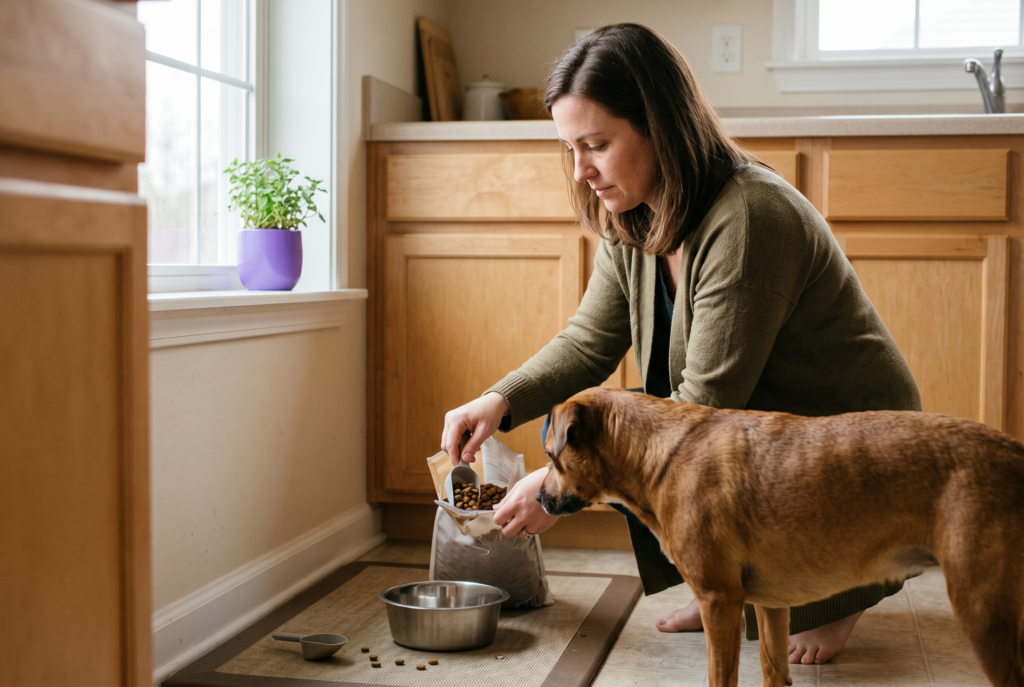
Open Farm’s resealable formats make portioning easy, and the cost per bowl depends on which line you feed.
What Open Farm costs per day
Open Farm prices vary more by format than almost any single number can capture, so it helps to anchor the cost to a daily figure for a medium dog. Kibble is the budget entry point, and the fresh-cooked plans sit at the top.
| Format | Approximate price | Rough cost per day* |
|---|---|---|
| Kibble | From about $19 for a small bag up to roughly $120 for a 24 lb bag | $1 to $3 |
| RawMix | Around $40 per bag | $2 to $4 |
| Freeze-dried raw | About $10 for 3.5 oz up to roughly $50 for 22 oz | Varies widely as a full meal |
| Freshly Crafted (gently cooked) | Subscription plan priced to your dog’s profile | Starts under $4, rises with weight |
*Daily cost depends on your dog’s weight, activity level, and whether you order one-time or on a subscription. Large and giant breeds sit well above these figures on any fresh or raw format.
The pattern here is the same one that runs through the whole fresh category. Dry kibble is the least expensive route, and cost scales directly with calories once you move to fresh or raw, so a large dog on a gently cooked plan can cost several times what a small dog does. If you want the full picture of how formats compare on nutrition, convenience, and price, our complete guide to fresh dog food lays out every option side by side.
Recommended
See the full Open Farm breakdown
Our detailed review covers every recipe line, sourcing certification, and pricing tier so you can decide which format fits your dog and your budget.
Pros and cons based on the data
- Pros: Lot-code traceability on every bag, third-party animal-welfare and sustainable-seafood certifications, no mandatory recall in over a decade, third-party lab testing per batch, and an unusually wide range of formats from kibble to gently cooked fresh.
- Cons: Higher price than mainstream dry food, fresh and raw costs that climb sharply for large dogs, a 2024 voluntary product withdrawal in its history, and a format range broad enough that choosing the right line takes some research.
Who Open Farm is for
Open Farm fits the owner who treats sourcing as a feature worth paying for. If you want to verify where the meat came from, care about welfare and sustainability certifications, and value a clean recall record, the premium is buying something concrete rather than just marketing.
It is a weaker fit if cost per bowl is your first filter, especially for a large or giant breed on a fresh plan. In that case the kibble or a RawMix topper strategy keeps you inside the brand without the full fresh-plan price. Owners moving a dog toward minimally processed food for the first time may also want to read how raw compares in our overview of the best raw dog food brands, since Open Farm’s freeze-dried line sits in that space.
How it compares to Ollie and Raised Right
Against two other names owners weigh, Open Farm separates itself on format range and sourcing proof rather than on a single headline price. Ollie is a fresh-cooked subscription built around portioning meals to a dog’s exact calorie needs, so it competes most directly with Open Farm’s Freshly Crafted line and tends to sit at a similar fresh-plan price point. Raised Right focuses on lightly cooked, very low-carbohydrate human-grade recipes, which appeals to owners optimizing for a specific macronutrient profile.
Open Farm’s edge is breadth and traceability: you can feed kibble, RawMix, freeze-dried raw, or fresh from one brand and trace every batch. If your priority is a precisely portioned fresh plan, a focused competitor may serve you better. If you want sourcing transparency across multiple formats under one label, Open Farm is the stronger pick, and where it lands for your specific dog comes down to which of those two criteria you weight more heavily.
Frequently asked questions
Has Open Farm dog food ever been recalled?
Open Farm has never been subject to a mandatory recall in over a decade of operation, according to information available from the FDA and AVMA. The brand did voluntarily withdraw a limited number of products in late 2024 over quality concerns and issued a public statement at the time. A precautionary withdrawal differs from a contamination recall, but both belong in a complete safety picture.
Is Open Farm worth the higher price?
It depends on what you are buying the premium for. Open Farm charges more for lot-code traceability, third-party welfare and sustainability certifications, and per-batch lab testing. If those features matter to you, the price buys something verifiable. If your main goal is the lowest cost per bowl, mainstream kibble will be cheaper, and Open Farm’s own kibble or a topper strategy keeps the brand within reach.
How much does Open Farm cost per day?
For a medium dog, Open Farm kibble runs roughly $1 to $3 per day, while the gently cooked Freshly Crafted plans start under $4 per day and rise with your dog’s weight. Freeze-dried raw and RawMix sit between those points depending on whether you use them as a full meal or a topper. Large and giant breeds cost more on any fresh or raw format because price scales with calories.
What makes Open Farm’s sourcing different?
Every Open Farm package carries a lot code you can enter on the brand’s website to trace each ingredient back to its source and view third-party lab results for that batch. The meat is certified under Certified Humane or Global Animal Partnership welfare programs, the seafood is Ocean Wise and Marine Stewardship Council certified, and recipes contain no corn, wheat, or soy. That batch-level transparency is the brand’s main point of difference.
 Dr. Marty Pets
 Evermore Pet Food
 Just Food for Dogs
 Maev
Maev Ollie
Ollie Open Farm
 PetPlate
 Raised Right
 Raw Paws Pet Food
 The Honest Kitchen
 The Pets Table
 We Feed Raw