Freeze-dried raw dog food sits in an odd spot in the pet food aisle. It looks and stores like kibble, but it is uncooked meat, organ, and bone with the water taken out. The keyword search volume tells you owners are confused about what they are actually buying: freeze-dried raw dog food draws roughly 6,600 U.S. searches a month, and most of those queries are some version of “is this safe” and “which brand.”
This guide answers both. We walk through how freeze-drying actually works, where it sits against frozen raw and fresh cooked food, and which of the brands we reviewed earn the format on nutrition and safety. The criteria are simple and stated up front: AAFCO nutritional adequacy, the brand’s pathogen-control method, the protein lineup, and the real cost per day.
What freeze-dried raw dog food actually is
Freeze-dried raw food is raw food with the moisture removed by sublimation rather than heat. The technical name for the process is lyophilization. Manufacturers flash-freeze the raw ingredients, then place them in a vacuum chamber where the frozen water turns directly from ice to vapor without ever passing through a liquid stage. A small amount of heat speeds the process, but the food stays well below cooking temperature throughout.
That distinction matters more than the marketing suggests. Freeze-drying is a preservation method, not a cooking method. High-heat extrusion, the process that produces kibble, degrades heat-sensitive nutrients and alters protein structures. Freeze-drying sidesteps that, which is why brands describe the result as raw nutrition in a shelf-stable form. Industry sources commonly cite nutrient retention in the high 90s percent range, though that figure comes from manufacturers rather than independent labs, so treat it as directional rather than precise.
The practical payoff is convenience. Freeze-dried raw needs no refrigeration, weighs a fraction of frozen raw, and rehydrates with warm water in a few minutes. You get most of the nutritional argument for raw feeding without a freezer full of meat. For a wider view of how this format fits the category, our fresh dog food guide maps all five formats side by side.
Freeze-dried vs. frozen raw vs. fresh cooked
The three formats compete on the same shelf but solve different problems. Frozen raw is the closest to a true raw diet and the cheapest per pound, but it demands freezer space and careful thawing. Fresh cooked trades the raw argument for a pathogen kill-step and refrigerated convenience. Freeze-dried raw keeps the raw nutritional profile and adds shelf stability, but it carries the highest price per calorie of the three.
| Format | Processing | Storage | Relative cost | Best for |
|---|---|---|---|---|
| Freeze-dried raw | Uncooked, moisture removed by sublimation | Shelf-stable, no fridge | Highest per calorie | Convenience-focused raw feeders, travel, toppers |
| Frozen raw | Uncooked, kept frozen (often HPP-treated) | Freezer required | Lowest per pound | Committed raw feeders with freezer space |
| Fresh cooked | Gently cooked to a pathogen kill temperature | Fridge or freezer | Mid to high | Owners who want fresh food without raw risk |
*HPP = High-Pressure Processing, a non-thermal method that reduces pathogen counts. Cost ranking is relative within the fresh-and-raw category, not against kibble.
If your decision comes down to raw versus everything else, the honest framing is that the format is a convenience and safety trade-off, not a nutritional miracle. Our best raw dog food roundup compares the broader raw category, and the We Feed Raw vs. Raised Right comparison drills into two of the brands below.
The safety question freeze-drying does not solve
Here is the finding that should shape your decision: freeze-drying preserves bacteria along with nutrients. It does not sterilize the food. The U.S. Food and Drug Administration is direct on this point, stating that freezing and drying do not kill Salmonella. If a pathogen is present in the raw ingredients, the freeze-drying process can carry it straight through to the bag.
The FDA applies a zero-tolerance standard for pathogens like Salmonella, Listeria monocytogenes, and certain strains of E. coli in any pet food, raw or otherwise. The American Veterinary Medical Association goes further. Its policy discourages feeding raw or undercooked animal-source protein that has not been subjected to a process to eliminate pathogens, citing risk to both pets and the people handling the food.
This does not make freeze-dried raw unusable. It means safety depends on the manufacturer, not the format. The brands worth your money apply a validated pathogen-control step, most commonly High-Pressure Processing, which uses intense water pressure rather than heat to reduce pathogen counts before freeze-drying. When you compare brands, the pathogen-control method is the single most important line on the label after the AAFCO statement. For a fuller treatment of the evidence, our is raw dog food safe guide weighs the research on both sides.
Compare Options
Find the right dog food for your pet
See how freeze-dried raw stacks up against fresh, frozen, and cooked formats from the brands we evaluated on AAFCO compliance, safety protocols, and price.
Best freeze-dried raw dog food brands
We shortlisted brands on four criteria: an AAFCO “complete and balanced” statement, a documented pathogen-control method, protein variety, and cost transparency. Two brands genuinely deliver freeze-dried raw meals. A third earns a place on this list as the strongest alternative for owners who want raw-style nutrition with a built-in kill-step.
| Brand | Format | Pathogen control | AAFCO status | Best for |
|---|---|---|---|---|
| We Feed Raw | Frozen raw plus freeze-dried (launched 2025) | High-Pressure Processing (HPP) | Complete and balanced | Vet-formulated, portion-customized raw plans |
| Open Farm | True freeze-dried raw, complete and topper | Test-and-hold safety protocol | All life stages* | Ingredient traceability and sourcing transparency |
| Raised Right | Gently cooked frozen and air-dried (not freeze-dried) | Low-temperature cook to USDA kill-step | Complete and balanced | Raw-style, low-carb nutrition without raw risk |
*Some Open Farm freeze-dried recipes are formulated for all life stages excluding growth of large-breed dogs. Check the recipe label.
We Feed Raw
Best for: owners who want a vet-formulated raw plan portioned to their dog. We Feed Raw builds biologically appropriate 80/10/10 recipes (muscle meat, bone, organ) formulated by a PhD animal nutritionist, and treats its raw line with High-Pressure Processing to reduce pathogen counts. The brand added a freeze-dried range in 2025, giving owners a shelf-stable option alongside the frozen plans. Recent third-party testing put a full We Feed Raw plan around $280 a month for frozen and roughly $200 for freeze-dried, depending on dog size. Our We Feed Raw review breaks down the plan customization, protein options, and pricing in detail.
Open Farm
Best for: owners who want to trace every ingredient back to its source. Open Farm makes a true freeze-dried raw line, sold both as complete meals and as toppers, with recipes formulated to AAFCO nutrient profiles. The brand’s differentiator is transparency: it publishes the geographic origin of each ingredient and safety test results per batch through a lot-level lookup tool, backed by a test-and-hold protocol. Most recipes are built around 95% meat, organ, and bone, with organic produce for added micronutrients. Our Open Farm review covers the full product line and how its sourcing claims hold up.
Raised Right
Best for: owners drawn to raw nutrition who are uneasy about raw pathogen risk. Raised Right does not make freeze-dried raw, and we are flagging that directly because the distinction is the whole point. Its meals are gently cooked to the minimum USDA temperature needed to kill pathogens, then either kept frozen or air-dried for shelf stability. The recipes are human-grade, limited-ingredient, and notably low-carb, often under 2% carbohydrate, with every batch lab-tested under a hold-and-release program. If the appeal of raw is whole-food, minimally processed nutrition rather than the raw state itself, Raised Right delivers that with the kill-step built in. Our Raised Right review details the recipes and testing protocol.
How to transition your dog to freeze-dried raw
Switch gradually. A sudden diet change is the fastest route to loose stools, and freeze-dried raw is richer than most kibble. A standard transition runs over 7 to 10 days, increasing the new food while reducing the old in steps.
- Days 1 to 3: about 25% freeze-dried raw, 75% current food.
- Days 4 to 6: roughly half and half.
- Days 7 to 9: about 75% freeze-dried raw, 25% current food.
- Day 10 onward: full freeze-dried raw, if your dog has tolerated each step.
Rehydrate the food with warm water before serving, especially during the switch. Adding moisture back aids digestion and helps with hydration, since the format is moisture-free by design. If your dog has a sensitive stomach, slow the timeline down rather than pushing through, and our guide to dog food for sensitive stomachs covers the warning signs worth watching.
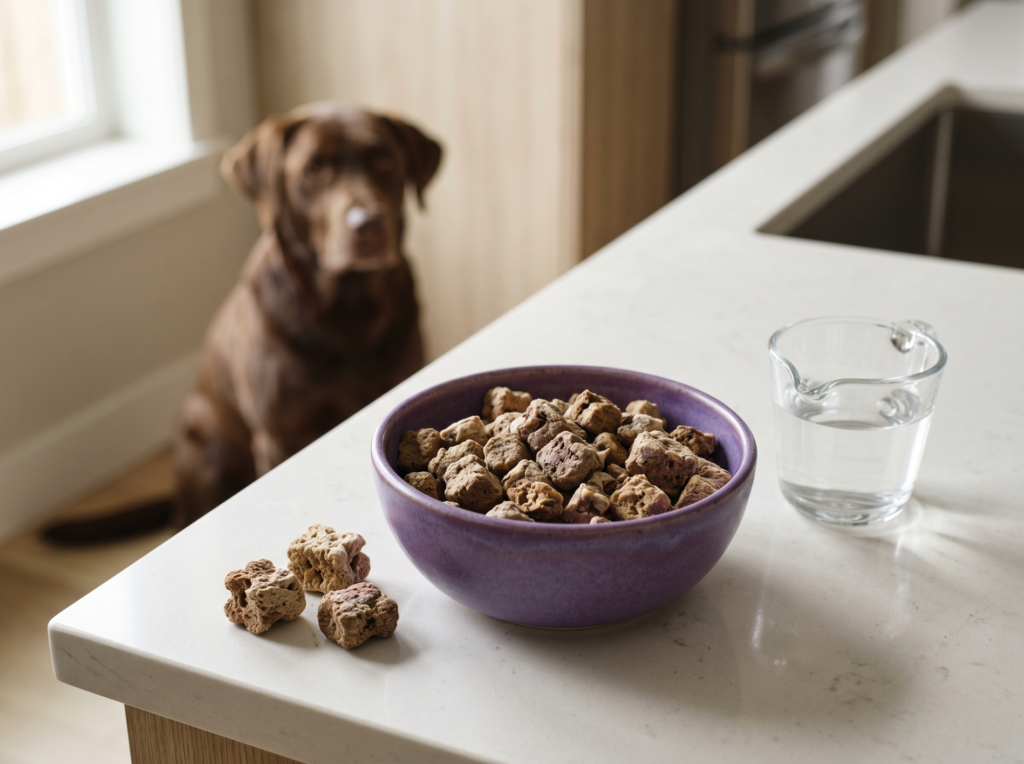
Freeze-dried raw morsels keep their porous texture until rehydrated with a little warm water before serving.
Storage and safe handling
Freeze-dried raw is shelf-stable unopened, but it is still raw. Treat it with the same hygiene you would use for raw meat. Store it in the original bag, sealed, away from heat and light, and use it within the window the brand specifies after opening, typically a month or two for freshness.
Because the format does not eliminate pathogens, handling matters. Wash your hands before and after feeding, clean the bowl and any scoop daily, and keep the food away from immunocompromised people and young children. These are the same precautions the AVMA recommends for any raw or undercooked animal-source protein, and they are not optional with this format.
How to choose: a quick decision frame
Start with the label, then the budget. If you want a complete diet, confirm the bag carries an AAFCO “complete and balanced” statement, because a large share of freeze-dried products are sold as toppers or treats and are not formulated to stand alone. Next, check the pathogen-control method, and favor brands that apply HPP or an equivalent validated step over those that rely on the format alone. If full freeze-dried raw stretches your budget past roughly $5 to $12 per day, use it as a topper over a complete base food, which is how many owners capture the appeal without the full cost. And if raw pathogen risk is the dealbreaker, a gently cooked or air-dried brand like Raised Right gives you raw-adjacent nutrition with the safety question already answered. When in doubt about your specific dog, talk to your veterinarian before changing the diet.
Frequently asked questions
Is freeze-dried raw dog food safe?
It can be, but the format itself does not make it safe. Freeze-drying preserves bacteria rather than killing it, and the FDA states that freezing and drying do not destroy Salmonella. Safety depends on the brand’s pathogen-control step, such as High-Pressure Processing, and on careful handling at home. The AVMA discourages feeding raw or undercooked animal-source protein that has not been processed to eliminate pathogens.
What is the difference between freeze-dried and frozen raw dog food?
Both are uncooked. Frozen raw is kept frozen and is the cheapest per pound, but it requires freezer space and thawing. Freeze-dried raw has the moisture removed through sublimation, making it shelf-stable and lightweight, but it costs more per calorie. Nutritionally they are similar, since neither uses high heat.
Does freeze-drying kill bacteria like Salmonella?
No. Freeze-drying removes moisture but does not kill pathogens. According to the FDA, freezing and drying do not kill Salmonella, which can survive in dry environments for weeks. That is why a separate pathogen-control method, most often High-Pressure Processing, is the key safety feature to look for.
How much does freeze-dried raw dog food cost?
As a complete diet, freeze-dried raw typically runs about $5 to $12 per day depending on your dog’s size and the brand. A full We Feed Raw freeze-dried plan tested at roughly $200 a month in early 2026. Many owners reduce the cost by using freeze-dried raw as a topper over a complete base food rather than as the entire meal.
Do I need to add water to freeze-dried raw food?
It is recommended, especially during the transition. Rehydrating with warm water restores moisture the food lost in processing, which supports digestion and hydration. You can feed it dry once your dog is fully adjusted, but adding water is the safer default while their system adapts.