A raw dog food diet is a feeding approach built on uncooked animal ingredients: muscle meat, organ meat, edible bone, and in some versions fruit, vegetables, and added supplements. The goal is to mirror what canines ate before commercial kibble existed. For a beginner, the diet comes down to three decisions: which model to follow, how much to feed, and how to transition safely. This guide walks through each one, with the safety guardrails that veterinary and regulatory bodies actually recommend.
Raw feeding has real advocates and real critics, and the evidence on both sides is mixed. What follows is a practical starting framework, not a health claim. The most important step before you begin is a conversation with your veterinarian.
What a raw dog food diet actually is: BARF vs. prey model
A raw dog food diet replaces cooked, processed food with uncooked animal-based ingredients. Beginners almost always start with one of two recognized models, and the difference between them matters for how complete the diet is.
The BARF model, short for Biologically Appropriate Raw Food, was popularized by veterinarian Ian Billinghurst. It combines raw muscle meat, bone, and organs with plant matter like vegetables, fruit, and seeds, plus supplements. The plant component is the defining feature. BARF aims for a more rounded nutrient profile and is the model most commercial raw brands follow.
The prey model takes a stricter animal-only approach. It feeds roughly 80% muscle meat, 10% raw edible bone, and 10% organ meat, with half of that organ portion being liver. The logic is to recreate the proportions of a whole prey animal. Prey model raw, often called PMR, includes no fruit, vegetables, or grains.
Neither model is automatically complete. A diet is only nutritionally complete when it meets the nutrient profiles set by the Association of American Feed Control Officials (AAFCO), the body that defines U.S. pet food nutritional standards. Many homemade raw diets fall short on calcium, certain vitamins, and trace minerals. This is the single most common beginner mistake, and it is why commercially balanced raw food exists.
| Feature | BARF Model | Prey Model (PMR) |
|---|---|---|
| Core ratio | Meat, bone, organ plus plant matter and supplements | ~80% muscle meat, 10% bone, 10% organ |
| Plant ingredients | Yes (vegetables, fruit, seeds) | No |
| Supplements | Commonly added | Rare, relies on whole-animal variety |
| Best for the beginner | Easier to balance, especially via commercial brands | Requires more sourcing knowledge to avoid gaps |
If you are new to raw feeding, a commercially prepared BARF-style diet is usually the simplest way to start, because a formulator has already done the balancing. For a wider view of how raw fits alongside fresh, freeze-dried, and other formats, our complete guide to fresh dog food breaks down every option side by side.
How to start a raw dog food diet: a step-by-step transition
Switch your dog to raw gradually. A sudden change is the fastest route to vomiting, loose stool, and a discouraging first week. A 7 to 10 day transition gives the gut time to adjust.
Here is a beginner transition that works for most healthy adult dogs.
- Days 1 to 3: Replace about 25% of the current food with raw, keeping the rest as the existing diet. Use a single, mild protein like chicken or turkey.
- Days 4 to 6: Move to a 50/50 split between raw and the old food. Watch stool quality before increasing further.
- Days 7 to 9: Shift to roughly 75% raw. Stool should be firm and consistent at this point.
- Day 10 and on: Move to 100% raw if digestion has stayed stable. Only then introduce a second protein source.
Two rules make the transition smoother. First, do not mix raw and kibble in the same bowl during the early days, since they digest at different rates and can upset sensitive dogs. Feed them as separate meals if you are running both. Second, introduce one new protein at a time, waiting several days between each, so you can spot any food sensitivity.
If your dog already has a sensitive digestive system, a slower transition and a vet conversation come first. Our guide to the best raw dog food brands covers which commercial options are formulated to be gentler on the gut.
How much raw food to feed your dog per day
Most adult dogs eat between 2% and 3% of their ideal body weight in raw food each day. Active dogs and hard keepers land near the top of that range or above it. Less active or overweight dogs sit at the bottom. Use your dog’s target weight, not their current weight, if weight loss or gain is the goal.
The math is straightforward. Multiply body weight in pounds by 16 to get ounces, then take the percentage.
| Dog’s Weight | 2% (lower activity) | 2.5% (average) | 3% (high activity) |
|---|---|---|---|
| 10 lbs | 3.2 oz/day | 4.0 oz/day | 4.8 oz/day |
| 30 lbs | 9.6 oz/day | 12.0 oz/day | 14.4 oz/day |
| 50 lbs | 16.0 oz/day | 20.0 oz/day | 24.0 oz/day |
| 70 lbs | 22.4 oz/day | 28.0 oz/day | 33.6 oz/day |
*Daily amounts are starting estimates. Adjust based on body condition over 4 to 6 weeks, splitting the total across two meals for most adult dogs.
Puppies are the exception. Growing dogs need far more, often 5% to 10% of their current body weight per day, adjusted as they grow toward adult size. Because puppy growth depends on correct calcium and phosphorus balance, puppy raw feeding is the scenario where professional guidance matters most.
What a complete raw diet includes
A balanced raw bowl is more than muscle meat. Feeding only chicken breast or ground beef, the most common rookie error, leaves a dog short on calcium, essential fatty acids, and key vitamins. A complete raw diet covers several components.
- Muscle meat: The protein base, around 70% to 80% of the bowl depending on the model. Vary the protein over time.
- Raw edible bone: Roughly 10%, the primary calcium source. Ground bone is safest for beginners, since whole bones carry choking and fracture risks.
- Organ meat: About 10%, with half being liver. Organs supply vitamin A, B vitamins, copper, and iron that muscle meat lacks.
- Omega-3 fatty acids: From oily fish or a fish oil supplement, to balance the fats and support skin and coat.
- Plant matter (BARF only): Vegetables and fruit for fiber and additional micronutrients.
Getting these proportions right by hand is difficult, which is the strongest argument for starting with a commercially balanced product. Brands like We Feed Raw formulate complete meals to AAFCO standards and use High-Pressure Processing to reduce pathogen risk, while Raised Right offers lightly cooked and gently prepared options for owners who want a softer entry point into the category. Both remove the guesswork of balancing a bowl from scratch.
Compare Options
Not sure where to start with raw?
See how the leading raw and fresh brands compare on ingredients, AAFCO compliance, safety processing, and cost per day before you commit.
Raw feeding safety: what the FDA and AVMA say
Raw feeding carries handling risks that cooked food does not, and the guidance here is worth reading before you start. The U.S. Food and Drug Administration enforces a zero-tolerance policy for pathogens like Salmonella and Listeria monocytogenes in all pet food, raw included. In one FDA study of 196 raw pet food samples, 15 tested positive for Salmonella and 32 for Listeria, a higher contamination rate than cooked products.
The American Veterinary Medical Association, the national body representing U.S. veterinarians, discourages feeding any animal-source protein that has not been treated to eliminate pathogens. The AVMA does support diets processed through validated methods such as cooking, pasteurization, or High-Pressure Processing, which is why HPP-treated commercial raw food sits in a different risk category than untreated homemade raw.
If you feed raw, basic kitchen hygiene reduces the human-health risk: wash hands, bowls, and surfaces after every meal, store raw food frozen until use, and keep it away from areas where human food is prepared. Households with infants, elderly members, pregnant women, or immunocompromised people face elevated risk and should weigh that carefully. For a fuller look at the evidence on both sides, see our breakdown of whether raw dog food is safe.
Common beginner mistakes to avoid
Most raw-feeding problems trace back to a short list of avoidable errors. Knowing them in advance saves you a frustrating start.
- Feeding only muscle meat. Without bone and organ, the diet is incomplete and risks calcium and micronutrient deficiency. This is the most frequent mistake.
- Switching too fast. Skipping the 7 to 10 day transition usually causes diarrhea and vomiting that owners mistake for a raw intolerance.
- Feeding whole cooked bones. Cooked bones splinter. Only raw bone is appropriate, and ground bone is safest for beginners.
- Ignoring AAFCO completeness. Assuming any raw mix is balanced. Confirm a commercial product is labeled complete and balanced for your dog’s life stage.
- Skipping the vet for puppies and seniors. Growth and aging both change nutrient needs, and getting calcium and phosphorus wrong in a puppy can cause lasting harm.
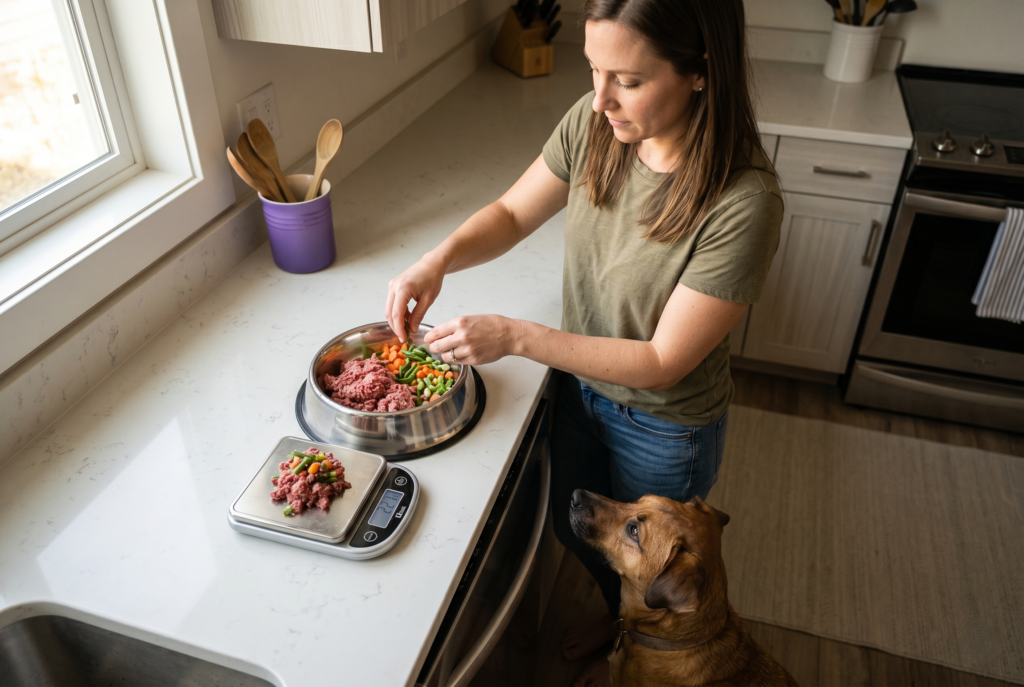
Portioning raw meat, bone, and vegetables by weight is the practical core of starting a raw dog food diet at home.
A note on veterinary guidance
This guide is general information, not veterinary advice. Before starting or changing a raw diet, consult your veterinarian, ideally one with training in animal nutrition, especially if your dog is a puppy, a senior, pregnant, or managing a health condition. A professional can confirm the diet meets your individual dog’s nutritional needs and flag any risks specific to your household.
Is a raw diet right for your dog?
A raw dog food diet fits owners who are willing to manage handling, storage, and balancing, and who want a minimally processed feeding approach. It works best when paired with a commercially balanced, pathogen-treated product rather than a from-scratch homemade mix, which is where most nutritional gaps appear. Beginners get the smoothest results starting with a single mild protein, a 7 to 10 day transition, and a vet conversation up front.
Raw is a weaker fit for households with immunocompromised members, for owners who cannot commit to strict hygiene, or for anyone who wants the simplicity of scoop-and-serve without the cold-chain logistics. If that describes you, a fresh cooked or gently cooked diet may deliver much of the appeal with less handling risk. Either way, the right next step is to compare formulated options against your dog’s weight, life stage, and your own routine, then confirm the choice with your veterinarian.
Frequently asked questions
How do I start my dog on a raw food diet?
Start with a single mild protein like chicken or turkey and transition over 7 to 10 days. Replace about 25% of the current food with raw for the first few days, move to 50/50 mid-week, then to 75% and finally 100% raw if digestion stays stable. Introduce a second protein only after the switch is complete.
How much raw food should I feed my dog per day?
Most adult dogs eat 2% to 3% of their ideal body weight in raw food daily. A 30 lb dog at 2.5% eats about 12 ounces a day, usually split into two meals. Puppies need more, often 5% to 10% of current body weight, adjusted as they grow.
What is the difference between BARF and prey model raw?
BARF (Biologically Appropriate Raw Food) includes muscle meat, bone, organs, plus vegetables, fruit, and supplements. The prey model uses animal ingredients only, in roughly 80% muscle meat, 10% bone, and 10% organ. BARF is generally easier for beginners to balance, especially through commercial brands.
Is a raw dog food diet safe?
Raw food carries a higher risk of bacterial contamination than cooked food. The FDA enforces a zero-tolerance policy for Salmonella and Listeria in all pet food, and the AVMA discourages feeding untreated raw protein. Commercial brands that use High-Pressure Processing reduce this risk. Strict hygiene and a veterinary consultation are recommended before starting.
Do I need supplements on a raw diet?
It depends on the model and whether the food is commercially balanced. A complete commercial raw diet formulated to AAFCO standards usually needs no extras. Homemade raw diets often require added calcium, omega-3 fatty acids, and trace minerals to be complete, which is best confirmed with a veterinary nutritionist.