The Quick Answer
When you compare the best credit cards, the choice between the Chase Sapphire Preferred and the Bilt Obsidian comes down to your biggest expenses. The Bilt Obsidian stands out for renters thanks to fee-free rent rewards, while the Chase Sapphire Preferred earns more across dining, travel, and everyday spending and carries a larger welcome bonus.
Chase Sapphire Preferred vs. Bilt Obsidian: An Overview
Two travel rewards cards with the same annual fee can still serve very different people. Both the Chase Sapphire Preferred and the Bilt Obsidian charge a $95 annual fee, but they reward different habits. The way to decide is to look at how each earns rewards, how you redeem them, and which travel protections come attached. We break down the key features of both so you can match a card to your own spending.
Annual Fees and Welcome Bonuses
Both cards carry a $95 annual fee, so the cost of entry is identical. The introductory offers are where they split. According to The Points Guy, the Chase Sapphire Preferred is currently offering a welcome bonus of 100,000 points after you spend $5,000 in the first three months. That is substantial upfront value if you can meet the spending requirement.
The Bilt Obsidian instead offers $200 in Bilt Cash upon approval, with no minimum spend. That makes it easier to claim, but its value is well below Chase’s typical welcome bonus.
Earning Rewards on Everyday Spending
Your daily spending decides which card pays off more. The Chase Sapphire Preferred earns across several popular categories, including elevated rewards on travel, dining, and select streaming. The Bilt Obsidian concentrates its bonus by letting you pick one high-earning everyday category. Here is how the primary earning rates compare.
| Spending Category | Chase Sapphire Preferred | Bilt Obsidian |
|---|---|---|
| Dining | 3x points | 3x points (if chosen as your category) |
| Travel | 5x via Chase Travel; 2x on other travel | 2x points |
| Rent payments | 1x point (with processing fees) | Up to 1.25x points (no transaction fee) |
| Groceries | 3x on online groceries (exclusions apply) | 3x points (up to $25,000/year, if chosen) |
The Unique Case of Rent Payment Rewards
The Bilt Obsidian’s signature feature is earning points on rent with no transaction fee. Cardholders can earn up to 1.25 points per dollar on rent, an expense that normally earns nothing once you factor in the 2% to 3% processing fee most cards trigger. To hit that top 1.25x rate, you generally need to put non-housing spending on the card equal to or above your rent, so the benefit rewards people willing to make Bilt their primary card. For renters who do, it is hard to match.
The Chase Sapphire Preferred has no rent-specific benefit. You can pay rent through a third-party service, but the processing fee almost always cancels out the points you earn.
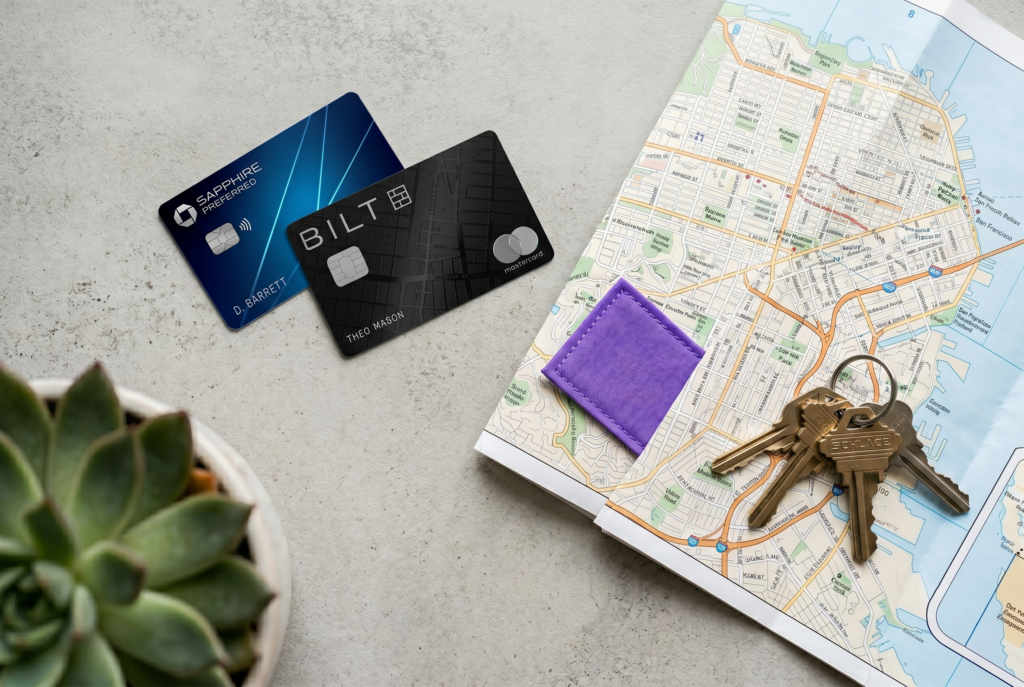
Choosing between travel rewards cards comes down to matching the rewards structure to your biggest expenses, from rent to travel.
Redeeming Points and Transfer Partners
Both Chase Ultimate Rewards and Bilt Rewards transfer to a range of airline and hotel partners, which is usually the best way to maximize value, and the two programs share several partners including World of Hyatt. A key difference has opened up for new applicants. Bilt transfers to World of Hyatt at a 1:1 ratio. For new Chase Sapphire Preferred cardholders who apply on or after June 15, 2026, the Hyatt transfer ratio is 4:3, a 25% reduction. Existing Sapphire Preferred cardholders keep 1:1 transfers until October 1, 2026. For frequent Hyatt travelers, that gives Bilt a clear edge.
Valuable Travel and Purchase Protections
Travel protections are a core reason to carry a travel rewards card. The Chase Sapphire Preferred is well regarded here, and it includes primary auto rental collision damage waiver. That means you can decline the rental company’s insurance and your card’s coverage applies first if the car is stolen or damaged.
The Bilt Obsidian offers secondary rental car coverage within the United States, which pays out only after your personal auto insurance, and becomes primary only when you rent outside the country. Both cards include trip cancellation, trip interruption, and trip delay protections, but Chase’s primary rental coverage is the stronger benefit for frequent renters.
How to Choose the Right Card for You
Start with your own budget. List your top monthly expenses. If a large share goes to rent, the Bilt Obsidian is a compelling pick, because its fee-free rent rewards and 1:1 Hyatt transfers are difficult to beat for that profile, provided you also run enough non-housing spend through the card to unlock the top rate.
If your spending leans toward dining, groceries, and general travel, and you value a large welcome bonus plus primary rental insurance, the Chase Sapphire Preferred is likely the better fit. Its higher rates across more categories accumulate points faster for a wider range of spenders. Weighing those trade-offs against your actual habits is what points you to the right card. If you want to see how each stacks up against other options, our Chase Freedom Unlimited review covers a no-annual-fee companion card, and our Capital One Venture X review looks at a premium travel alternative.
The Bottom Line
- Annual fee: Both the Chase Sapphire Preferred and the Bilt Obsidian charge $95.
- Best for renters: Bilt Obsidian wins, with fee-free points on rent payments.
- Best for general spending: Chase Sapphire Preferred earns more across dining, streaming, and online groceries.
- Welcome bonus: Chase offers a much larger spend-based bonus; Bilt offers a smaller, immediate cash bonus.
- Hyatt transfers: Bilt’s 1:1 ratio beats the 4:3 ratio that applies to new Sapphire Preferred cardholders.
- Travel insurance: Chase provides primary rental car coverage, stronger than Bilt’s secondary U.S. coverage.
Frequently Asked Questions
What are the main differences between Chase Sapphire Preferred and Bilt Obsidian?
The differences are in rewards and benefits. Bilt Obsidian excels at earning points on rent with no fee and offers a better World of Hyatt transfer ratio. Chase Sapphire Preferred earns more across categories like dining and travel, comes with a larger welcome bonus, and includes primary rental car insurance.
Which credit card offers better rewards for rent payments?
The Bilt Obsidian is clearly better for rent. It is one of the few cards that lets you earn points on rent with no transaction fee, the fee that usually wipes out any rewards earned on rent with other cards.
How do the annual fees and welcome bonuses compare for these two cards?
Both charge a $95 annual fee. The Chase Sapphire Preferred currently offers 100,000 points after spending $5,000 in the first three months. The Bilt Obsidian offers $200 in Bilt Cash upon approval with no spending requirement.
What are the travel benefits of Chase Sapphire Preferred versus Bilt Obsidian?
Both offer trip cancellation and delay protections. The key difference is rental coverage: Chase Sapphire Preferred provides primary auto rental collision damage waiver, while the Bilt Obsidian offers secondary coverage within the United States.
Which card has better point transfer partners, Chase Sapphire Preferred or Bilt Obsidian?
Both have strong airline and hotel partner lists with significant overlap. For frequent World of Hyatt travelers, Bilt has the edge with its 1:1 transfer ratio, compared with the 4:3 ratio for new Chase Sapphire Preferred cardholders.
Is the Bilt Obsidian card worth it for non-renters?
For non-renters, its value drops. The customizable 3x category is useful, but cards like the Chase Sapphire Preferred offer more high-earning categories at once. A non-renter would need to decide whether Bilt’s other benefits, such as the Hyatt transfer ratio, outweigh a broader rewards structure elsewhere.