

⚡ Key Takeaways
- A University of California, Davis review of 200 homemade recipes found that 95% were deficient in at least one essential nutrient, and 83% were short on several, so cooked meat and rice alone will not keep a dog healthy.
- Calcium is the most important addition. Meat is high in phosphorus and almost devoid of calcium, so a boneless home-cooked diet needs roughly 1,250 mg of calcium per 1,000 calories for an adult dog, per AAFCO, in a calcium-to-phosphorus ratio of about 1.2 to 1.4 to 1.
- Most homemade diets also need an omega-3 source with EPA and DHA, plus a vitamin and trace-mineral premix to cover vitamin D, zinc, vitamin E, choline, iodine, copper, and manganese.
- Taurine matters for at-risk breeds and low-meat recipes, but most dogs make enough on their own.
- The cleanest route is a single complete premix formulated to AAFCO standards, chosen with a veterinarian. Dose calcium and fat-soluble vitamins to your dog’s ideal weight, since these carry real overdose risk.
Home cooking gives you control over every ingredient in your dog’s bowl. It does not give you a balanced diet by default. A meal that looks complete to a human, lean protein, a starch, some vegetables, is almost always missing minerals and vitamins that dogs need in specific amounts and ratios.
This guide covers the supplements that actually close those gaps, how to think about dosing by weight, and the point where supplementing a recipe stops being the simplest path to balanced nutrition. The goal is a meal that meets AAFCO nutritional standards, not one that just looks wholesome.
Why homemade dog food needs supplements at all
The problem with homemade diets is consistency of nutrients, not quality of ingredients. Fresh chicken, beef, and vegetables are excellent foods. They simply do not contain the full set of nutrients a dog needs in the right concentrations once you remove the bone, organ variety, and fortification that commercial diets are built around.
The evidence here is direct. Researchers at the University of California, Davis School of Veterinary Medicine reviewed 200 homemade recipes drawn from books, websites, and even veterinary sources. Only four met the established nutrient profiles for adult dogs, and all four were written by board-certified veterinary nutritionists. The most common shortfalls were choline, vitamin D, zinc, and vitamin E, deficiencies the study linked to immune dysfunction, liver problems, and musculoskeletal issues over time.
One finding from that study is worth holding onto. Because so many recipes shared the same deficiencies, rotating between different homemade recipes does not fix the problem. Variety does not balance a diet when every option is short on the same nutrients. That is the gap supplements are meant to close.
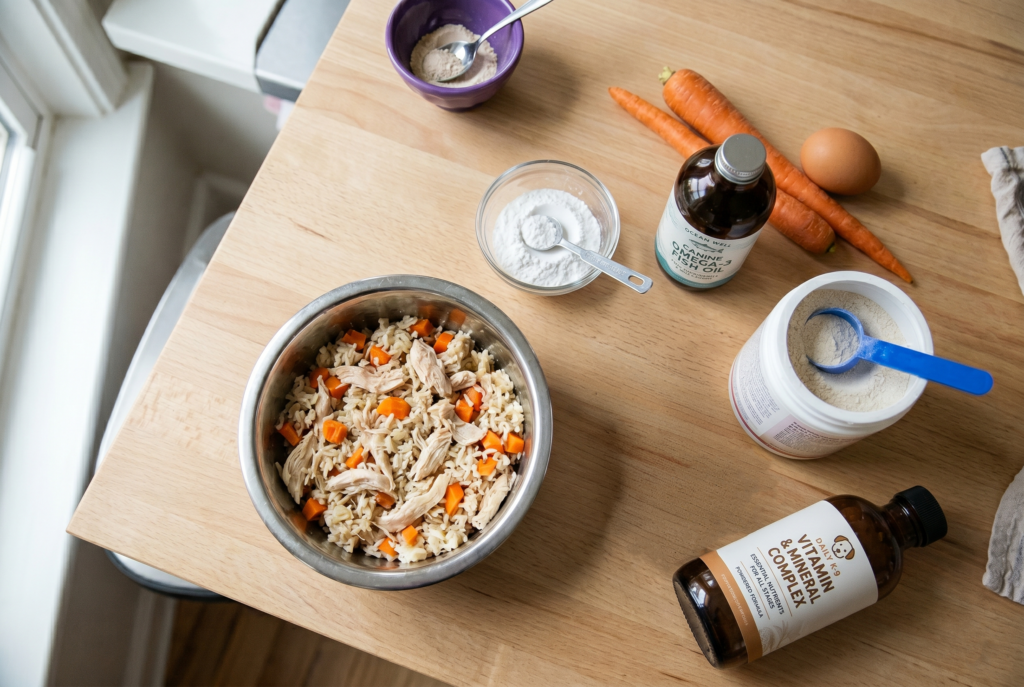
A home-cooked bowl of chicken, rice, and carrots needs added calcium, an omega-3 source, and a complete vitamin and mineral premix to meet AAFCO nutritional standards.
The 6 supplements most homemade diets actually need
Most boneless, home-cooked dog diets are missing the same handful of things. Below are the six that come up most often, what each one does, and where the real risk sits. Doses here are starting reference points, not prescriptions. Calcium and the fat-soluble vitamins in particular carry real toxicity risk when overdone, so confirm amounts for your dog with a veterinarian.
1. Calcium (the single most important one)
Calcium is the deficiency that matters most, because meat is rich in phosphorus and almost devoid of calcium. A diet of muscle meat and rice with no added calcium is badly skewed, and the imbalance pulls calcium out of the bones over time. This is the gap you cannot skip.
For a healthy adult dog, AAFCO’s profile works out to roughly 1,250 mg of calcium per 1,000 calories of food, while the National Research Council reference is closer to 1,000 mg per 1,000 calories. Just as important is the ratio: the Merck Veterinary Manual puts the optimal calcium-to-phosphorus ratio at about 1.2 to 1.4 parts calcium for each part phosphorus, with AAFCO allowing a range of 1:1 to 2:1. Common sources are calcium carbonate, plain ground eggshell powder, or bone meal.
Puppies are a separate case, and a riskier one. Growing dogs need about three times the calcium per calorie that adults do, but excess calcium during growth, especially in large breeds before six months, is linked to skeletal abnormalities. Never add plain calcium to a puppy’s diet without veterinary guidance, since puppies need calcium and phosphorus together in a controlled ratio.
2. Omega-3 fatty acids (EPA and DHA)
Most homemade diets lean heavily on grain-fed beef or chicken, which are high in omega-6 fats and low in omega-3s. Fish oil corrects that balance. The active components are EPA and DHA, which the American Kennel Club notes support skin, coat, joint, heart, and immune health.
A practical detail people miss: a 1,000 mg fish oil capsule is not 1,000 mg of omega-3s. Only a fraction of that, often 300 mg of combined EPA and DHA, is the active part, so read the EPA and DHA line, not the total oil weight. Skip flaxseed oil as your primary source. Dogs convert plant-based ALA into EPA and DHA inefficiently, so a marine source does the job far better.
3. Vitamin D
Dogs cannot make meaningful vitamin D from sunlight the way humans do, so it has to come from the diet. It was one of the four nutrients the UC Davis study flagged as commonly deficient. Vitamin D regulates calcium and phosphorus absorption, which ties it directly to bone health.
This is a nutrient to respect rather than freelance. Too little causes problems, but too much is toxic, and the margin is narrower than with water-soluble vitamins. For most home cooks, vitamin D is best delivered inside a complete premix rather than dosed on its own.
4. A trace-mineral and multivitamin premix (zinc, iron, copper, iodine, manganese)
This is the catch-all that does the heaviest lifting. Grocery-store meats and vegetables are routinely low in zinc, iodine, copper, and manganese, and short on choline and vitamin E. Trying to buy and dose each of these separately is where home cooks get into trouble, both from the complexity and from the toxicity risk of stacking individual minerals.
A veterinary-formulated vitamin and mineral premix designed for homemade diets is the practical answer. These powders are built to AAFCO standards and act as a single safety net across the whole panel of trace nutrients, which is why veterinary nutritionists tend to recommend a complete premix over a drawer full of individual bottles.
5. Taurine (breed and recipe dependent)
Taurine is an amino acid that supports heart muscle function. Most dogs synthesize enough on their own, so it is not universally required, which is why it sits here rather than at the top of the list. The exceptions matter, though.
Certain breeds, including Golden Retrievers, Newfoundlands, Cocker Spaniels, and Doberman Pinschers, are more prone to taurine-related heart issues, and diets low in animal protein or built around certain legumes can raise the risk. If your dog is in an at-risk breed or your recipe is light on meat, taurine is worth raising specifically with your veterinarian.
6. A complete multivitamin (the simpler all-in-one route)
For many owners, the cleanest version of items 3 and 4 is a single all-in-one supplement made for home-cooked diets. Rather than dosing vitamin D, zinc, copper, iodine, and the rest separately, a complete premix covers them together in balanced amounts.
Quality control is the thing to check, because the FDA does not regulate pet supplements as strictly as human ones. Look for the National Animal Supplement Council (NASC) Quality Seal, which signals that a brand has passed independent facility audits and meets the council’s labeling and testing standards. It is the most useful at-a-glance marker of a supplement worth trusting.
Compare Options
Not sure homemade is worth the effort?
See how complete, AAFCO-compliant fresh and dehydrated diets stack up against home cooking on cost, convenience, and nutrition.
How to choose and dose supplements by your dog’s weight
Supplement needs scale with how much food your dog eats, which scales with their calorie requirement, not simply their weight on the scale. That distinction is the foundation of dosing correctly, and it is why the same recipe needs different amounts for a 15-pound dog and a 70-pound one.
Two principles keep you out of trouble. First, dose calcium and the fat-soluble vitamins (A, D, E) to your dog’s ideal weight and calorie needs, not their current weight, because these carry the real overdose risk. Second, match the supplement to the recipe: a diet that already includes raw meaty bones needs little or no added calcium, while a boneless cooked diet needs the full amount.
The table below shows the general direction supplement amounts move with size. Treat it as a framework for the conversation with your veterinarian, not a substitute for a recipe analysis.
| Dog size (ideal weight) | Approx. daily calories | Calcium direction | Omega-3 (EPA+DHA) direction |
|---|---|---|---|
| Small (10 lbs) | ~350 cal | ~440 mg | Lower dose |
| Medium (30 lbs) | ~750 cal | ~940 mg | Moderate dose |
| Large (70 lbs) | ~1,400 cal | ~1,750 mg | Higher dose |
Calcium figures above apply the AAFCO reference of roughly 1,250 mg per 1,000 calories for healthy adult dogs. Calorie estimates are typical maintenance ranges and vary with age, activity, and metabolism. For omega-3s, a common practical target is in the range of 50 to 75 mg of combined EPA and DHA per kilogram of body weight, but check the specific product and your veterinarian’s guidance before settling on a number.
When supplementing a homemade recipe is not enough
Supplements can rescue a good recipe. They cannot rescue an unbalanced one, and they cannot turn guesswork into a complete diet. If you are sprinkling a multivitamin onto a recipe you found online without knowing its calorie content or nutrient profile, you are still likely feeding an unbalanced meal, just one with extra ingredients.
There are three situations where the math stops favoring home cooking. The first is puppies and large-breed growth, where calcium and phosphorus have to be controlled tightly and the cost of getting it wrong is permanent. The second is dogs with medical conditions, where a board-certified veterinary nutritionist should design the diet. The third is simply time and consistency: a properly balanced homemade diet requires a verified recipe, precise weighing, and the same supplements added the same way at every meal, indefinitely.
For many owners, a complete commercial diet delivers the freshness they wanted from home cooking without the deficiency risk. Fresh and gently cooked diets are formulated to AAFCO standards from the start, so the calcium ratio and trace minerals are already handled. Human-grade dehydrated options like The Honest Kitchen sit closest to home cooking in spirit, using whole-food ingredients in complete-and-balanced formulas you rehydrate at home.
If you are committed to cooking at home, the highest-value step is starting from a recipe that is already nutritionally analyzed, then layering supplements onto it. Our guides to complete and balanced homemade recipes and the most common deficiencies in homemade diets walk through both sides of that equation.
Who should supplement, and who should rethink the plan
If you feed a healthy adult dog a home-cooked diet built on a verified recipe, supplementing is straightforward and worth doing well: add calcium to match the recipe, a marine omega-3 source dosed to weight, and a complete vitamin and mineral premix carrying the NASC seal. That covers the predictable gaps.
If you have a puppy, a large-breed dog still growing, or a dog with a health condition, the better move is a recipe and supplement plan designed by a board-certified veterinary nutritionist, or a complete commercial diet that takes the calculation off your plate entirely. The deficiencies that hurt dogs most are the invisible ones that accumulate over months, so the safest path is the one that removes the guesswork before it starts. Whichever route you choose, confirm the specifics with your veterinarian before changing what is in the bowl.
Frequently asked questions
Does homemade dog food really need supplements?
Yes, in almost every case. A University of California, Davis review found that 95% of homemade recipes were deficient in at least one essential nutrient. Boneless home-cooked diets are reliably short on calcium, and commonly short on vitamin D, zinc, vitamin E, and choline, so a calcium source, an omega-3 source, and a complete vitamin and mineral premix are typically needed to make the diet balanced.
What is the most important supplement for homemade dog food?
Calcium. Meat is high in phosphorus and very low in calcium, so a meat-and-starch diet without added calcium is badly imbalanced. AAFCO’s reference works out to roughly 1,250 mg of calcium per 1,000 calories for an adult dog, kept in a calcium-to-phosphorus ratio of about 1.2 to 1.4 to 1. Calcium carbonate, ground eggshell powder, and bone meal are common sources.
Can I just give my dog a human multivitamin instead?
No. Human multivitamins are formulated for human nutrient needs and ratios, and some contain ingredients or dose levels that are inappropriate or unsafe for dogs. Use a supplement formulated for dogs, ideally one carrying the National Animal Supplement Council (NASC) Quality Seal, which indicates the brand has passed independent audits and testing.
How do I know how much supplement to give my dog?
Dose to your dog’s ideal weight and calorie needs rather than their current weight, since calcium and fat-soluble vitamins carry overdose risk. Amounts scale with how much food the dog eats, so a large dog needs more than a small one. Because correct dosing depends on the specific recipe and product, confirm the amounts with your veterinarian, especially for puppies and dogs with health conditions.
 Dr. Marty Pets
 Evermore Pet Food
 Just Food for Dogs
 Maev
Maev Ollie
Ollie Open Farm
 PetPlate
 Raised Right
 Raw Paws Pet Food
 The Honest Kitchen
 The Pets Table
 We Feed Raw